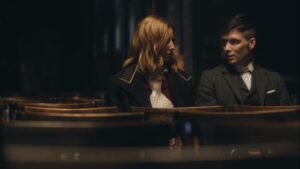
Full spoilers for House Of The Dragon Season 3 Episode 8, “The Treasons of Tumbleton,” follow. This article does not spoil future events from Fire & Blood.
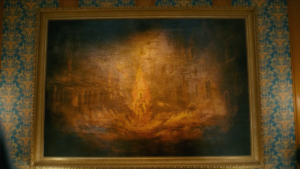
Quick answer: Helaena’s final tapestry appears to warn that Rhaenyra may achieve exactly what she has spent the entire series fighting for — the Iron Throne — only to discover that possessing it brings blood, suffering, and destruction. The embroidery shows Rhaenyra seated on the throne with red lines running from her crown and hands while fire, a dragon, and reaching hands surround her.
The image does not necessarily mean the Iron Throne is literally going to kill Rhaenyra. It works more powerfully as a visual summary of what Season 3 has already been showing us: Rhaenyra has won the throne, but ruling from it is becoming a punishment rather than a reward. Helaena’s final vision gives Rhaenyra the image she has wanted for years and makes it horrifying.
This Week’s House Of The Dragon Coverage
- Recap & Reaction Podcast: House Of The Dragon 3.08 Recap & Reaction: Rhaenyra Becomes The Problem
- Explainer: First Battle Of Tumbleton Explained: Why The Town Matters In House Of The Dragon
- Explainer: How Does Ormund Hightower Die In House Of The Dragon?
- Explainer: Who Is Alys Rivers? Her Immortality And Harrenhal Past Explained
- Explainer: Who Is Roddy The Ruin? Roderick Dustin And The Winter Wolves Explained
- Explainer: Why Did Helaena Kill Herself In House Of The Dragon?
- Knee Jerk Reaction: KNEE-JERK REACTION | House Of The Dragon Season 3 Finale Review: Rhaenyra Finally Crossed The Line
- HOTD Season Guide: House Of The Dragon Season 3 Guide: Episodes, Recap & Ending Explained
Looking for every episode? Start with our complete House Of The Dragon episode guide for every season, episode title, release date, recap, review, and podcast reaction.
Get The Dragon Brief
One smart House Of The Dragon catch-up before the next episode — theories, explainers, podcast drops, and the character threads worth remembering.
What Does Helaena Embroider Before She Dies?
Shortly before her death, Helaena finishes an elaborate section of the embroidery she has been creating. After Rhaenyra learns that Helaena jumped from the Red Keep, she enters her chambers and finally studies the work closely.
One section depicts Helaena herself falling. Another shows Rhaenyra sitting on the Iron Throne while red seams appear to flow from her crown, hands, and body. Around the throne are fire, a dragon, severed or reaching limbs, and the general visual language of violence that has surrounded the Dance throughout the season.
The amount of detail matters because this was not something Helaena stitched impulsively moments before her death. The embroidery suggests she had been working through these images for some time. Whatever Helaena understood about her own fate and Rhaenyra’s future had been occupying her long before the finale.
That also makes the tapestry something more interesting than a suicide note. Helaena leaves behind the way she understands the Dance itself.
Why Is Rhaenyra Bleeding On The Iron Throne?
The simplest interpretation is that Helaena sees Rhaenyra’s reign as inseparable from blood.
Rhaenyra spent the first half of the series fighting for the right to sit the Iron Throne. Season 3 finally gives it to her, but almost immediately the throne stops functioning as a symbol of victory. She looks uncomfortable sitting on it, her rule becomes increasingly unstable, and the decisions required to hold the capital begin pushing her toward the kind of ruler she once believed she could avoid becoming.
The finale intensifies that transformation. Rhaenyra dismisses Mysaria, confines Baela, has Helaena force-fed, demands that the High Septon publicly validate her rule, and responds to his refusal by removing him. She then tells the people of King’s Landing that Aegon the Conqueror’s prophecy proves she was meant to rule.
By the time she discovers Helaena’s embroidery, Rhaenyra no longer sees the throne merely as something Viserys promised her. She increasingly sees herself as necessary to history.
So the blood on Helaena’s tapestry works on multiple levels. Rhaenyra has suffered enormously to reach the throne, other people have suffered because she reached it, and even more blood may be required for her to remain there.
Is The Iron Throne Rejecting Rhaenyra?
That idea has been visually hanging around Rhaenyra since she took King’s Landing. The show has repeatedly made the Iron Throne look physically uncomfortable for her rather than triumphant. She shifts against its blades, struggles to settle into it, and never quite looks as though the chair has welcomed its new occupant.
Helaena’s embroidery strengthens that imagery. The red lines around Rhaenyra can be read as blood flowing from the throne and her body, while some of the stitching around her resembles bindings or chains. Instead of sitting freely above Westeros, she almost appears trapped inside the thing she fought to possess.
Whether the series intends us to believe the Iron Throne literally “rejects” rulers is less important than what the visual means. Rhaenyra finally has the chair, and the chair hurts.
That has always been the great trick of the Iron Throne. Everyone treats it like a prize because they imagine the story ends once they sit down. House Of The Dragon keeps reminding us that sitting down is when the real problem begins.
Is Helaena’s Tapestry A Prophecy?
Yes, at least in part, but I would be careful about treating every stitch as a literal one-to-one prediction.
Helaena’s embroidery includes events she has witnessed, events connected to her visions, and images that appear symbolic rather than documentary. That makes the tapestry a combination of memory, prophecy, interpretation, and mythology.
This is important because Helaena does not experience the future like someone reading a history book. Her dreams arrive through insects, animals, colors, fragments, and strange phrases whose meaning often becomes clear only after events occur. The embroidery gives her a way to translate that nonlinear experience into something physical.
So when Rhaenyra sees herself bleeding on the throne, the safest reading is not, “Helaena has shown us the exact way Rhaenyra will die.” The stronger reading is that Helaena sees Rhaenyra’s relationship with the throne as fundamentally connected to pain, violence, and destruction.
That warning is already coming true before Rhaenyra even finishes looking at it.
Is Helaena Responsible For The House Of The Dragon Opening Tapestry?
The Season 3 finale strongly connects Helaena’s embroidery with the visual language of the show’s opening credits. Throughout the season, the tapestry has changed as the Dance progresses, adding battles, deaths, dragons, and new versions of the family’s history.
That has always made the credits more than a recap device. The tapestry is history being turned into an image.
And history is one of the central obsessions of House Of The Dragon. The characters are not simply fighting over who gets to rule. They are fighting over which version of events will survive them. Who was the rightful monarch? Who was the traitor? Who was the hero? Who gets remembered as a king, queen, murderer, or usurper?
Earlier in the season, the opening tapestry even presented events in ways that simplified or altered what viewers actually saw happen. That suggests the embroidery is not necessarily objective truth. It is history becoming mythology.
Helaena exists in an unusual position inside that process because she can see fragments other characters cannot. Yet even she translates those fragments into symbols. Her tapestry may contain truth, but it is truth filtered through Helaena.
Why Does Helaena Show Herself Falling?
Helaena’s depiction of her own fall is one of the clearest signs that she understood death was approaching before she went to the window.
That connects directly to the visions and insect imagery surrounding her throughout Season 3. Helaena has repeatedly imagined possible futures outside the Red Keep — motherhood, chickens, freedom, Dreamfyre — while becoming increasingly convinced that none of those lives are actually available to her.
By the finale, Mysaria has warned her that Rhaenyra will never release her, her unborn child has become another political asset, and Rhaenyra has physically overridden Helaena’s refusal to eat by having her force-fed.
Helaena’s final embroidery therefore suggests that the window was not an impulsive response to one terrible moment. She had been contemplating where her story was headed for some time.
We break down the full chain of events in our Why Did Helaena Kill Herself? explainer.
Why Does Rhaenyra Seem Fascinated By The Image?
This might be the most unsettling part of the scene.
Rhaenyra has just discovered that Helaena died, and she is looking at an embroidery filled with blood, fire, and obvious warning signs. Yet when she reaches the image of herself on the Iron Throne, her reaction is not simple terror.
There is almost recognition in it.
That makes sense because Rhaenyra sees the one thing she desperately wants confirmed: herself on the throne.
The blood should be the warning. The throne is the validation.
And that is essentially Rhaenyra’s problem by the end of Season 3. She has become so committed to the belief that she is ordained to rule that suffering can increasingly be interpreted as proof that she is being tested rather than evidence that she may be making terrible choices.
Aegon returning doesn’t make her question the prophecy. It becomes another challenge she must overcome. The High Septon refusing to anoint her doesn’t make her reconsider whether the gods support her. It becomes evidence that the High Septon is wrong.
Now Helaena gives her an image of herself bleeding on the Iron Throne, and even that contains the one piece of information Rhaenyra wants most.
She gets the throne.
What Do The Fire And Dragon Behind Rhaenyra Mean?
The imagery surrounding Rhaenyra makes it difficult to read Helaena’s tapestry as a simple coronation prophecy. This is not a peaceful queen surrounded by banners and loyal subjects. The throne is engulfed by violence.
A dragon appears behind her amid the fire, while hands and limbs reach toward the throne from the destruction. The exact identity of every figure is intentionally difficult to determine, and the episode does not give us a legend explaining each symbol.
The larger meaning is much clearer. Rhaenyra’s rule is inseparable from the people and dragons being consumed around it.
That is particularly important after Tumbleton. While Rhaenyra publicly tells the people that prophecy gives her a sacred obligation to protect the realm, Daemon’s army is attacking a town in her name and Ulf eventually turns Silverwing loose on both sides.
The finale keeps placing Rhaenyra’s idea of divine order beside images of actual destruction.
Helaena’s tapestry compresses that contradiction into one picture.
What Does Rhaenyra Closing The Window Mean?
The finale ends with Rhaenyra closing the window in Helaena’s chamber, and the choice feels deliberate because windows have been repeatedly associated with Helaena’s desire to see beyond the Red Keep.
Helaena wanted to see the moon. She watched the world from windows. Eventually, the window becomes the route through which she leaves the castle entirely.
Rhaenyra enters that room after Helaena’s death, sees the tapestry, looks toward the world outside, and shuts the window.
It works as a visual expression of what Rhaenyra has been doing internally throughout the finale. She is shutting out dissent, uncertainty, and anything that threatens the story she needs to believe about herself.
Viserys failed because he was too weak. Mysaria failed her. Baela is insolent. The High Septon is wrong. Aegon’s miraculous return is merely another test. Every contradiction can be pushed outside as long as Rhaenyra keeps the central belief intact.
She is the queen.
She was chosen.
She must continue.
Then the window closes.
What Helaena’s Tapestry Really Means For Rhaenyra
The most interesting thing about Helaena’s final image is that it does not deny Rhaenyra what she wants.
It gives it to her.
Rhaenyra is sitting on the Iron Throne.
That is what makes the image so much more effective than a simple picture of Rhaenyra defeated or dead. For three seasons, she has treated possession of the throne as the answer to the central injustice of her life. If she can reclaim what Viserys promised her, then all of the sacrifice required to reach it can still mean something.
Helaena’s final embroidery offers a darker possibility: maybe Rhaenyra gets exactly what she wants and discovers that getting it was never the same thing as winning.
The throne is there.
So is the blood.
KEEP GOING WITH HOUSE OF THE DRAGONRead why Helaena kills herself, find out what really happened in the First Battle of Tumbleton, and follow every review, podcast, and explainer in our House Of The Dragon Season 3 guide.