Full spoilers for House Of The Dragon Season 3, Episode 7, “The Dragon in Winter,” follow.
House Of The Dragon is at its best when Westeros stops feeling like a rational political system and becomes a haunted nightmare filled with prophetic dreamers, emotionally damaged Targaryens, manipulative witches, severed heads, and dragons that refuse to behave like obedient weapons.
“The Dragon in Winter” gives us all of that. Helaena’s visions become stranger and more frightening. Aemond’s relationship with Alys Rivers becomes deeply uncomfortable. Alicent attempts to murder her own son. Daemon is forced to apologize to Lady Jeyne Arryn. Several dragonriders discover how quickly their powerful mounts can transform a tense family confrontation into uncontrollable violence.
This was another great episode and another 4.79 Flames outing for me. More importantly, Episode 7 gives the season a clear argument heading into the finale: everyone believes power gives them control, but almost nobody in this story controls what they think they do.
Helaena Understands What The Dragons Are Doing To Her Family
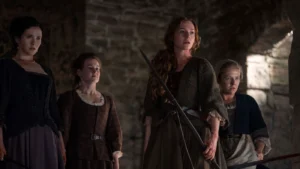
The episode’s central idea arrives during Rhaenyra’s conversation with Helaena. Rhaenyra initially wants to know why her half-sister no longer rides Dreamfyre, but her questions quickly become more desperate. She wants information about Daemon, Aemond, Tumbleton, Ormund Hightower, and whether the gods intend for her to prevail.
Rhaenyra is not merely asking Helaena to interpret her dreams. She is asking Helaena to validate her reign.
She wants confirmation that every death, betrayal, and increasingly brutal decision that brought her to the Iron Throne was part of some larger divine plan. Helaena cannot give her that certainty because her visions do not arrive as clean answers. She experiences fragments: a gray mare, open gates, her children, falling snow, Dreamfyre, fire, death, and possible futures she cannot fully understand herself.
For the first time, the series allows us to experience some of that confusion from Helaena’s perspective. Her ability feels less like a convenient prophecy machine and more like a constant emotional assault. She can glimpse pieces of what may happen, but she cannot organize those pieces into the military briefing Rhaenyra wants.
Helaena instead offers a warning. She explains that being with Dreamfyre has become “too much” and suggests that Viserys stopped riding because he did not want to be changed. Then she asks Rhaenyra whether possessing so many dragons has altered her too.
Rhaenyra answers that she does not wish to be altered. That is not the same thing as saying she has not been.
When Rhaenyra grabs Helaena and demands answers, she proves the point. The queen believes she is fundamentally different from Aemond, yet she treats Helaena exactly as Aemond once did when he wanted to force her into battle. When persuasion fails, both characters turn to power.
Helaena is no longer a sister or a frightened young woman in that moment. She becomes another resource Rhaenyra believes should obey her.
The Dragonriders Are Sitting In The Saddle, But They Are Not Steering
The confrontation involving Rhaenyra, Daemon, Rhaena, Addam, and their dragons transforms Helaena’s warning into action.
Every person enters the sequence with a plan. Daemon wants to protect Rhaena and contain the secret he created. Rhaena wants to prove that claiming Sheepstealer restored her place within her family. Rhaenyra wants answers about the unknown rider, while Addam arrives to support his queen.
Then the dragons see one another, and the human argument becomes almost irrelevant.
The sound design throughout this sequence is impeccable. These dragons breathe, scream, snarl, collide with the earth, and react like enormous territorial animals. Human voices disappear beneath the noise as riders shout instructions that cannot be heard and might not have been obeyed anyway.
That is what makes the scene more than an impressive visual-effects showcase. The chaos carries the episode’s meaning.
The Targaryens think of dragons as the ultimate expression of their authority. In practice, they are sitting on living creatures with instincts, fears, loyalties, memories, and desires of their own. The riders may occupy the saddle, but they are not necessarily steering.
Viserys warned Rhaenyra about this in Season 1 when he called the idea that the Targaryens control the dragons an illusion. “The Dragon in Winter” makes that warning horrifyingly literal.
Rhaena’s experience is especially tragic. She believed claiming Sheepstealer would finally make her complete. The absence of a dragon had always made her feel deficient within her own family, so bonding with one became her attempt to heal that wound.
Instead, Sheepstealer creates another crisis she cannot control. The dragon that was supposed to restore Rhaena’s place within the Targaryen family is nearly torn apart by that family’s dragons.
The series leaves Sheepstealer’s condition deliberately uncertain, but the emotional consequence is already clear. Rhaena believed a dragon would solve her identity. The dragon only magnified the danger inside it.
Aemond, Alicent, And Alys Become Gloriously Weird
The episode gets super weird at Harrenhal, and everyone knows how much I love it when House Of The Dragon gets weird.
Alys appears to Aemond in Alicent’s form. Aemond confesses to attacking Aegon, the encounter becomes sexual, and Alicent’s voice gradually begins blending with Alys’s. Aemond panics and runs outside, only to discover that his actual mother has arrived wearing the same clothing he saw in the vision.
The scene is disturbing, funny, sad, and revealing because the supernatural imagery grows directly from Aemond’s emotional wound. He wants to believe he has become a completely self-created man: a warrior, a dragonrider, a king, and the founder of a new Targaryen dynasty.
Underneath that identity remains the neglected boy who desperately wanted his mother to choose him over Aegon.
Alys understands that vulnerability. She does not need to overpower Aemond physically because she can occupy the emotional role he cannot defend himself against. His desire for the throne and his desire for Alicent’s approval are connected because both are attempts to prove that he matters more than his older brother.
The sequence is not simply telling us that Aemond is romantically attracted to his mother. It collapses his hunger for maternal approval, political legitimacy, sexual intimacy, and domination into one terrifying vision. Alys turns every part of his identity into something she can study and manipulate.
Then the real Alicent arrives with an assassin, only for Aemond to kill the man almost immediately. Alicent’s original plan allowed her to remain one step removed from the murder. Once Aemond eliminates that option, she must decide whether she can personally kill her own son.
She cannot stab him, so she poisons the spiced wine she once gave him as a child. Even Alicent’s attempt to murder Aemond has to look like motherhood.
That is why the choice works emotionally, even though Alicent’s rapid journey from King’s Landing to Harrenhal still feels like the plot moving her where it needs her to be. She cannot stop being Aemond’s mother long enough to become a clean assassin. She tries to kill him through the memory of comforting him.
Naturally, Alys saves him and responds like an exhausted parent whose foolish child has created another mess she must clean up. Perfect. No notes. Please allow this entire Harrenhal situation to remain as strange as possible.
Daemon Apologizing To Lady Jeyne Gives Me Life
Before Daemon can find Rhaena, he has to return to the Eyrie and deal with Lady Jeyne Arryn. Watching Daemon swallow his pride, observe the proper courtesies, and essentially ask permission to clean up the disaster he created gives me life.
The scene is funny because Daemon enters with the energy of a man accustomed to being the most dangerous person in any room. Lady Jeyne does not care about that performance. She wants accountability, protection for the Vale, and some acknowledgment that Daemon’s family has created an enormous problem in her territory.
Daemon cannot intimidate his way to the information he needs. He has to change tactics, and the cost of receiving that information is his pride. For one glorious moment, one of the most dangerous men in Westeros is defeated by basic manners.
Ormund Wins Ulf By Giving Him What Rhaenyra Never Did
Ormund Hightower continues to be one of the season’s strongest additions because he understands something Rhaenyra does not: controlling a dragon is not the same thing as earning the loyalty of its rider.
Rhaenyra and Daemon treated Ulf like an embarrassment they were forced to tolerate because they needed Silverwing. They granted him status without ever allowing him to feel respected.
Ormund offers him ale, freedom, attention, dignity, and the promise of Driftmark. That promise is almost certainly ridiculous. Ormund does not possess Driftmark, and he probably has no intention of giving it to Ulf.
It does not need to be true. It only needs to target Ulf’s deepest desire. Ulf wants proof that claiming a dragon transformed him into someone the highborn can no longer dismiss. Rhaenyra tells him he should be grateful for what she gave him. Ormund tells him he deserves more.
Rhaenyra may possess more dragons than anyone else, but she is rapidly losing control of the people riding them. That is a catastrophic management problem to have with the First Battle of Tumbleton rapidly approaching.
READ THE COMPLETE CRAFT ANALYSIS
The full Nerd Clan Knee Jerk Reaction goes deeper into how the Helaena and Rhaenyra scene changes power through blocking, why Harrenhal exposes Aemond’s real emotional wound, how Ormund turns Ulf into an opponent hidden inside Rhaenyra’s forces, and whether Episode 7 is constructing a satisfying finale—or merely another promise that the real ending is still coming.
Read the full House Of The Dragon 3.07 Knee Jerk Reaction inside the Nerd Clan.
Aegon And Sunfyre Rise From The Ashes Together
Aegon and Sunfyre provide the episode’s most satisfying surprise.
When Aegon, Tyland, and Larys encounter soldiers searching for the missing royal gold, Aegon refuses to continue running. He decides he would rather die openly as a king than disappear as a fugitive while history records that Aemond murdered him.
For once, Aegon makes a genuinely kingly choice.
Tyland decides to remain beside him. Larys, unsurprisingly, discovers that his loyalty has reached its expiration date and leaves. Their choices reveal exactly what each relationship means when loyalty finally carries a mortal cost. Then Sunfyre emerges from the darkness.
Aegon and Sunfyre have both been burned, mangled, abandoned, and presumed dead. Their reunion works because Aegon believed his dragon remained alive when nobody else did. Whether that knowledge came from their bond, denial, madness, or some combination of the three, Aegon was right. The dangerous part is what he will learn from being right.
Rhaenyra desperately wants Helaena to tell her that the gods chose her. Aegon appears to receive that confirmation without asking. He will not interpret Sunfyre’s arrival as unpredictable animal behavior. He will see it as destiny.
Seeing Criston Cole’s head carried on a spike was also immensely satisfying. Last week, the series gave Criston an unexpectedly complicated death filled with exhaustion, shame, and regret. This week, all that interiority is gone. History has reduced the man who spent his life protecting his own mythology to an object carried by someone else’s army.
I appreciated the tragedy of Criston’s death. I also loved seeing his head on a spike. Both things can be true.
Can House Of The Dragon Possibly Finish This Season In One Episode?
“The Dragon in Winter” creates strong momentum heading into the finale, but it also leaves an enormous amount of story on the board. Tumbleton is approaching. Ulf has turned. Hugh remains a wildcard. Corlys is imprisoned. Alyn has received his father’s severed finger. Rhaenyra and Daemon are barely functioning as a partnership. Aemond is trapped inside Alys’s influence. Alicent has failed to kill him. Aegon and Sunfyre have returned, and Vhagar remains somewhere in the Riverlands.
That is a lot of ground to cover in one episode.
The finale does not need to conclude the entire Dance of the Dragons, but it does need to create an irreversible consequence that changes the dramatic condition of the series. After the way Season 2 ended, House Of The Dragon cannot afford another finale that functions primarily as a trailer for the season coming next.
Episode 7 gives me hope because its spectacle has meaning. The dragons are not here merely because dragons look cool, although they look extremely cool. They are the physical expression of the Targaryens’ central delusion.
Rhaenyra believes she commands the dragons. Aemond believes he commands Harrenhal. Alicent believes she can control the price of her freedom. Ormund believes he can control Ulf. Rhaena believes Sheepstealer restored her identity. Aegon believes Sunfyre has chosen him.
Maybe some of them are right.
That possibility may be even more dangerous than all of them being wrong.
House Of The Dragon Season 3, Episode 7, “The Dragon in Winter,” earns 4.79 Flames.