Full spoilers for Netflix’s Little House on the Prairie Season 1 follow.
Netflix’s 2026 Little House on the Prairie is basically Virgin River in the 1800s. I mean that as both criticism and compliment, because this thing is warm, easy to watch, frequently beautiful, and built with the kind of comfort-TV rhythm that makes “one more episode” almost frictionless.
I was not supposed to be watching it. Mary put it on with my daughter while I was making dinner, and I announced that this was absolutely going to be their thing. I made the same mistake with Gilmore Girls, and we all know how THAT turned out. Twenty minutes later I was asking who Mr. Edwards was, why Caroline didn’t trust him, and whether these people were ever going to build an actual house instead of sleeping under a piece of fabric while wolves contemplated eating them. By episode two, I was in.
There Is Absolutely A Place For 1800s Virgin River
There is absolutely room for this kind of television. We have enough dragons, serial killers, dystopias, superheroes, and multiversal lunatics trying to erase existence. Sometimes I apparently just want to watch Charles Ingalls chop wood with his sad alcoholic friend.
That accessibility is a huge part of the appeal. Little House on the Prairie wants hardship without despair, danger without nihilism, and family conflict without making the family itself feel fundamentally unsafe. It is genuinely family-friendly television without feeling like something created exclusively for children, which is probably a large part of why Mary, my daughter, and I burned through all eight episodes so quickly.
The problem is that Little House occasionally confuses emotional safety with dramatic safety. The prairie is supposedly brutal, but Netflix photographs it like an Airbnb. Everyone is a little too clean, the costumes are a little too perfectly distressed, the dirt feels art directed, and even hardship tends to arrive wrapped in beautiful light and reassuring music. The story keeps telling us that survival here is precarious while the filmmaking keeps making me wonder whether the Ingalls should start renting the place out on weekends.
Independence Is Full Of Suspiciously Well-Calibrated People
That same polish extends to Independence itself. The town is filled with side characters, and most of them are pleasant to watch, but many feel suspiciously calibrated for exactly the dramatic function the story needs.
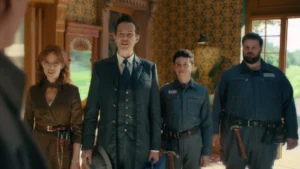
Eli James becomes the human face of railroad corruption. His wife Jemma embodies the kind of respectable prejudice Caroline is supposed to reject. Emily is the generous, independent shopkeeper who would probably give away half her inventory if someone looked hungry enough. Caleb is the abandoned child she takes in, while Dr. George Tann becomes her romantic interest until the show reveals that he is still married, sends him away, and eventually brings him back with divorce papers.
None of those stories are inherently bad. The issue is that I can usually SEE the machinery. These people don’t always feel like characters whose lives continue after the Ingalls leave the room; sometimes they feel like slightly more independent NPCs waiting for the episode to activate whatever specific function they were designed to serve.
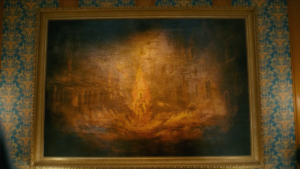
The way those stories resolve only reinforces the feeling. Caleb’s abandonment eventually gets an answer. Tann’s marriage becomes an obstacle he can literally resolve with paperwork. Relationships fracture and get talked through. Even when the prairie fire appears ready to destroy Independence, everyone digs a firebreak, things become increasingly hopeless, and the wind changes direction at exactly the moment they need it to.
The Ingalls still lose their crops, so the fire has consequences, but that pattern runs throughout the season: Little House is very good at introducing mess and much less willing to let the mess contaminate whatever happens next.
And when the solution isn’t a convenient change in the wind, Mr. Edwards is frequently standing somewhere nearby waiting to provide it. Charles needs help building? Edwards appears. Christmas needs some magic? Edwards appears. Charles needs work? Edwards has an opportunity. The Ingalls don’t know where to go next? Edwards has an idea.
I LOVE Edwards, but sometimes this show treats him like nineteenth-century roadside assistance.
Want the full Knee-Jerk Reaction?
The public version gives you the map. Inside the Nerd Clan, I go much deeper into why Independence can feel populated without ever feeling completely alive, why Mr. Edwards is the major exception, how Charles and Edwards are actually two versions of the same wounded man, and why the season is really about Charles’s belief that he can create safety through control.
Read the full Little House on the Prairie KJR in the Nerd Clan →
Mr. Edwards Is Where Little House Gets More Interesting
Edwards works because his problems don’t disappear when an episode resolves. His drinking, grief, and fear of attachment interfere with the thing he actually needs most: family. Becoming part of the Ingalls’ life means allowing himself to care about people again, which also means becoming vulnerable to losing another family.
His relationship with Charles is even more interesting because the two men are responding to versions of the same wound in completely different ways. Charles builds because he is terrified of losing another family; Edwards avoids building a life because he is terrified of losing another family. Charles responds to grief through relentless forward motion, while Edwards has convinced himself that nothing lasts long enough to be worth building in the first place.
That gives the season something deeper than the basic “family survives the prairie” plot, because Charles isn’t really trying to build a house. He is trying to prove that enough work, enough planning, and enough control can finally make everyone safe.
The prairie spends eight episodes telling him otherwise. Disease doesn’t care. Fire doesn’t care. The railroad doesn’t care. Government policy doesn’t care. And the Osage land conflict certainly doesn’t care about Charles’s belief that being a decent man with good intentions should somehow be enough.
Why Independence Is Actually The Point
That is also why setting this story in Independence works so well thematically. Charles heads west chasing independence while almost every major story demonstrates that true independence is impossible. He needs Edwards. His family needs Dr. Tann. The settlers need one another. Every supposedly self-sufficient act eventually reveals another relationship underneath it.
The Osage story gives that idea its most important complication because it is one of the few conflicts the Ingalls cannot solve simply by becoming better people. Charles can develop empathy and the Osage can still lose their land. Laura can genuinely care about Good Eagle while remaining part of a settler family whose presence has consequences for her family. The Ingalls’ desire for a home is understandable, but that desire becomes considerably more complicated once the story acknowledges that somebody else already called this place home.
That tension is dramatically richer than making Charles either a noble pioneer or an obvious villain. He can want something good for his family while participating in something morally compromised, and there isn’t a heartfelt conversation capable of making that contradiction disappear by the end of the episode.
By the finale, Charles loses the physical home he worked so hard to build, but the family leaving Independence is larger than the one that arrived because Edwards is now part of it. The house disappears while the definition of home expands. Charles spends the season attempting to create security through property and control, only to discover that the most durable thing he built was a relationship.
That is probably the best writing in the entire season.
Is Netflix’s Little House On The Prairie Worth Watching?
After everything I just complained about, yes. I liked the damn thing.
Netflix’s 2026 Little House on the Prairie is predictable, overly polished, and sometimes so modern in its emotional language that Laura sounds like she attended the writers’ room meeting about what the episode means. But it also has real heart and a sincere belief in family, community, grief, and connection. More importantly, whenever the show trusts behavior instead of explanation—particularly with Edwards—it can be genuinely moving.
And I don’t think every television show needs to reinvent television. Sometimes I want dragons, murder, superheroes, or some billionaire trying to collapse seventeen timelines because his mother didn’t hug him enough. Sometimes I am apparently perfectly happy watching Charles Ingalls build a house with his sad alcoholic friend while everyone learns something about the people they need to survive.
So yes, Netflix basically made 1800s Virgin River. Somewhere between rolling my eyes at the suspiciously tasteful frontier dirt and becoming genuinely concerned about whether Mr. Edwards was going to get his shit together, Netflix apparently won.
I guess I’m watching Season 2.
Goddammit.