Full spoilers for the Outlander series finale follow.
The Outlander finale is full of emotion. That is what makes diagnosing its problems so complicated.
Jamie and Claire’s conversation about the bees is lovely. The blue vase returns us to the earliest moments of Claire’s story. Jamie’s words to Bree carry the weight of a father who knows he may never see his daughter again. Fanny’s fear of losing the family she only recently found is real. The actors understand the history beneath every embrace, glance, and trembling goodbye.
I believe all of those feelings.
Jamie may die. His family loves him. They are frightened of losing him. Jamie loves them too. He leaves anyway.
Then the finale moves to another relationship and performs another version of that same emotional scene. The feelings remain sincere, but the story rarely forces them to become anything new.
That is the next major diagnosis in my project to rewrite the Outlander finale without breaking Outlander:
There are too many goodbyes and not enough turns.
The Finale Keeps Starting Over
The number of conversations is not the real problem. The problem is that the conversations do not build upon one another.
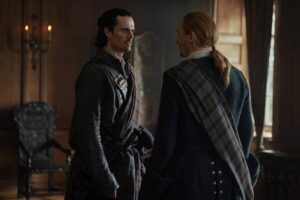
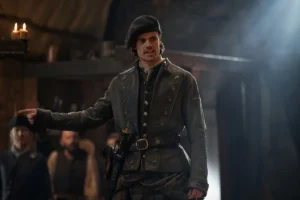
The finale begins with strong material. Jamie calls his men beneath the Fiery Cross and accepts responsibility for leading them toward Kings Mountain. We hear him read his will, establishing that Jamie believes he is preparing for his own death.
Then Jamie and Claire share their final morning at the Ridge. They talk about the bees sleeping inside a flower, heaven, ghosts, their children, Claire’s rootless childhood, the blue vase, Craigh na Dun, and whether she regrets touching the stone.
That conversation contains some of the finale’s most important ideas. It connects the Ridge to the pilot, the bees to mortality, and the vase to Claire’s lifelong search for home.
The trouble begins when the episode repeats the same emotional movement across several separate scenes.
Bree asks Roger to bring Jamie home. Fanny fears Jamie and Claire are abandoning her. Jamie returns Frank’s book to Bree. Jamie speaks to the bees. Jamie and Claire discuss his possible death again at Kings Mountain. The battle then gives them another opportunity to say goodbye.
Each scene is emotionally sincere, but the episode keeps returning to the same starting position: Jamie may die, his family fears losing him, and he intends to leave anyway.
The music rises. The actors deliver the emotion. The scene ends. Then another relationship enters and begins the same movement again.
The finale keeps restarting its emotional engine instead of allowing one scene to change the conditions of the next.
The Difference Between A Moment And A Scene
The finale contains many potentially memorable moments.
Jamie reading his will. The bees inside the flower. The return of the vase. Frank’s book changing hands. Jamie bowing to Claire. Claire running through the battle. The blue light. The final montage.
Any one of those could become an image viewers remember for years.
The problem comes when the story appears to exist primarily to move the characters from one predetermined emotional moment to another.
A moment delivers a specific effect: a striking image, a swelling score, a meaningful callback, or a line designed to contain the emotional meaning of the hour.
A scene creates a living space filled with possibilities. The characters can interrupt one another, avoid difficult truths, misunderstand what somebody needs, make a choice, and change the relationship. The location feels inhabited. The people feel as though they existed before we entered the room and will continue living after we leave it.
The scene loads the emotional weapon.
The moment fires it.
The Outlander finale keeps firing, but it rarely gives the scenes enough room to load.
Emotion Is Not The Same Thing As Drama
Emotion asks us to feel what the characters feel.
Drama places that emotion under enough pressure that somebody must do something with it.
That action creates a turn.
A turn happens when a scene changes its emotional or dramatic direction. Someone learns something they cannot unlearn. A relationship changes shape. A promise becomes impossible to keep. A character receives what they wanted and discovers that it carries an unexpected cost.
A turn does not need to be a giant plot twist. It can be almost silent.
One of the aired finale’s strongest examples comes when Jamie bows to Claire before Kings Mountain.
Jamie is facing the battle that Frank’s book says will kill him. Claire stands before him as his wife, his equal, his witness, and the person around whom he has built his life. Then Jamie bows.
The gesture changes the scene because it expresses something the dialogue cannot fully contain. Jamie is not simply saying goodbye again. He is recognizing Claire and the life they created together at the moment he believes he may lose it. The scene begins in fear and ends in recognition.
That is a turn.
A goodbye can be heartbreaking and still leave the story exactly where it began. A turn makes it impossible to continue without something having changed.
How The Final Morning Should Work
The answer is not to remove every goodbye. This is the end of an eight-season story. Jamie and Claire deserve private time together. Bree, Roger, Ian, Rachel, Fanny, William, Lord John, and the children all deserve a place within the emotional architecture of the episode.
The solution is to stop treating those relationships like separate emotional appointments.
The final night and morning at Fraser’s Ridge should become one continuous piece of story. The family should inhabit the same living space. The preparations for Kings Mountain should provide the ticking clock. Each conversation should reach into the past, reveal who someone has become, and change the conditions of the next scene.
Jamie and Claire’s morning should define what home means. Frank’s book should change the responsibility Bree carries. Fanny’s fear should lead to an active place within the family’s future. Roger, Bree, Ian, and Rachel should confront what the coming battle requires from them rather than simply repeating that everyone needs to return safely.
By the time Jamie walks toward his horse, his departure should feel like the consequence of everything that happened during the final night and morning—not merely the next event written into the episode.
Read The Full Writer’s-Room Reconstruction
Inside the Nerd Clan, I have rebuilt the entire movement from the Fiery Cross through Jamie’s final walk toward the horses. The full post includes a new structure for Jamie’s will, the family’s last evening together, the redesigned morning at the Ridge, developing script pages, and the first major change to William’s role in the finale.
The Goodbye That Changes Everything
Everyone at the Ridge understands Jamie. They know that once he believes his family is threatened, there is almost no chance of changing his mind.
William is different.
He has only just begun to accept Jamie as his father. He has not spent decades learning how completely Jamie can love someone and still walk away when he believes leaving is the only way to protect them.
That makes William the one person capable of turning Jamie’s departure into a genuine choice.
That is where Part 3 begins.
Which farewell from the aired finale worked best for you—and which one felt like the episode was repeating something it had already said?
Keep going with our complete Outlander Season 8 coverage, reviews, podcasts, and finale explainers.\