In Peaky Blinders, “In the Bleak Midwinter” is a private wartime phrase shared by Tommy Shelby and the men who survived France with him. Steven Knight has explained that the soldiers once believed they were about to die in No Man’s Land, sang the hymn while waiting for death, and then survived unexpectedly. From that moment forward, they treated the rest of their lives as borrowed time: they had already accepted death once, and everything afterward was a bonus.
That explains the phrase. Episode 1 shows us why it matters. Tommy whispers “In the bleak midwinter” immediately before apparently shooting Danny Whizz-Bang in the head, and Danny has just answered Tommy with two words that completely change the emotional temperature of the scene: “Yes, Sergeant Major.” For a few seconds, the canal in Birmingham becomes France again, and Tommy and Danny return to the roles the war carved into them.
That is where Steven Knight turns a piece of character backstory into something much richer. “In the Bleak Midwinter” becomes a death ritual, a memory trigger, a symbol of borrowed life and a shortcut back into the brotherhood these men formed during the war. The deeper you look at Christina Rossetti’s original poem, the more eerily suited it feels to Tommy Shelby and the men who came home with him.
This begins in Peaky Blinders Episode 1. Our Season 1 Episode 1 breakdown goes deeper into Danny Whizz-Bang, Tommy’s war trauma, the stolen guns, Grace, the magic horse and the choice that begins turning Tommy Shelby into a legend.
What Does “In The Bleak Midwinter” Mean In Peaky Blinders?
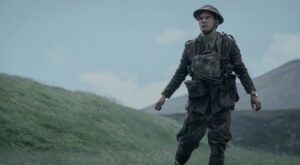
Steven Knight has now given the phrase a specific history inside the world of Peaky Blinders. He describes Tommy and his fellow soldiers emerging into No Man’s Land with virtually no chance of survival, accepting that death was coming and singing “In the Bleak Midwinter” while they waited. Rescue arrived instead, and the survivors made a psychological bargain with themselves: they had died in that moment, so whatever came next belonged to extra time.
Knight summarized the idea beautifully when discussing Tommy’s story: “From now on, everything is a bonus. We died then. Now we do what we want.” That explanation turns the hymn into one of the keys to Tommy Shelby’s psychology because it gives him an entirely different relationship with risk. A man who already feels that his original life ended in France can gamble with his future in ways that would terrify somebody who still experiences every day as something secure and permanent. Netflix Tudum documents Knight’s explanation of the soldiers’ pact here.
That idea is sitting underneath Tommy long before the series tells us the full story. He walks toward danger with an unnerving calm, converts threats into opportunities and repeatedly chooses the path that creates a larger conflict. “In the Bleak Midwinter” gives language to the worldview supporting those choices: death already came close enough for Tommy to accept it, and the man who walked away from that moment behaves as though fear has lost some of its bargaining power.
Related Coverage
- Explainer: Did The Peaky Blinders Really Have Razor Blades In Their Hats? No, But Who Cares? It Makes For Awesome TV
- Knee Jerk Reaction: KNEE-JERK REACTION | Peaky Blinders Season 1 Episode 1: Tommy Shelby’s Greatest Weapon Is Belief
- Peaky Blinders Season Guide: Peaky Blinders Season 1: Episodes, Cast, Recap & Complete Guide
Get Peaky Blinders Updates
Get Mary & Blake’s Peaky Blinders Knee-Jerk Reactions, deep episode breakdowns, character studies, screenwriting craft, and the real history behind the Shelby world.
“Yes, Sergeant Major” Takes Tommy And Danny Back To France
The first use of the phrase works because Knight refuses to stop the story and explain any of this. Danny believes Tommy is about to execute him for killing an Italian during one of his traumatic episodes, so he talks about Rosie, his children and the ordinary lives he wants his sons to have. He asks Tommy to make sure they become apprentices and foremen, and he begs for a burial place on a hill because he cannot bear the thought of ending up in mud again.
Tommy then tells Danny that he was a good man and a good soldier. Danny answers, “Yes, Sergeant Major,” and suddenly their entire relationship shifts. Tommy Shelby, bookmaker and Peaky Blinder, gives way to Sergeant Major Shelby, while Danny becomes one of his men again. Knight has changed the scene’s time period emotionally without changing its physical location.
That makes Tommy’s next words devastatingly efficient. He softly says, “In the bleak midwinter,” and Danny simply nods because the phrase already belongs to both of them. A weaker version of this scene could have given Tommy a speech about France, explained the hymn and reminded Danny of their shared history; Knight lets two men communicate through language that the audience has not yet been invited to understand.
That is strong screenwriting because mystery is doing character work. We may lack the full definition of the phrase in Episode 1, yet Danny’s response tells us that the definition already exists between them. The story creates curiosity while preserving the feeling that these men had lives together long before we met them.
The Canal Becomes A Battlefield Without Leaving Birmingham
The scene also pays off one of the pilot’s larger ideas about war. Earlier, Danny loses himself inside the Garrison when ordinary industrial sounds become artillery in his head, and Tommy physically restrains him while reminding him that he is home. Danny’s body has returned to Birmingham while part of his mind continues operating according to the sensory rules of France.
At the canal, Tommy enters that psychological space with him. Danny uses Tommy’s military rank, Tommy gives him the language of their wartime death ritual, and the scene begins to resemble a soldier receiving his final orders. The past has pushed its way into the present through dialogue, memory and behavior.
This is why the war feels like an invisible character in the premiere. Knight rarely needs a battlefield flashback to make France present because the men carry it into civilian spaces themselves. A factory hammer can become an explosion, mud can become a terror, military rank can reappear beside a canal, and four words from an old hymn can make Birmingham feel thousands of miles away.
Why Christina Rossetti’s “In The Bleak Midwinter” Fits Peaky Blinders So Well
The phrase comes from Christina Rossetti’s poem originally published as “A Christmas Carol” in 1872. Gustav Holst later composed the CRANHAM setting for the text, which appeared in The English Hymnal in 1906, placing the hymn comfortably within the cultural world that Tommy and his fellow soldiers could have known before and during the First World War. Hymnary traces the poem and Holst setting here.
Knight has publicly explained the soldiers’ fictional backstory with the hymn. His explanation stops short of discussing why he selected Rossetti’s particular text, so this next part is my reading of what the poem contributes to the drama. Once you start pulling apart the imagery, the choice feels almost freakishly well suited to these men.
Rossetti opens on a world frozen into stillness. The earth is “hard as iron,” the water has become “like a stone,” and the snow keeps accumulating across a landscape that feels heavy, silent and suspended. The Poetry Foundation preserves Rossetti’s original poem here. For soldiers waiting for an enemy to arrive and kill them, that imagery offers exactly the emotional terrain Knight needs: cold, stillness, inevitability and a world that appears to have stopped moving.
“Bleak Midwinter” Describes Tommy Shelby As Much As The Weather
The title itself is doing a lot of symbolic work. “Bleak” suggests exposure, emptiness and an absence of comfort, while “midwinter” places us at the darkest point in the seasonal cycle, far from the warmth and renewal associated with spring. The phrase describes an environment where life has gone quiet and survival feels precarious.
That makes it an unusually good description of Tommy when we first meet him. He has returned from France physically capable, intelligent and frighteningly composed, while his interior life remains trapped in a much colder place. He sleeps badly, reaches for opium after his nightmares, stares out over Birmingham in the middle of the night and treats threats with the fatalistic calm of somebody whose relationship with mortality changed permanently overseas.
Danny gives us the explosive version of the same damage. Tommy has learned to compress his pain into control, planning and risk, while Danny’s memories erupt into the room around him. “In the Bleak Midwinter” gives both characters a shared emotional climate even though they express the damage in radically different ways.
The Poem Moves From A Frozen World Toward Something Intimate
Rossetti’s structure becomes even more interesting when you look beyond the opening image. The poem begins with an enormous frozen landscape, then gradually moves toward the smallness of the stable, the intimacy of Mary and the child, and finally the speaker asking what a poor person can offer. The scale keeps shrinking until the answer becomes deeply personal: the speaker can offer the self.
That movement has a fascinating relationship with Knight’s fictional wartime story. Tommy and the other men have reached a moment where their military options have disappeared, their ammunition is gone and their ability to control the outcome has collapsed. What remains is how they choose to meet death and who stands beside them while they wait.
Jeremiah’s suggestion that they sing therefore becomes more than something to fill the silence. The hymn gives the soldiers a shared ritual at the point where action has run out, allowing them to face the moment together rather than as isolated men waiting to be killed. Knight turns a Christmas carol into a piece of battlefield fellowship.
We’re following these ideas across the whole series. Head to the Peaky Blinders hub for the complete rewatch, episode KJRs, history explainers and our deeper dives into Steven Knight’s writing, direction, lighting, music and visual storytelling.
A Christmas Hymn About Birth Becomes A Ritual About Death
This is the symbolic turn I find most fascinating. Rossetti wrote a Christmas poem whose central event is a birth, and Knight attaches it to a group of men who have collectively accepted their deaths. Then those men unexpectedly survive, which means the song associated with the end of their lives also becomes attached to the beginning of whatever comes afterward.
That is almost a blueprint for Tommy Shelby. The man who entered that wartime moment expected his life to end, while the man who emerged from it believes he is living on time that was never promised to him. France becomes a dividing line between two versions of Tommy, and the hymn sits directly on that border between death and rebirth.
The religious imagery makes the choice richer without requiring Tommy to become a conventionally religious character. Rossetti’s poem moves through humility, sacrifice and the giving of oneself, while Knight’s soldiers use it in a moment when their own bodies are essentially all they have left to offer. The show turns that spiritual language into something rougher, sadder and deeply personal to the men who survived.
Danny Whizz-Bang Lives Through The Ritual Twice
The Episode 1 scene becomes even more clever once we learn that Tommy has staged Danny’s execution. The Italian witnesses see the gun, the blood and the body falling onto the passing barge, while Danny later wakes to discover that Tommy used a shell packed with sheep brains. Tommy has given everybody exactly enough evidence to believe a death occurred.
Danny experiences something different. He prepares himself to die, returns emotionally to the military hierarchy of France, hears the phrase attached to the first time he accepted death and then survives again. The pattern of his wartime experience has repeated itself in Birmingham: Danny reaches the end, accepts it and discovers that life has somehow continued.
That makes “In the Bleak Midwinter” part of the pilot’s larger fascination with belief. Tommy stages the magic horse and lets Small Heath believe in witchcraft; later, he stages Danny’s death and lets the Italians believe they have witnessed an execution. Danny’s experience adds another layer because Tommy uses a ritual associated with genuine death inside an illusion designed to save his life.
Why The Song Returns At The End Of Episode 1
Knight brings “In the Bleak Midwinter” back at exactly the point where Tommy chooses the direction of his new life. Polly asks whether he disposed of the stolen guns, Tommy tells her that he did the right thing, and she immediately understands from his answer that the weapons are still in Birmingham. Tommy has chosen leverage, danger and a conflict large enough to bring the government directly into his world.
Then the screenplay calls for “In the Bleak Midwinter” as Tommy walks through Garrison Lane, a place the script describes as his kingdom. Charlie has already asked whether Tommy is looking for another war, and the music now follows Tommy after he has made the decision that will create one. France and Birmingham begin to overlap through sound.
That placement is far too precise to treat the hymn as decorative music. Knight uses it first around Danny’s apparent death and then returns to it after Tommy accepts a dangerous new future. The song connects the battlefield that created Tommy with the battlefield he is beginning to construct for himself at home.
The Phrase Is A Screenwriting Shortcut That Gets Heavier Every Time
This is where “In the Bleak Midwinter” becomes a great example of recurring symbolism. Knight establishes a phrase with an emotional charge before giving us its full history, then allows later scenes to add meaning to it. Each repetition can carry death, France, brotherhood, trauma, survival and borrowed time without requiring the characters to explain those ideas again.
That accumulation is what makes a recurring motif useful instead of ornamental. The audience learns the emotional vocabulary of the story, and the writer can eventually activate an enormous amount of memory with four words. A phrase that initially sounds mysterious becomes increasingly specific because we keep bringing our previous experience of it into the next scene.
The best part is that the words retain enough space for different characters to experience them differently. Danny hears the voice of his Sergeant Major before what he believes will be his death. Tommy carries the phrase as proof that his original ending has already happened. The shared words connect the men while their individual wounds give the ritual different emotional shapes.
So What Does “In The Bleak Midwinter” Really Mean To Tommy Shelby?
For Tommy, “In the Bleak Midwinter” carries the memory of the moment he and his fellow soldiers accepted death together and somehow survived. It reminds him that the life he is living feels borrowed, that the men who came home share an experience outsiders cannot fully enter, and that death has already occupied a permanent place in his imagination.
The brilliance comes from everything Steven Knight lets those words gather around them. Christina Rossetti gives him frozen earth, darkness, birth, sacrifice and the offering of the self; the war gives Tommy brotherhood, trauma and an encounter with death; Episode 1 gives the phrase Danny Whizz-Bang, “Yes, Sergeant Major” and a second impossible survival. By the time the hymn follows Tommy through his kingdom at the end of the pilot, four words are carrying an entire emotional history.
That is why “In the Bleak Midwinter” belongs so completely to Peaky Blinders. The hymn remembers the man Tommy Shelby was before France, the soldier he became inside it and the dangerous man now walking through Birmingham on time he never expected to have. When Danny calls him Sergeant Major, the war comes rushing back into the room, and the phrase tells us that some part of Tommy never really left it.