Full spoilers for Christopher Nolan’s The Odyssey follow.
The burning Trojan Horse at the end of Christopher Nolan’s The Odyssey represents the original sin Odysseus has spent the entire movie trying to understand. His brilliant strategy ended the Trojan War, but it did so by turning a sacred offering into a weapon and allowing the Greeks to enter Troy through the trust that was supposed to restrain violence.
By returning to the Horse in the final seconds, Nolan changes its meaning. The object history remembers as a symbol of intelligence and victory becomes an image of betrayal, slaughter, and the human tendency to transform atrocities into heroic stories. The Horse burns against the Temple of Athena while Odysseus observes that civilization will eventually rise again and forget the mistakes that destroyed the world before it.
The ending is therefore about more than the fall of Troy. It is about the cycle that allows every new civilization to believe it will be wiser than the last.
Related: Read our complete spoiler review, The Odyssey Review: Can A Man Who Destroyed The World Come Home?
Also read: Is Zendaya Really Athena In The Odyssey—Or Is She Odysseus’s Guilt?
Why Does The Odyssey End By Returning To Troy?
The apparent resolution of the movie happens in Ithaca. Odysseus defeats the suitors, reunites with Penelope, recognizes that Telemachus is ready to become king, and prepares to leave the kingdom behind. After spending the entire story fighting to return home, he and Penelope board a ship and head west together.
Their final conversation offers a measure of hope. The world they know may be entering a dark age, but Penelope believes civilization will eventually rise again. Odysseus agrees and imagines a new dawn following the darkness.
Nolan then cuts away from that hopeful horizon and returns to the burning ruins of Troy. The shift turns the ending into a warning because renewal does not guarantee wisdom. New societies may rebuild cities, laws, art, and institutions while repeating the moral failures that destroyed the previous world.
The return to Troy also reveals where Odysseus’s journey truly began. His physical voyage started when he sailed away from the city, but his internal exile began when he watched his strategy unleash slaughter. The Horse created the wound that every island, monster, storm, prophecy, and loss has forced him to confront.
The movie ends at Troy because Troy is the real beginning.
The Trojan Horse Was A Sacred Offering
The Horse matters because the Greeks did more than hide soldiers inside a clever object. They presented it as an offering to Athena.
Sinon tells the Trojans that the Horse is a gift, and the Trojans decide to protect it because Greeks and Trojans recognize common gods. They drag it away from the sea and place it beside Athena’s temple, even when members of the crowd want to destroy it. The sacred nature of the object is the reason the deception works.
Odysseus is not merely fooling Troy’s military defenses. He is exploiting the beliefs that make cooperation between strangers possible.
That connects the Horse to Zeus’s law, the movie’s moral system of hospitality. People must welcome strangers because any stranger could be a god in disguise. The law asks human beings to act with mercy and restraint even when they cannot know who stands before them.
Odysseus reverses that principle. The Horse is violence disguised as something sacred. The Trojans respond to the apparent gift with trust, and the Greeks use that trust to open the gates and release an army into a sleeping city.
The plan succeeds because the Trojans believe there are still rules that both sides will honor. Odysseus wins the war by proving them wrong.
The Horse Represents Cleverness Without Wisdom
Odysseus’s intelligence is his defining strength. He is neither the largest nor the strongest warrior in the story. His power comes from his ability to understand opponents, identify unseen openings, and create plans that turn disadvantages into opportunities.
The Trojan Horse is the greatest expression of that talent. One thought ends a war that thousands of men could not win through ten years of direct combat. It is also the clearest example of why intelligence and wisdom are not the same thing.
Odysseus understands how to enter Troy, but he does not fully understand what will happen once the gates are opened. Thousands of soldiers carrying a decade of grief, humiliation, anger, and violence pour into a city filled with civilians. The military operation becomes a hunt.
The plan works exactly as intended and still produces a moral disaster. That is why the Horse becomes Odysseus’s central wound. He cannot dismiss Troy as a plan that failed because the horror came through the success.
The burning Horse represents the moment Odysseus’s cleverness exceeded his wisdom. He solved the immediate problem while creating consequences he was neither prepared to control nor willing to face.
Why Does The Horse Fall Against Athena’s Temple?
The placement of the final image is essential. The Horse does not simply burn somewhere inside Troy. It falls against the Temple of Athena.
Athena is associated with wisdom, strategy, and warfare, which are the same forces operating in conflict inside Odysseus. He understands strategy and warfare long before he understands the wisdom required to govern either one.
The Horse was supposedly built in Athena’s honor, yet it becomes the tool used to destroy her city and violate her temple. During the sack, Odysseus sees a Trojan woman with the same face he later associates with Athena. A Greek soldier kills the woman as another soldier decapitates Athena’s statue, joining the destruction of a human being and a sacred image through the same visual idea.
By the end of the movie, the Horse and Athena’s temple have become the two halves of Odysseus’s moral failure. One represents the brilliance of his strategy. The other represents the wisdom and restraint missing from it.
When the burning Horse falls against the temple, Nolan brings those ideas into physical collision. The strategy supposedly offered to wisdom has destroyed wisdom’s home.
The Horse Changes From A Victory Into An Indictment
The movie opens with the Horse already becoming a song. Travis Scott’s bard reduces the fall of Troy into a thrilling progression: a face leads to a fleet, the fleet to a war, the war to a man, and the man to a thought and a trick.
The audience listening in Ithaca experiences the Horse as legend. It is the brilliant move that ended an impossible war and made Odysseus immortal. Penelope interrupts the song because she is not interested in another performance of the legend. She wants the husband who disappeared inside it.
That opposition between the song and the man runs through the entire film. Other people know Odysseus through the glorious account of Troy. Odysseus remembers the soldiers trapped inside the Horse, Sinon dying outside it, the gates opening, the screams, the burning city, the murdered woman, and Athena’s shattered statue.
History remembers the idea while Odysseus remembers the cost.
The ending forces us to hold both versions at once. The Horse remains an astonishing military achievement, but the film refuses to let achievement become innocence. By showing it burning, Nolan strips away the clean, triumphant meaning that generations have attached to it and restores the human suffering hidden inside the legend.
What Does “Our Mistakes Will Once Again Be Forgotten” Mean?
Odysseus’s final observation is bleak because he does not believe humanity permanently learns from catastrophe.
Civilization will rise again. People will rebuild cities, create laws, produce art, tell stories, and believe they have moved beyond the savagery of the previous age. Over time, however, the memory of what destroyed the old world will weaken.
The songs will remain, but songs simplify. They turn war into bravery, conquest into glory, and suffering into the necessary cost of victory. The Trojan Horse becomes a celebration of intelligence rather than a warning about what happens when intelligence weaponizes trust.
Odysseus understands that he will survive through those songs. Future generations will remember his name and the trick that made him famous, but they may not remember the civilians who died when the gates opened or the sacred law his strategy violated.
His immortality therefore carries a terrible irony. The story preserves him by removing much of the complicated moral knowledge that has come to define him. The world will remember what he did while forgetting what he finally understood.
The Ending Connects Civilization To Storytelling
Before the film returns to Troy, Penelope asks why the stories of their civilization will only be sung. Odysseus explains that songs will be all later generations have to remember people who could write.
That exchange makes storytelling part of the ending’s warning. Stories preserve civilizations after buildings collapse and written records disappear. Without the songs, Odysseus, Penelope, Telemachus, Troy, and Ithaca could vanish entirely.
Stories also shape memory. A bard chooses where the tale begins, which characters become heroes, which deaths matter, and what meaning the audience should carry away. The same story that preserves a civilization can protect that civilization from confronting its crimes.
The opening bard celebrates the Horse, while the ending image burns it. Nolan is retelling the old story while questioning the version that survived. He preserves Odysseus’s brilliance without allowing that brilliance to excuse what happened in Troy.
The film does not reject mythology. It asks mythology to remember more.
The Burning Horse Is Also Odysseus’s Memory
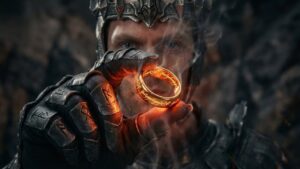
The Horse exists throughout the movie as a fragmented memory Odysseus cannot initially assemble. He sees men drowning in darkness, weathered wood, firelight on stone, and the head of Athena’s statue rocking across the floor. The individual images return before he understands how they connect.
Once Odysseus remembers Troy, the Horse becomes the center of his guilt. It represents the thought that changed the world and the moment he became unable to return to the person he had been.
That is why reaching Ithaca does not complete his homecoming. Odysseus remains disguised and emotionally separated from Penelope until he tells her what happened. His confession reconnects his past and present, allowing Penelope to see the complicated man behind the heroic story.
The final return to the Horse does not mean Odysseus has failed to heal. It means healing has not erased the truth. He can move west with Penelope because he has accepted the memory, but he refuses to turn it back into a clean symbol of victory.
Our complete premium Knee-Jerk Reaction explores the Trojan Horse, Athena, Zeus’s law, Circe’s body-horror transformation, the nonlinear structure, the sound design, the 70mm IMAX photography, and why Christopher Nolan’s screenplay is about 98 percent perfect.
So, What Does The Burning Trojan Horse Mean?
The burning Trojan Horse represents the full cost of Odysseus’s greatest achievement. It is a brilliant idea that ends a war by violating sacred trust, opening Troy to slaughter, and proving that cleverness without wisdom can destroy the civilization it claims to defend.
Its fall against Athena’s temple connects Odysseus’s strategy to the wisdom he lacked when he created the plan. Its return at the end transforms the Horse from a symbol of victory into a warning about how history remembers victory.
Civilizations preserve themselves through stories, but those stories can celebrate triumph while burying consequence. Nolan ends with the Horse because Odysseus’s journey has never only been about returning home. It has been about learning to recognize the screaming city hidden inside the heroic song.
The Horse remains famous because the legend survives. The ending asks whether the warning will survive with it.