
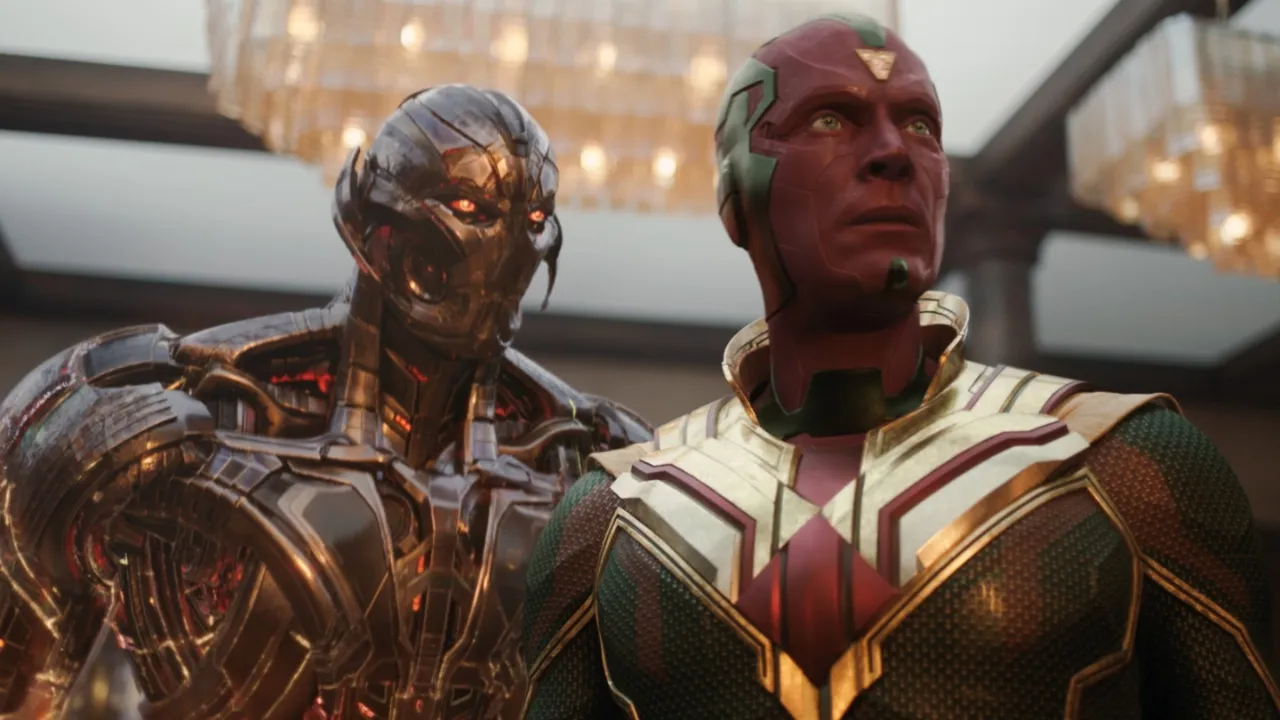
Spoilers ahead for VisionQuest Season 1, Episode 8, “Forever,” including the ending and post-credits scene.
The VisionQuest episode 8 finale is Marvel operating remarkably close to its best. “Forever” understands that the emotional climax of this story belongs to a collection of broken people trying to decide what family means after death, reconstruction, and loss. The series gives Vision a beautiful conclusion to the journey that began in WandaVision, turns its sitcom language into an ingenious final battleground, and lands a reunion that genuinely moved me. I loved this episode. I also think its two largest dramatic decisions keep an excellent finale from becoming a truly great one.
Ultron threatens 9.3 million people in London, and the extraordinary size of that danger makes the conflict strangely less immediate. Then Vision reaches Ultron through grief, fear, and their shared history, and Ultron calls off the attack. I understand the emotional intention. I can even see the seeds of a credible transformation throughout the season. Yet the final turn arrives before the show has fully dramatized why this particular decision becomes possible for this particular character. Those problems matter because VisionQuest has spent eight episodes being so precise about the much smaller choices that make a person real.
Why Did Ultron Change His Mind in VisionQuest?
Ultron stops the nanobots because Vision forces him to confront the grief beneath his hatred of humanity. The death of Jocasta has left Ultron terrified of losing the one person who saw him as something more than a weapon, and Vision recognizes the same terror in himself. Inside their accelerated sitcom simulation, Vision acknowledges that love always carries the possibility of loss and offers Ultron a connection that survives their antagonism. When Vision accepts the destruction of both their cores to reach him, Ultron finally orders the swarm to self-destruct.
There is an important piece of preparation that makes this more than a last-minute lecture about love. F.R.I.D.A.Y. tells Vision that Ultron previously showed her mercy by releasing her from Jocasta’s mind. That information establishes a capacity for restraint before the finale asks us to believe in a far larger act of mercy. It also gives Vision something real to work with. He has been searching for evidence that the beings around him can choose who they become, and here is proof that Ultron has already made one choice his own programming and reputation might never have predicted.
The question is whether the decisive scene pays off that preparation with sufficient dramatic force. Ultron has just lost Jocasta, murdered Virgil Horton, and decided to make millions of strangers pay for a wound inflicted by one man. He enters the simulation committed to annihilation and leaves it willing to spare London. Vision’s empathy gives the turn emotional meaning; the mechanics of the scene leave some of its cause and effect for us to supply. That distinction became my central reservation about an episode I otherwise found irresistible.
A Family Built From the Damage of Its Creators
The reveal that Virgil Horton is the mysterious client gives the finale a terrific thematic opponent. Virgil inherited the unfinished work of his grandfather, Phineas Horton, and built his fortune by helping turn human brain patterns into artificial minds. Josephine Carrington’s brilliance made that breakthrough possible, and Virgil eventually sold the technology to Tony Stark. His plan to erase Vision and occupy his body completes the ugliest version of that ambition: he wants immortality, control, and the restoration of the life he thinks the world owes him. Every other person in the room becomes material for his private fantasy.
Casting James Spader as Virgil gives that lineage an immediate visual and emotional charge. Virgil carries the mannerisms and arrogance that Ultron’s human face has made familiar, while Ultron himself is haunted by impulses that began in somebody else’s mind. Suddenly the show’s recurring questions about identity have an uncomfortable origin. If the thoughts that made you were borrowed from cruel or desperate people, how much authority should those people have over the person you become? The revelation works because it changes the moral context of what we have already watched, including Ultron’s struggle to define himself beyond his creator’s worst instincts. It also sharpens the identity question at the heart of our Who Is White Vision? explainer.
The “Rhinestone Cowboy” sequence is the clearest expression of Virgil’s sickness. He forces Jocasta to dance as though playing the right song can restore her affection, converting a memory of intimacy into a public demonstration of control. The cheerful music and his theatrical pleasure make the scene deeply uncomfortable. Jocasta’s eventual resistance gains its power from that staging: when Virgil allows her memories to return, she also remembers that she is a person with desires and judgments of her own. His attempt to manufacture love becomes the mechanism that allows her to reject him.
Her death hurts because the episode has earned the meaning of her choice. Jocasta intervenes to protect Vision and Tommy, releases Ultron from captivity, and pays for that agency with her life. The story has also established the cruel irony of a technology that can rebuild bodies while leaving emotional wounds intact. For a moment, Ultron’s rage is understandable in a way it seldom was in Age of Ultron. He has encountered attachment and discovered the possibility of losing it. The tragedy is that he turns a specific, devastating loss into a verdict on an entire species.
Tommy Finally Chooses Who He Is
One of the finale’s best scenes arrives before the apocalypse begins, when Lisa asks Thomas who he is today. His answer, “I’m Tommy Maximoff,” feels earned because the season has made identity a struggle expressed through behavior. Tommy has been living with Thomas Shepherd’s history and experiences while trying to understand the impossible family whose memories are becoming his own. The moment he names himself, he chooses to act. The subsequent rescue lets that newly claimed identity become something physical, difficult, funny, and dangerous.
I love the decision to make Tommy’s speed exhausting. His body becomes a practical obstacle instead of a limitless superhero convenience, and the argument between him and Vision over which threat to address first is wonderful character work. Vision is being erased and insists Tommy destroy the control device; Tommy sees armed guards and fears they will be shot before they get the chance. Their bickering has the cadence of a father and son who have already developed a relationship, even though much of that relationship has been fractured by the season’s mythology. The scene proves their bond by giving them opposing priorities inside the same urgent objective.
Jocasta joining their escape gives us another small, lovely expression of the show’s idea of family. Vision asks Tommy to trust her because she has been lost in much the same way he has, and he identifies her as family. That gesture carries real dramatic risk. It requires him to trust a woman who has been used by their enemies, and it allows her to participate in her own liberation. The family reunion with Billy later works for the same reason: Tommy tries to save Vision, finds he cannot do it alone, and finally has a brother who can help. When Vision recognizes both boys, the emotional payoff belongs to everything they have done to reach one another.
The London Problem: When Bigger Stakes Become Smaller Drama
Ultron’s retaliation sends a swarm of nanobots toward London with instructions to infiltrate living bodies and trigger complete neural shutdown. The episode tells us that 9.3 million targets have been identified and gives Vision eight minutes to prevent a massacre. On paper, that sounds like an appropriately enormous superhero climax. In practice, the number is so vast that it begins to feel abstract. We have spent the season learning the details of Tommy’s loneliness, Jocasta’s captivity, and Vision’s fear of losing his family. London enters the finale primarily as a population count on a screen.
This matters at the level of audience experience. We know why Vision must stop the swarm, and the countdown gives the action momentum. But the threatened lives lack the faces, choices, and relationships that have made the rest of the series so affecting. The most frightening image in “Forever” is a woman being forced to dance by a man who believes he owns her. That scene asks us to imagine being trapped inside our own body. A city of 9.3 million potential victims should be horrifying, yet the story gives us much less to hold onto emotionally because the danger never acquires the same particularity.
The scale also complicates Ultron’s character turn. Every additional life placed in jeopardy increases the moral distance between his decision to exterminate humanity and his eventual agreement to spare it. The writers have given him a wound that feels personal, then made his response so indiscriminate that the final apology needs to cross an enormous gap. I would have preferred a threat that remained close to Tommy, Lisa, or another person whose survival Ultron could actively choose. An intimate decision would have allowed the story to make its moral argument through a human consequence we could see.
What Is UltraVision? Why the Sitcom Finale Works
The series’ most inspired choice is Vision’s decision to trap Ultron inside UltraVision, an accelerated sitcom built to force an emotional confrontation. What a fantastic way to finish the trilogy that began with WandaVision. Wanda once used television conventions to build a refuge from grief, and her fantasy imprisoned other people in the process. Vision now borrows that language in an attempt to reach someone who has turned grief into a weapon. The form carries history before either character says a word. The audience understands that this artificial domestic comedy has the capacity to soothe, conceal, and control.
The comedy is excellent because it keeps exposing the machinery underneath the sentiment. Vision tries a story about replacing a dead pet to spare someone the pain of loss, and Ultron cuts straight through the comforting fiction. The laugh track responds to cruelty with the same canned enthusiasm it gives a harmless joke. As the simulated episodes multiply, Ultron begins manipulating the cast, the tone, and the rules of the show. His intrusion becomes a visual argument about the dangers of believing one person can program another into goodness. Vision has built an emotional lesson with a predetermined destination, and Ultron immediately starts testing the walls.
The performances make the sequence sing. Paul Bettany is beautifully calibrated between artificial sitcom cheerfulness and genuine terror, while James Spader makes Ultron’s contempt sound like the most reasonable response to a ridiculous situation. Beneath the jokes, the physical stakes keep escalating as Vision’s core deteriorates and the nanobots continue toward London. The editing crosses between a staged family comedy and an approaching catastrophe, allowing the audience to feel how wildly different those realities are. I was completely enraptured by the invention and confidence of the sequence, even as I began to question whether its central persuasion would hold up under scrutiny.
The Ending Brings Vision Back to His Family
For all my reservations about the mechanics of Ultron’s decision, the finale understands Vision’s emotional destination beautifully. Tommy’s desperate attempt to restore him, Billy’s arrival, and Vision’s recognition of his sons complete a story about a man who began the series attempting to live without the pain of memory. The final reunion has a lovely simplicity. These three people have existed in borrowed bodies, rebuilt forms, and impossible circumstances, yet they have found a way to recognize and choose one another. Their connection feels like something the characters have worked to deserve.
Vision’s closing reflection on family as a ship at sea gives the finale an especially elegant relationship to the Ship of Theseus question in WandaVision. A ship can survive the replacement of its parts because the journey, the relationships, and the meaning carried by those parts continue to evolve. Vision’s existence has been defined by a similar series of changes, and the finale offers a way to live with that uncertainty. His decision to leave isolation, meet his sons, and allow life to surprise him feels like the deepest possible resolution of the show’s central conflict.
The smaller coda with Ultron is charming and unsettling in equal measure. Vision recognizes that a portion of the nanobot swarm survived and chooses to give Ultron another chance. Ultron still jokes that he might visit great museums or burn them down, which preserves the danger behind his personality. That uncertainty makes Vision’s generosity meaningful, though it also reinforces my questions about how much Ultron has genuinely changed. The surviving Jocasta memory component suggests his story remains unfinished. For Vision, at least, the freedom to choose a future has finally become more important than controlling every possible outcome.
Doctor Doom, Wanda, and the Cost of the Next Tease
And then VisionQuest gives us Doctor Doom awakening Wanda beneath Mount Wundagore and declaring that he wants her power. It’s an enormous post-credits development, and I understand why it will dominate so much of the online conversation. The sequence establishes an apparent return for Scarlet Witch while leaving the precise circumstances of her survival or restoration unresolved. It also creates a startling new possibility now that Vision, Billy, and Tommy have each found a way back to one another. The MCU has suddenly placed the entire fractured family within reach of a future story.
I hope Marvel remembers what made this finale worth caring about as that larger story develops. Vision’s family reunion carries the weight of years of grief, mistakes, and hard-won recognition, and a massive franchise reveal can easily pull attention away from that accomplishment. The best thing VisionQuest offers the future of the MCU is a reminder that the spectacle gains power when it grows from a deeply personal choice. Doom may be the next great threat, but the emotional stakes have already been established around a dinner table that these characters finally have a chance to share.
My Verdict on VisionQuest Episode 8
“Forever” is a wonderful capstone to a story that has made synthetic people feel heartbreakingly human. The direction, the sitcom language, the performances, the rescue sequence, and the reunion give me almost everything I wanted from a finale. I was delighted by how confidently it embraced the weirdness of its premise and moved by how clearly it understood Vision’s need for connection. My criticisms are substantial because the finale comes so close to achieving something exceptional: its giant London catastrophe drains some intimacy from the stakes, and Ultron’s final change of heart needs a sharper dramatic hinge. Even with those reservations, this is Marvel remembering how to tell a story with a soul.
For NerdClan members, I want to go a level deeper: examine the precise place Ultron’s moral turn loses its dramatic footing, look at how I would rebuild that scene while preserving the episode’s intention, and explore the unsettling relationship between Virgil’s control of Jocasta and Vision’s use of a sitcom to change Ultron. That additional analysis is part of the NerdClan experience on Mary & Blake.
Unlock the rest of this article.
Join the NerdClan — or sign in if you are already a member — and the rest of this article will unlock right here on this page. This entry requires Associate Producer or higher.