
Full spoilers for Avengers: Age of Ultron and Avengers: Endgame. Trailer details for Avengers: Doomsday.
The family images in the Avengers: Doomsday trailer are doing more than reminding us that Steve Rogers once loved Peggy Carter. They put a difficult dramatic question in front of him: what does a hero owe the world after finally choosing a life of his own?
That question connects the trailer to the farmhouse sequence in Age of Ultron, but the connection is not simply that both stories pause for domestic scenes. Clint Barton’s home gives the Avengers a view of a life beyond the mission. The Doomsday trailer reverses the arrangement. Steve is no longer looking at someone else’s home from the outside. He has built one, and the Fantastic Four arrive at its door asking him to become part of the larger story again.
That is a meaningful setup for a multiverse-sized conflict because it translates scale into a choice. A collapsing universe can be difficult to feel. A man leaving his child and partner to answer a call is immediate. But the trailer has only established the pressure point. The film still has to make Steve’s family more than a symbol, make his return more than a cameo, and make Doom’s accusation more than a line about “stolen lives.”
The farmhouse is a hinge in Age of Ultron
The farmhouse sequence can look like a detour when measured only by plot mechanics. The Avengers have been compromised by Wanda’s visions, Ultron remains a threat, and the film cuts away from the team’s next tactical move to reveal Clint’s private life. Laura opens the door. The children run into the room. The heroes, who have been moving through the story as a unit, suddenly have to behave like guests in a family home.
The reveal changes the meaning of Clint’s earlier behavior. He has not been absent from the emotional world of the Avengers; he has been protecting a separate one. His family is not a new motivation inserted at the moment the plot needs a hostage. It is the hidden context of choices he has already made. When he goes back into danger, the audience can now see the cost he is carrying with him.
That changes the room for everyone else, too. Natasha is confronted with the possibility of a life she has never believed she could have. Her conversation with Bruce turns on the damage each of them thinks makes a normal future impossible. Bruce sees the Hulk as a threat he cannot safely bring into a family. Natasha describes the Red Room’s sterilization of her as a procedure that made her a monster. They are talking about love, but also about whether the lives they were given have left them capable of choosing another one.
Steve’s response is quieter and more revealing. He has no partner or child in that house. He is surrounded by a domestic life that belongs to Clint, and his own lost future has already been planted in the film through Wanda’s vision of Peggy and the dance they never got to share. Clint’s home is therefore not just a respite for the team. It puts several possible relationships to heroism in the same space: Clint has built a family while continuing to fight; Natasha and Bruce wonder whether they can; Steve is still carrying the life he lost.
That is why the farmhouse can carry dramatic weight without turning into a separate family subplot. It changes what the Avengers know about one another and what the mission means to them. Fury arrives with a plan, but the scene has already given the team a reason to understand what is at stake beyond winning the next fight. The world they are protecting is made of ordinary lives, including the lives they might have had themselves.
In craft terms, the farmhouse is a hinge. Before it, the Avengers are a damaged team trying to recover from Wanda’s attack. After it, they have seen a version of the world that their work is supposed to preserve. The scene does not solve their conflicts. It puts those conflicts under a different light and gives the next decision a human context.
Doomsday reverses Steve’s place in that scene
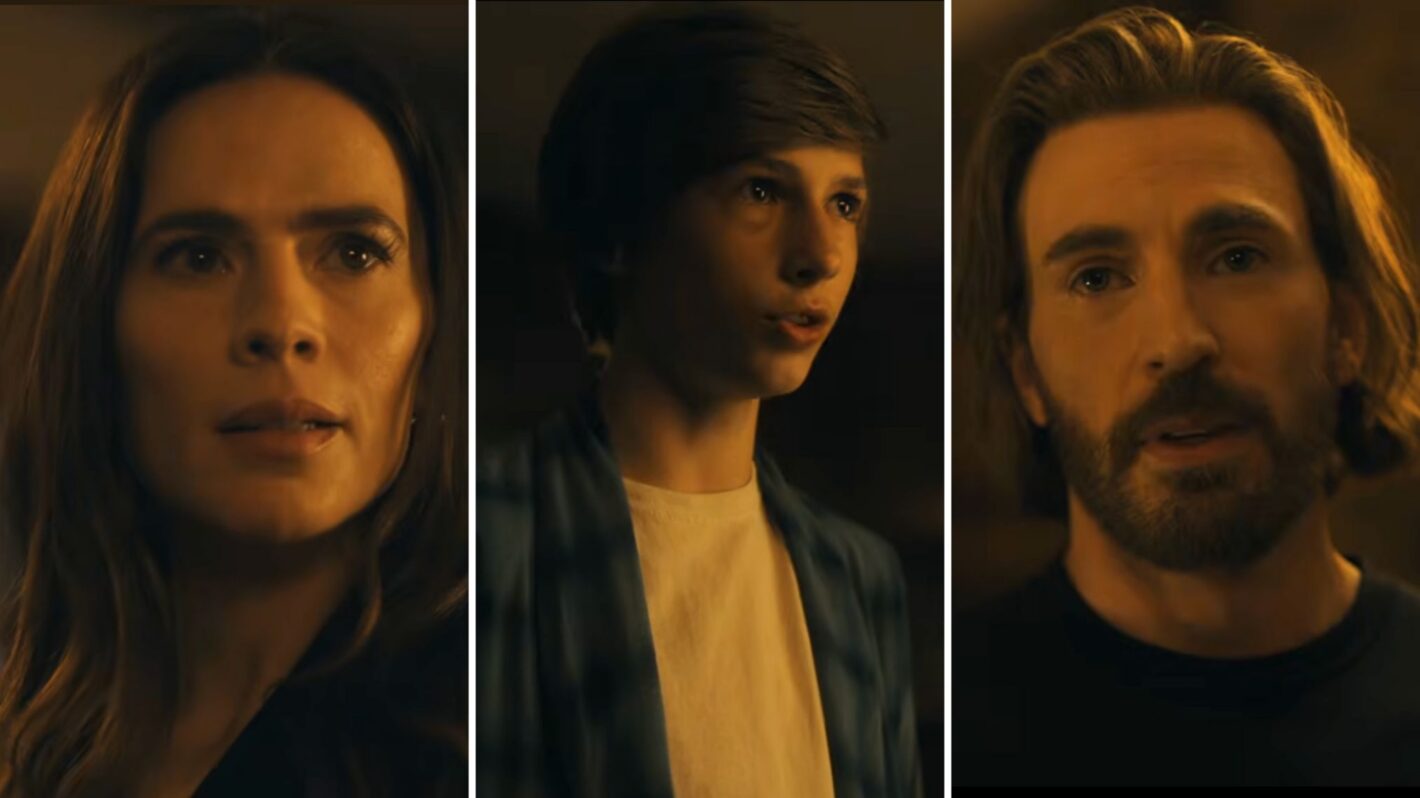
The trailer’s important move is to place Steve on the other side of Clint’s reveal. In Age of Ultron, he is the hero watching someone else’s family life. In the Doomsday footage, he has a home with Peggy and a son. We see the quiet routine of that life, including Steve walking the boy to school and kissing him good night. The child asks, “Dad, were you a superhero?” Peggy’s answer shifts the measure of Steve’s identity away from the uniform. She asks whether he thinks their son does not know him from those ordinary acts of care.
That exchange is pointed because it does not argue that Steve’s heroic past is irrelevant. It asks whether the public symbol is the whole person. To the world, Steve Rogers is Captain America. To Peggy and their son, his character is also expressed in repeated, private acts that do not need an audience. The trailer gives those acts a visual rhythm before it brings the old name back into the house.
Then the Fantastic Four arrive and ask, “Are you Steve Rogers?” The question is simple, but its placement makes it disruptive. The name enters the family space from outside. Steve is no longer only the father whose son is learning about his history; he is a figure other people have come to find. The trailer cuts between that arrival, the family images, and Steve’s account of the Avengers. It turns his return into a collision between two identities that have both become real.
The order matters. If the film opened with Steve already in uniform, returning to action, the audience could read the family as background information. By showing the domestic life first, the trailer makes departure the dramatic event. Steve leaves a specific home. He does not step out of retirement into an empty space. His eventual choice carries a cost because the film has shown what he is leaving behind.
That is also why the family can deepen the meaning of the ending of Endgame. Steve’s decision to return the stones and remain in the past with Peggy was presented as the completion of a long-delayed personal desire. He had spent his life answering calls from the world. At last, he chose the dance and the life that had been taken from him. The trailer now asks what happens when that choice becomes part of a larger history, and when the man who finally chose a private life is summoned back into public responsibility.
The trailer’s two lines give that question a moral shape: “We made a choice that we knew was right,” followed by “We didn’t know those choices would have consequences.” The edit invites us to connect Steve’s past decision with the crisis now unfolding, but it does not confirm every proposed timeline explanation. We do not know from the trailer whether Steve caused an incursion, whether Doom blames him for a specific loss, or whether the line refers to another decision entirely. What we can see is the dramatic tension: Steve can believe he made the right choice and still have to face what followed.
A choice can be right and still have a cost
This is a more interesting conflict than simply asking whether Steve made a mistake. If the film declares that his choice to live with Peggy was selfish and therefore wrong, it risks flattening the ending of Endgame into a setup for punishment. If it insists that the choice was entirely private and had no consequences for anyone else, then the trailer’s warning becomes empty. The stronger possibility sits between those answers: Steve chose something genuinely valuable, but no choice exists outside the lives it affects.
Robert McKee writes, “True character is revealed in the choices a human being makes under pressure.” The pressure matters because a character’s values are easy to state when they do not conflict. Steve has always said he will stand between danger and other people. His family forces that principle into a new shape. Does protecting the world require him to leave the people closest to him? Does protecting them mean refusing the call? Can he find a third choice, or does the crisis make that impossible?
The trailer does not answer those questions, and it should not. Its job is to make us understand why the answers will matter. The boy’s question makes Steve’s past legible to the next generation. Peggy’s response makes the present life feel substantial. The Fantastic Four’s arrival creates the interruption. Steve’s departure gives that interruption a consequence. These are distinct beats in a dramatic progression: establish a value, introduce an opposing demand, force a choice, and let the audience feel what the choice costs.
That progression is the difference between vulnerability and a threat pasted onto a hero. A family member can be placed in danger simply to make the hero angry. But danger alone does not reveal character. The story needs to force the hero to choose how to respond, and the response needs to tell us something new or newly complicated about who the hero is. If Steve’s family is only kidnapped so he can punch Doom harder, the relationship will have served as ammunition. If the family changes what Steve is willing to do, what he refuses to do, or how he understands his responsibility, then it has become part of the story’s moral engine.
The same standard applies to Peggy and James. The trailer has given them emotional presence, but the finished film must give them more than the function of being precious to Steve. They need particular points of view and relationships with each other that matter independently of the danger surrounding them. Peggy, especially, cannot exist only as the reward Steve earned at the end of Endgame. She is Peggy Carter: a character with a history of making decisions under pressure. If the film gives her agency in the present, then the family becomes a relationship rather than an object that the plot can threaten.
Doom’s accusation needs a human argument behind it
The trailer’s phrase “stolen lives” places Doom’s motive near the same question. The footage associates the line with images of heroes who have children and with scenes of Steve leaving his family. That does not prove what Doom means, and it does not establish that his own losses were caused by Steve or by any particular hero. Several online readings connect the phrase to Doom losing a wife and son, or suggest that the Avengers’ time travel and other choices set off the chain of events that took them. Those are theories, not confirmed story facts.
But the phrase itself creates a useful dramatic possibility. Doom may see the heroes’ lives as evidence of an injustice: they made choices, survived, and went on to build families while someone else paid the cost. If that is his argument, the film can make him more than a powerful villain with a tragic backstory. He becomes an opponent who interprets the heroes’ survival as a moral debt.
That interpretation can be emotionally understandable without being morally correct. Grief can explain why Doom wants control. It cannot automatically justify taking choice away from everyone else. In fact, the conflict becomes sharper if Doom’s response to loss is to impose his own design on the multiverse. He might call that protection or restoration. The heroes may see it as another theft: Doom deciding that the lives of entire worlds are his to arrange because he cannot accept what happened to his own.
Steve and Doom could then mirror each other through the family theme without becoming identical. Steve chose a private life after years of sacrifice. Doom may believe that the existence of such private happiness proves the universe is unjust or unstable. Steve’s answer cannot simply be “I deserve this.” Doom’s answer cannot be “I suffered, so I get to rule.” The conflict would concern who has the right to make choices, who bears their consequences, and whether grief gives anyone ownership over other people’s futures.
That is where the farmhouse connection becomes useful rather than merely nostalgic. Clint’s home in Age of Ultron did not prove the Avengers were selfish for fighting. It revealed what they were fighting for and what they were risking by returning. Steve’s family can do the same in Doomsday, while Doom’s accusation twists that value into a challenge. The family is not evidence that Steve should stay home at any cost. It is evidence that his choices affect real people—and that the world he saves is made of lives that cannot be reduced to a tally.
The criticism of the trailer points to a real risk
Some viewers see the piano, the family montage, and the emotional lines as a shortcut designed to manufacture feeling before the audience knows these relationships. Others see Steve’s return as a betrayal of the ending of Endgame: a character who chose Peggy now apparently abandons that life for another Avengers reunion. Those objections should not be dismissed as people refusing to feel. They identify the exact work the movie has to do.
Music cannot create intimacy by itself. A montage of a child growing up can suggest years, but suggestion is not the same as dramatizing a relationship. And the fact that Steve once wanted a family does not automatically resolve the apparent contradiction between his choice in Endgame and his departure in Doomsday. The film has to show the pressure that makes leaving necessary, the conversations that shape the decision, and the consequences that remain after he goes.
At the same time, calling the choice selfish does not finish the analysis. Steve’s decision at the end of Endgame can be read as an act of self-fulfillment after a lifetime organized around sacrifice. The fact that the choice benefits him does not make it false to his character. The new story can complicate that fulfillment without retroactively declaring it a moral failure. In fact, the cost of making a good choice may be more compelling than the punishment for making a bad one.
This is the difference between emotional manipulation and emotional setup. Manipulation asks the audience to feel a consequence the story has not earned. Setup gives us enough behavior, history, and change to understand why a later choice hurts. The trailer is asking us to invest early. The movie will have to repay that investment with scenes that let Peggy and James be people, not just images in a farewell montage.
Steve’s return cannot be the whole movie
There is another structural danger here: Steve’s emotional story could become so legible that it crowds out the other characters. A family gives the audience a fast route into the stakes, but Doomsday cannot treat every other hero as a guest in Steve’s story. Sam Wilson’s identity as Captain America needs its own dramatic pressure. Reed Richards and Doom need a conflict rooted in their own history and opposing ideas. The Fantastic Four’s decision to seek Steve must serve their story as well as his. And if Doom’s loss is meant to matter, the film has to make that loss particular instead of using it as a generic explanation for villainy.
The farmhouse offered a useful model for ensemble storytelling because it let one setting reveal different characters rather than pausing for only one. Clint’s family changed how the group saw him. Natasha and Bruce exposed their fear of intimacy. Steve’s silence brought his unfinished life into the scene. The scene belonged to Clint’s home, but its dramatic value spread across the team.
Doomsday can use Steve’s family as an entry point in the same way. The question is not whether the trailer should focus on Steve; the marketing clearly wants his return to anchor the audience’s understanding of the movie. The question is whether that entry point opens into a larger network of relationships and choices. Steve’s family should make the Avengers’ return emotionally readable, then the film should widen the lens so that the other characters bring their own costs and values into the conflict.
The multiverse supplies the external scale. Relationships supply the terms of the argument. Without the first, the crisis may not feel large enough for an Avengers film. Without the second, the crisis risks becoming abstract spectacle: worlds collide, heroes assemble, and the audience is asked to care because the screen is crowded. The trailer’s family material is an attempt to connect those levels. It starts with a child asking who his father was, then turns toward a world asking for that father back.
The test is what Steve does after he leaves
John Truby writes, “Theme is best expressed through the structure of the story and the moral argument.” The trailer has introduced a moral argument, but the film has to embody it in action. Steve’s home life cannot merely decorate his return. It must affect the shape of the decisions that follow.
Here is the craft test: after Steve leaves, what can he do differently because he has a family? What will he refuse to sacrifice? What promise does he make to Peggy, and does the crisis force him to break, reinterpret, or keep it? What does his son understand about the man who left? Does Peggy participate in deciding what happens next, or does the plot simply move her offscreen? And when Doom accuses the heroes of having “stolen lives,” can Steve answer with something more difficult than denial?
If those questions change the action, the family has become story. If the answers leave Steve’s behavior untouched, then the scenes may remain attractive packaging around the same old mission. That is why the trailer’s quiet images matter. They are not proof that Doomsday has already earned an emotional payoff. They are a promise about the kind of conflict the film could build.
The farmhouse in Age of Ultron worked because it did not ask the audience to choose between family and heroism. It showed that the two are already entangled. Clint’s love for his family is part of what makes his return to battle costly. Steve’s family can make the same idea more complicated: his home is the life he chose, and the world’s need for him is the obligation he has never entirely escaped.
The spectacle will tell us how large the threat is. Steve’s departure can tell us what that threat asks of a person. And if Doom’s anger grows from seeing other people keep the lives he lost, then the conflict may force the Avengers to confront not only what they must save, but what their survival has cost.
Our Avengers: Doomsday guide tracks the larger story questions. For the literal clues about why Steve is back, read what the trailer confirms about his return; for the scene that helps explain why these domestic moments matter, see our Age of Ultron farmhouse breakdown. Our piece on Doom’s “stolen lives” accusation follows the moral argument raised by the trailer. This essay is about the craft underneath all three: the relationships that make a choice consequential.
The quiet scene is where the spectacle finds its human cost. The next question is whether the film lets that cost change what its heroes choose.