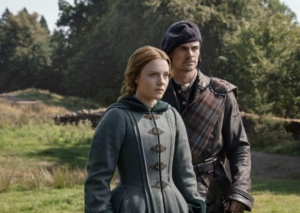
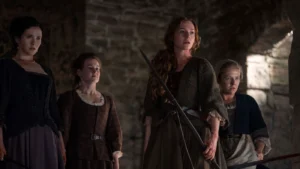
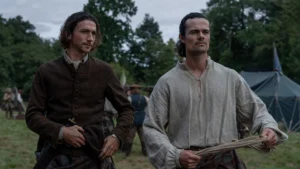
I think “Something Borrowed” might be my favorite episode of Outlander: Blood of My Blood Season 1. There are things I can pick at, particularly with Henry and Julia, whose story feels like it ran out of dramatic runway before the finale was ready to resolve it. I also wanted a little more clarity surrounding exactly what the fiery crosses were calling Brian toward. But those issues are surrounded by so much terrific character work, beautiful direction and confident storytelling that I found myself completely wrapped up in the episode.
What I loved most is how frequently the finale turns its big plot mechanics into small human choices. Jocasta has to decide whether her resentment toward Ellen matters more than her sister’s happiness. Murtagh has to decide what loving Ellen actually means once he knows she will never choose him. Brian has to decide how far he is willing to go to protect the life he and Ellen have chosen. Even Ned Gowan, probably the smartest guy in the room, reaches the point where Ellen’s disappearance has completely destroyed the MacKenzies’ plan and simply asks Colum where they go from here. Even small moments like Murtagh saying he is going hunting and won’t be back until early the next morning (such great college roommate vibes here); or Ellen suppressing an internal squeal of joy when Brian is “revealed”, or when Brian and Ellen share the morning wrapped in the Fraser tartan – just small moments that make the characters feel lived in and not engineered.
That humanity is the secret sauce of the episode. For all the weddings, escapes, killings, time travel and impending rebellion, “Something Borrowed” works because the characters rarely feel like pieces being moved around a board. Their choices create the turns.
Brian Killing Malcolm Actually Works
The moment that genuinely shocked me was Malcolm discovering Ellen and Brian during their escape. I expected Malcolm to learn the truth eventually, but I did not expect the story to end his relationship with Ellen by having Brian kill him.
The reason it works for me is the construction of the scene. Brian does virtually everything he can to avoid killing Malcolm. Malcolm discovers Ellen disguised as a servant and immediately understands what has happened. His humiliation turns into rage, but Brian does not meet that rage at the same level. He asks Malcolm to let them pass. Ellen tries to reason with him. Brian continues trying to de-escalate the confrontation, and eventually he is willing to beg Malcolm for Ellen’s sake.
That progression is important because the writers have spent the season establishing Brian as a fundamentally compassionate man. If he simply pulled his sword and eliminated Ellen’s inconvenient fiancé, the plot might arrive at the same destination, but Brian would feel like a different character. Instead, the scene keeps applying pressure while removing his alternatives. Malcolm will not let them leave, he will not listen to Ellen, and he eventually raises his sword to kill Brian. Brian’s violence becomes the final response available to him rather than the first one he chooses.
There is also an interesting contrast between Malcolm and Murtagh running underneath the entire episode. Both men love Ellen, and both men have to confront the fact that she loves Brian. Murtagh eventually accepts her choice and helps Brian reach her. Malcolm cannot accept it and attempts to prevent them from leaving. Murtagh’s love ultimately becomes an act of release, while Malcolm’s becomes possessive once the future he imagined is taken away from him.
That makes Malcolm’s death more meaningful than a shocking way to clear the romantic obstacle. Brian and Ellen finally choose each other completely, but the story refuses to make that choice painless. Their freedom immediately has blood attached to it.
This Week’s Blood Of My Blood Coverage
- Recap & Reaction Podcast: Blood of My Blood Episode 1.10 Review: “Something Borrowed” | This Was…Excellent.
- Explainer: Who Is Malcolm Grant in Blood of My Blood? His Story, Ellen, and What Happens in the Finale
Get The Droughtlander Dispatch
Smart Outlander and Blood of My Blood updates — episode coverage, podcast drops, character guides, history explainers, and the stories worth remembering.
Murtagh Understands What Loving Ellen Actually Means
The Murtagh and Ellen scene in the bothy may be my favorite scene of the entire episode because the writers trust the history between these characters. Everybody involved understands the emotional situation, so nobody needs to explain it to us.
Murtagh still loves Ellen. Ellen knows he loves her, and Murtagh knows she understands. When he gives her the boar’s tusk bracelets he made for her, the object carries much of the emotional weight. Those bracelets belonged to a future Murtagh once imagined for himself. Giving them to Ellen anyway becomes his way of letting go of that future without pretending his feelings have disappeared.
His request that he be allowed to find happiness in Brian and Ellen’s happiness completes the movement of his character across the season. Murtagh began by wanting Ellen for himself. He ends the season wanting Ellen to have the life she has chosen, even though that life does not include him in the way he once hoped.
That is why the Malcolm comparison becomes so effective. The finale gives two men essentially the same emotional problem and lets their responses reveal who they are. Malcolm believes losing Ellen means something has been taken from him. Murtagh eventually understands that loving Ellen means respecting what Ellen wants. The episode does not need to announce that distinction because the characters dramatize it.
The Wedding Switcheroo Pays Off the Setup
I could tell something was wrong with the wedding almost immediately. Opening on the ceremony, hiding the bride beneath the veil and then jumping backward to the previous day makes the manipulation pretty obvious. The episode wants us asking who is underneath that veil.
Normally, withholding information that aggressively can become irritating because the story is essentially announcing that it has a trick coming. In this case, the trick earns its place because the identity of the bride is only part of the payoff. What matters more is the chain reaction Ellen’s disappearance creates.
Colum has promised the Grants a marriage alliance, and suddenly he has no bride. The political solution he has spent the season constructing collapses because Ellen finally exercises the agency everyone has been denying her. I particularly love Ned’s reaction once they discover she is gone. Ned is normally the person with the answer, yet even he looks at Colum and asks where they go from here. It is a tiny moment, but it tells us how thoroughly Ellen has disrupted the board.
The answer, hilariously, is Dougal.
There is something wonderfully appropriate about Dougal being swallowed by the same marriage machinery he has helped perpetuate throughout the season. The MacKenzies still need to honor the alliance, Maura is available, and suddenly Dougal discovers that clan obligation can make decisions about his life too. Maura then completely overturns the sexual dynamic we expect from him. Dougal is accustomed to being the confident one, but Maura wants to consummate the marriage immediately and has absolutely no problem making it clear that their “business” is not finished when Dougal thinks it is.
It is funny because it is character-specific. The episode does not stop for a comedy sketch; the humor grows directly out of putting Dougal MacKenzie in a situation where someone else is driving.
Jocasta Finally Gets Something She Needed From Ellen
Jocasta is another example of the finale paying off something that has been sitting underneath the season. Her jealousy toward Ellen has always been visible, but “Something Borrowed” finally gets underneath it. Ellen once participated in arranging Jocasta’s marriage and helped make an enormous decision about her sister’s life without giving Jocasta the freedom Ellen is now fighting to preserve for herself.
Once Ellen recognizes that and apologizes, the dynamic between them changes. Jocasta does not suddenly become a different person, nor does the episode pretend years of resentment never existed. What changes is that Ellen finally sees the wound underneath the resentment.
That makes Jocasta’s decision to help her much more satisfying. She stands up for Ellen against Maura, helps facilitate the escape and ultimately puts her sister’s chance at love ahead of her own bitterness. Her jealousy can coexist with her love for Ellen because those feelings were never mutually exclusive in the first place.
That complexity is exactly why these little human scenes are so effective. Jocasta does not help Ellen because the plot suddenly needs a helpful sister. She helps because Ellen finally gives her the acknowledgment she has been missing, and Jocasta knows better than almost anyone what it means to have your future decided for you.
Unlock the rest of this article.
Join the NerdClan — or sign in if you are already a member — and the rest of this article will unlock right here on this page. This entry requires Associate Producer or higher.