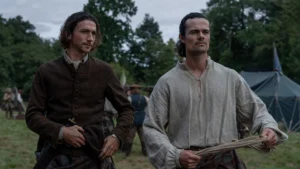
Our Blood of My Blood Episode 1 review breaks down “Providence,” a premiere that succeeds because it remembers Outlander is not just mythology and family trees. It is grief, ritual, longing, Scotland, dangerous romance, and people being forced to make choices while history closes around them.
Red Jacob’s death turns Castle Leoch into a political pressure cooker, Ellen MacKenzie suddenly discovers how little protection she has without her father, and Brian Fraser arrives with just enough familiar Fraser energy to make their first connection work without feeling like a Jamie impression. Then the premiere drops Julia and Henry Beauchamp into the equation and reveals that this prequel is not merely filling in Jamie’s side of the family tree. It is reaching directly into Claire’s mythology too.
Full spoilers for Outlander: Blood of My Blood Season 1 Episode 1, “Providence,” follow.
Watch Our Blood Of My Blood Episode 1 Recap & Reaction
Listen To The Podcast
Subscribe To Outlander Cast
APPLE PODCASTS YOUTUBE SPOTIFY
Starting Blood Of My Blood?
Visit our Blood Of My Blood Season 1 Episode Guide for every recap, review, explainer, and fan reaction from the season.
Our Blood Of My Blood Episode 1 Ratings
Mary’s Kilt Rating: 5.0 / 5
Blake’s Kilt Rating: 4.1 / 5
BomB Impact: Mary — 3.0 / 5 | Blake — 4.0 / 5
Blood Of My Blood Episode 1 Recap: What Happens In “Providence”?
“Providence” opens with the death of Red Jacob MacKenzie and immediately turns mourning into politics. Castle Leoch is grieving, but grief does not stop the succession problem. With no clearly named heir, Colum and Dougal begin occupying very different positions inside the family struggle, while Ellen discovers that her value to the clan is rapidly shifting from daughter to political asset.
Brian Fraser enters that unstable world through his connection with Ellen, and their first encounters begin establishing the romance that will eventually lead to Jamie Fraser. But the episode’s largest turn comes from the Beauchamp side of the story. Julia and Henry are revealed in the twentieth century before the stones pull their story into the past, making it clear that Blood of My Blood intends to complicate Claire’s family history as aggressively as Jamie’s.
Blood Of My Blood Episode 1 Review
“Providence” works because it remembers that Outlander is not just plot. It is mood. It is grief. It is ritual. It is longing. It is a camera staying on a face long enough for the ache to arrive before somebody explains what we are supposed to feel.
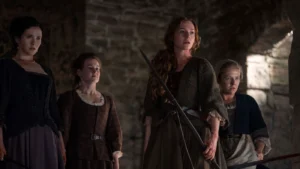
For long stretches, this premiere gets that exactly right. It does not begin with empty franchise fan service or a frantic roll call of familiar names. It begins with death. Red Jacob’s body is being washed, the MacKenzie house is already destabilizing, and Ellen is forced to understand in real time that whatever protection her father once provided has vanished with him.
That is a much smarter opening than a prequel automatically earns, because the episode starts with pressure instead of recognition.
Scotland Feels Like A Character Again
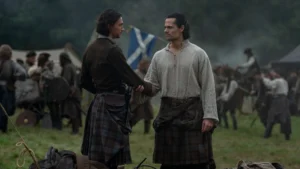
That pressure is also why “Providence” feels closer to early Outlander than a late-stage brand extension. Scotland matters again, and not merely as wallpaper. The rituals surrounding Red Jacob’s body, the singing, the corridors of Castle Leoch, the tartan, the damp stone, and the sense that grief and politics are occurring inside the same physical space give the premiere its bones.
This franchise has always been strongest when setting participates in the drama. Scotland is not simply where the characters happen to be. Its history, landscape, rituals, families, weather, superstition, and political structures change what choices are possible. “Providence” understands that, and the episode feels richer because the world itself is applying pressure.
When Outlander drifts too far from that relationship between place and story, some of the literal and figurative magic disappears. This premiere knows exactly what returning to Scotland gives it.
Jamie Payne’s Direction Makes Ellen And Brian Work
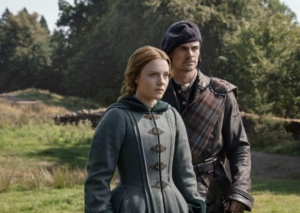
The first meeting between Ellen and Brian should probably be corny. On paper, the ingredients are sitting dangerously close to prequel-romance cliché: a hidden encounter, immediate attraction, the bridge, and the knowledge that these two people are eventually going to become the parents of Jamie Fraser.
Jamie Payne’s direction keeps the sequence on the right side of that line. The partial views, the framing, the lighting, and the sense that Brian and Ellen are discovering something before either of them fully understands what it is create mystery around the attraction rather than simply announcing that destiny has entered the room.
The camera frequently does more work than the dialogue, and in a romance like this that is exactly what we need. Brian and Ellen become more believable when the episode allows us to watch them reacting to one another rather than forcing them to explain the significance of the connection.
Bear McCreary Makes Blood Of My Blood Feel Like Outlander
Bear McCreary remains one of the secret weapons of this franchise because the music carries memory. The score does not merely tell us a scene is emotional. It reconnects the audience to a musical language we already associate with Scotland, longing, danger, family, and the strange pull this world has always exercised over its characters.
That is especially valuable in a premiere that has to introduce younger versions of people we know while convincing us that the new characters are more than references. The music tells your body that you are back inside an Outlander story before the story has completely proven it intellectually.
That emotional familiarity buys the episode some trust, but the premiere mostly earns the rest.
The Casting Works Because The Characters Feel Familiar Without Becoming Impressions
The casting is another major reason “Providence” survives the enormous amount of franchise baggage attached to it. Brian and Ellen carry behavioral and visual echoes of the family we know, but the episode does not simply ask the actors to cosplay Jamie and Claire.
Brian feels spiritually connected to Jamie without becoming a younger-man impression of Sam Heughan’s performance. Dougal may be even more immediately legible. He arrives physical, impulsive, proud, volatile, and faintly dangerous, and the characterization works because he starts making choices almost immediately.
That matters more than resemblance. A prequel character becomes interesting when we can recognize the emotional DNA without feeling as though the production is pointing at a museum exhibit labeled “THIS BECOMES THE PERSON YOU KNOW.”
Where “Providence” Gets Too Talky
The premiere’s biggest weakness is exactly what I was worried about going in: there are stretches where the dialogue starts doing work the drama should be doing. A premiere obviously needs exposition. We have families, succession rules, political relationships, history, and two timelines to establish.
The problem is not information. The problem is when characters begin sounding like delivery systems for that information. There are moments where you can feel the script making sure we understand the family tree or clan dynamic instead of allowing desire, conflict, and behavior to make the information memorable.
Once the audience can see the gears moving, the spell breaks a little. It does not destroy “Providence,” but it keeps the hour from reaching the level of its best visual and atmospheric material.
The Ellen And Brian Bridge Scene Has A Missing-Time Problem
The same issue appears in the connective tissue around Ellen and Brian’s bridge sequence. Emotionally, I understand what the episode is selling: they meet, something sparks, and time almost stops because neither person wants the encounter to end.
I will absolutely buy soul recognition in Outlander. That is not the problem.
The practical timeline becomes fuzzy enough that it starts feeling less like purposeful romantic compression and more like a scene may simply be missing. Ellen appears to be gone long enough that the audience starts asking logistical questions the episode probably does not want us asking.
That distinction matters. Withholding information should increase tension or curiosity. Missing connective tissue merely makes the viewer wonder whether the story forgot to account for something.
Who Are Julia And Henry Beauchamp?
The Beauchamp reveal is the moment “Providence” expands the entire premise. Julia and Henry are not random twentieth-century characters being added to create another romance. They are Claire Beauchamp Randall Fraser’s parents, which means their arrival in the eighteenth century potentially changes the way we understand Claire’s family history and her relationship with time travel itself.
That is where the premiere’s BomB Impact becomes genuinely interesting. Filling in Brian and Ellen’s story gives us more context for Jamie. Pulling Julia and Henry into the stones threatens to alter the architecture of Claire’s mythology.
That is exactly the kind of risk a prequel should be willing to take. Simply coloring inside the margins of facts we already know is not enough to justify ten hours of television.
Who exactly are Julia and Henry Beauchamp?
The premiere intentionally drops two enormously important names into the story without stopping to explain every implication. We broke down their relationship to Claire, what the original Outlander established about them, and why their appearance changes the scale of the prequel.
Did Julia And Henry Travel Through The Stones?
Yes: “Providence” reveals that Julia and Henry’s story becomes entangled with the standing stones and the eighteenth-century timeline. What the premiere does not completely explain is the full mechanism of the crossing or what their presence means for the time-travel rules the franchise has already established.
That uncertainty is useful at this stage because it gives the season a real mythology question instead of simply answering everything on arrival. But the series will eventually have to distinguish mystery from looseness. The more Blood of My Blood changes what we know about Claire’s family, the more important it becomes for those changes to feel intentional rather than convenient.
Want the full time-travel breakdown?
We broke down what Episode 1 shows us about Julia and Henry’s crossing, how it connects to Craigh na Dun, and the biggest questions it creates about the existing Outlander rules. Read: Did Julia And Henry Travel Through The Stones? →
Why The Beauchamp Reveal Gives This Prequel A Reason To Exist
This is the bomb under the table. Once Julia and Henry enter the twentieth-century story and then become part of the eighteenth-century one, Blood of My Blood stops being a prequel solely about Jamie Fraser’s parents.
Now the series has the potential to alter how we understand Claire’s mythology too, and I admire the danger in that choice. A prequel should not exist just to tell us how known facts happened. The best version should make the original story feel different because of what we now understand about the people and history underneath it.
“Providence” may ultimately make mistakes with that responsibility. But choosing to take the risk is far more interesting than spending a season politely illustrating a family tree.
Why Blood Of My Blood Episode 1 Works
“Providence” is not a perfect premiere, but it is a promising one because it understands the emotional weather of Outlander. Scotland matters. Grief works better than lore as an opening hook. Ritual gives the world texture. Brian and Ellen feel like people before they feel like historical obligations, and the Julia and Henry reveal creates a genuine reason to wonder what this prequel can add to the franchise.
When the episode stumbles, it stumbles in recognizable ways: too much explanatory dialogue, some connective tissue that could be cleaner, and occasional moments where the franchise seems slightly too pleased that we recognize what it is showing us. But those weaknesses do not erase what works.
For long stretches, I stopped feeling like I was watching a prequel I was supposed to politely appreciate.
It felt like Outlander again.
More Blood Of My Blood Episode 1 Coverage
- Who Are Julia And Henry Beauchamp? — Claire’s parents, their place in the existing mythology, and why the premiere changes their story.
- Did Julia And Henry Travel Through The Stones? — what the premiere reveals about their crossing and the time-travel questions it creates.
- Where The Clans Stand This Week — our Episode 1 fan reaction and community temperature check.
Keep going through Blood Of My Blood.
Our Season 1 Episode Guide connects every recap, review, explainer, and fan reaction, while the complete Blood Of My Blood guide connects Brian, Ellen, Julia, Henry, and the prequel into the larger Outlander ecosystem.
Blood Of My Blood Season 1 Episode Guide →
Complete Blood Of My Blood Guide →
Outlander Cast Podcast Hub →
Tell Us Your Rating
What is your Kilt Rating for “Providence”? Drop your BomB Impact too, and tell us whether the premiere immediately felt like real Outlander to you or whether you were still waiting for the prequel to prove itself.
You can also send us a voicemail at SpeakPipe.
Pull up a chair.
The Nerd Clan is where the deeper Mary & Blake conversation lives: bonus podcasts, extended analysis, book clubs, community discussion, and all the Outlander nerdery that keeps going after the credits roll.
Slàinte Mhath. 🏴