
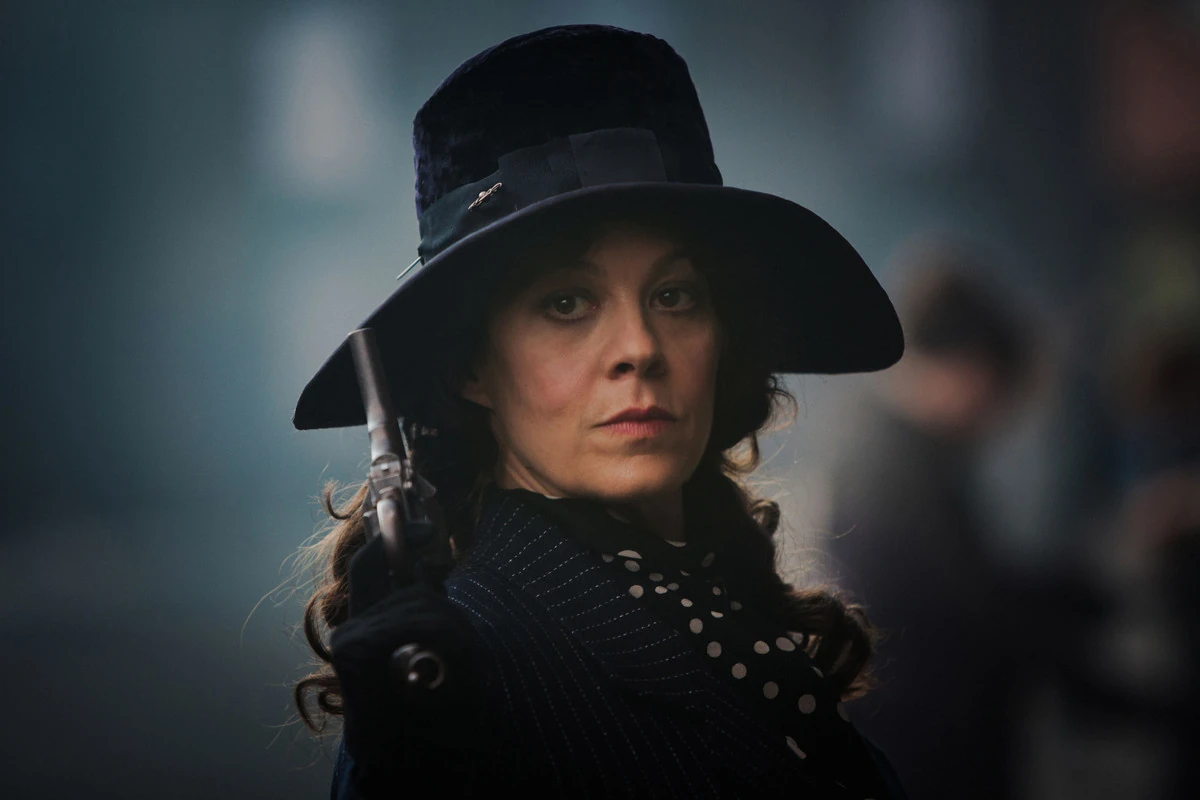
Season 1 spoilers follow. This article covers Polly Gray’s leadership and its consequences through the first six episodes of Peaky Blinders, without revealing later-season developments.
Polly Gray was running the Shelby family’s betting business while Tommy, Arthur and John were fighting in the First World War. When the brothers return, Tommy rapidly becomes the strategist behind the gang’s expansion, but Polly does not suddenly become a ceremonial relative. She knows the books, understands the neighborhood, has negotiated survival through the war, and remains one of the few people who can tell Tommy that his plans are dangerous.
That’s the central power struggle hidden inside the first season. Tommy arrives believing he can turn the world into a system of opportunities. Polly has spent years making sure the family survives the things that happen when systems fail. And the way Helen McCrory plays those two ideas against one another is one of the show’s great pleasures.
Who Ran the Shelby Business While Tommy Was Away at War?
Polly Gray handled the family operation during the war. In a 2013 Den of Geek interview conducted by Louisa Mellor, series creator Steven Knight explained why that mattered to his conception of Peaky Blinders. Women frequently managed households and illegal enterprises while men were away fighting. When the men returned, they found capable women already exercising authority, and that created friction. Knight’s Polly was a woman who had run the business extremely well.
Helen McCrory described Polly in similar terms during a later Den of Geek interview. She emphasized the hard work and practical intelligence of working-class women, their role in keeping communities functioning, and the tendency for the returning men to expect their places back. That’s a revealing starting point for a character routinely described as the Shelby matriarch. The title sounds familial; the job she performed was operational.
Why Polly’s Authority Is Different from Tommy’s
Tommy understands leverage. He is brilliant at recognizing when an opponent desperately needs something and at giving that need a price. The stolen guns demonstrate his ability almost immediately: an accident that could bring the gang down becomes an opportunity to negotiate with the state.
Polly’s intelligence comes from another direction. She knows whose family will be affected by the decision, who will carry the loss, which secrets can be safely kept, and what happens if the person at the center of a plan is also the person most likely to be hurt by it. Tommy measures a move by the position it creates. Polly measures it by the damage the family must absorb. In a story that keeps confusing protection with control, that is an essential distinction.
This is why the pilot’s debates about disposing of the weapons matter. Polly can see what Tommy’s ambition might attract before he can be persuaded to care about the human consequences. She’s not automatically correct in every dispute, and neither is he. The show is good because it forces two kinds of competence into rooms where only one person can decide what happens next.
How Helen McCrory Makes Polly the Center of a Scene
McCrory often gives Polly authority without asking the camera to imitate the showier ways men claim power. She can turn a domestic conversation into a negotiation simply by withholding agreement, remaining composed, or allowing someone else to exhaust their argument. Her presence changes the meaning of Tommy’s confidence. He knows he needs her approval even when he is already preparing to ignore her advice.
In McCrory’s own account, Polly’s initial priority is family stability. That is an acting objective, and it clarifies why a woman who has dealt effectively with the practical demands of running the business would be so threatened by risks she did not choose. McCrory also talks about Polly’s desire to maintain her place within the family. The two impulses coexist. Polly protects people and understands that retaining authority is part of being able to protect them.
My favorite part of this dynamic is that Knight rarely lets Polly become a simple voice of reason. Her hard decisions can resemble Tommy’s. She threatens, bargains, and insists on obedience when she believes the family is at risk. The difference is not a tidy moral hierarchy; it’s the history each character brings to the room.
What Episode 2 Reveals About Polly and Inspector Campbell
Episode 2 puts Polly’s power in direct conversation with the official power represented by Inspector Campbell. She’s comfortable confronting a man whose authority depends on the government’s resources and the threat of force. She has survived long enough in Small Heath to know that a uniform does not make a person trustworthy, and she recognizes the danger of men who mistake their orders for righteousness.
That gives the scene a fascinating triangle even when Tommy isn’t speaking. Campbell has formal authority; Tommy has the stolen guns; Polly has the knowledge of what the family can survive. The episode makes all three forms of power feel real. Our Episode 2 Knee-Jerk Reaction examines how Tommy converts problems into assets. Polly’s response is the necessary counterweight: she knows some costs cannot be converted back into profit afterward.
Why Polly Opposes Some of Tommy’s Family Decisions
John Shelby’s desire to marry Lizzie Stark gives the season a useful test. Tommy takes it upon himself to decide whether his brother’s partner is acceptable, and the family treats John’s possible marriage as public business. The arrangement that ultimately connects John with Esme Lee serves Tommy’s larger ambitions, but it also demonstrates how easily the family’s private lives become instruments of strategy.
Polly participates in the family power structure, even when she objects to particular choices. That complicity is important. She has learned to protect the family through authority because she has seen what happens when it has too little. The show lets us see the limits of that habit: defending someone and deciding for them can begin to look disturbingly similar. Our Episode 4 KJR follows the same question through John’s marriage and Tommy’s warning to Finn.
What Polly’s Children Reveal About Her Need for Control
Late in Season 1, Polly tells Ada that her own children were taken by the authorities years earlier. That revelation changes how her constant attention to the family feels. Her history includes a catastrophic failure of the institutions that claim to preserve order, and it helps explain why she has built so much of her identity around keeping the Shelbys together.
I wouldn’t use that history to excuse every decision Polly makes. It is something more valuable: a motive that makes the behavior legible. When she worries that Tommy is leading the family toward disaster, she isn’t speculating abstractly. She remembers what it feels like to lose control of the people she loves. We’ve covered the factual details separately in What Happened to Polly Gray’s Children? This article focuses on how the loss shapes her leadership.
Polly and Grace: Two Women Trying to Define Their Own Authority
Grace Burgess begins the season with a role created by Campbell and discovers feelings that no longer fit the mission. Polly’s place is almost the inverse: she’s deeply embedded in the family organization and must negotiate the arrival of a woman who could change Tommy’s behavior in ways she cannot predict.
Their eventual confrontation is so compelling because neither woman is simply there to react to Tommy. Polly sees the structural threat that Grace represents; Grace recognizes that the family possesses secrets and loyalties that her official badge will never earn. McCrory and Annabelle Wallis make their conversation a negotiation about belonging, honesty, and authority. The tension comes from watching each woman assess what the other can do.
This is the sort of character scene Peaky Blinders deserves credit for. The dialogue is political even when it is personal, and personal even when the subject is the gang’s survival. Our Season 1 finale analysis digs deeper into how the staging and performances make that encounter work.
Why the Show Needed Polly Before It Needed Tommy’s Empire
When a drama begins with a charismatic gangster on a horse, it is tempting to read every later act as evidence that the organization exists because he created it. Season 1 quietly contradicts that idea. The Shelby world was functioning before Tommy returned from France. His talents reshape the family’s future, but they depend on relationships, labor and institutional memory that already existed.
That’s why Polly is indispensable. She makes the world feel older than its protagonist. She represents years of compromises, acts of loyalty, and decisions made without the luxury of appearing heroic. Tommy can build an empire on that foundation. Whether he remembers who built the foundation becomes one of the show’s most productive tensions.
Polly Gray: Season 1 Quick Answers
Who plays Polly Gray? Helen McCrory plays Polly, Tommy Shelby’s aunt and a central figure in the family business.
Did Polly run the business during World War I? Yes. The show’s background and Steven Knight’s description establish that she helped maintain the operation while the brothers fought.
Why does Tommy listen to Polly? She understands the finances, the family’s relationships, and the consequences of the decisions he makes.
Who are Polly’s children? Season 1 introduces the loss of Sally and Michael; their story is explained in our dedicated guide.
Does this article reveal later seasons? No. It focuses on the leadership and character dynamics established by the Season 1 finale.
Keep Exploring the Shelby Family
Follow all six episodes in our Season 1 guide, our pilot breakdown, the Episode 2 power struggle, and the Grace betrayal explainer.
Sources and reporting: Steven Knight interviewed by Louisa Mellor, Den of Geek (2013); Helen McCrory interviewed by Den of Geek (2014). The analysis of Season 1’s writing, performances and character construction is original Mary & Blake commentary.