
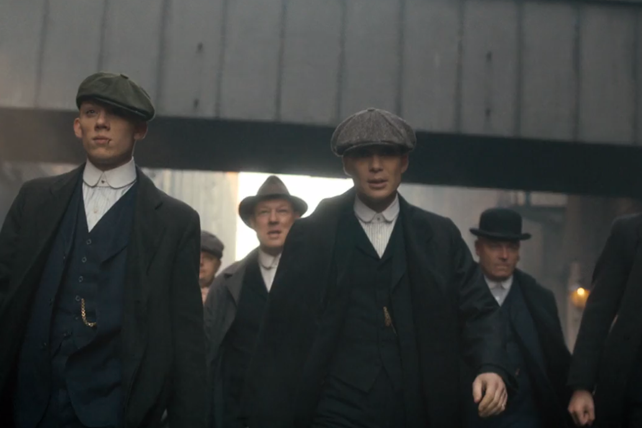
Spoiler warning: This review covers the entire first season of Peaky Blinders, including the events and ending of Episode 6.
In Peaky Blinders Season 1 Episode 6, Tommy Shelby finally defeats Billy Kimber, establishes the Shelby family as a major force in the racecourse betting business, reunites with Freddie Thorne, and outmaneuvers Inspector Campbell. His campaign to transform a local Birmingham gang into an increasingly legitimate organization has succeeded. Yet Tommy’s victory comes with Danny Whizz-Bang’s death, the discovery that Grace betrayed him, and the painful realization that his ability to control events offers little protection against emotional loss.
What makes Steven Knight’s first-season finale so effective is the way it transforms the fulfillment of Tommy’s ambitions into an examination of their consequences. Tommy has spent six episodes anticipating threats, manipulating appearances, and treating information as the most valuable commodity in Birmingham. His greatest strategic vulnerability comes from the one person he has allowed himself to love, while the death of a fellow soldier forces him to confront a responsibility that business success can never resolve.
I absolutely love how Knight brings these ideas together. The finale opens with a demonstration of Campbell’s hypocrisy, builds toward a beautifully constructed confrontation between Polly and Grace, and interrupts an anticipated gangster showdown with Ada Shelby carrying her baby into the street. Beneath those moments lies another impressive piece of storytelling: the pilot’s major dramatic ideas return with different meanings. Tommy has achieved the future he imagined for the Peaky Blinders, and whether he can find happiness inside it is a far more complicated question.
Peaky Blinders Season 1 Episode 6 Recap: What Happens in the Finale?
Campbell begins the finale recovering from Grace’s rejection of his marriage proposal in increasingly ugly fashion. While he visits a brothel and sends Grace a letter condemning her relationship with Tommy, the Shelby family prepares to move against Billy Kimber. Tommy reveals that the attack will happen that day, with the Lees allied to the Shelbys through John’s marriage to Esme. His plan is to confront Kimber’s men at Worcester and replace their organization with a legitimate racecourse betting operation.
Polly tells Ada about the authorities taking away her children, Sally and Michael, and explains the survival philosophy behind the family’s ruthlessness. Freddie is freed, and the family begins repairing its divisions. But Kimber learns about the planned attack and comes directly to Small Heath. Tommy realizes Grace, whom he trusted with the attack’s date, has been working for Campbell. With the Lees already heading toward Worcester, the Shelbys are outnumbered at home.
Campbell orders the police to stand down, hoping the rival gangs will destroy one another. Ada arrives with her baby and tries to interrupt the confrontation. Kimber fires, Tommy is wounded, and Danny Whizz-Bang is killed. Tommy shoots Kimber and wins, leaving Campbell to face the failure of his strategy. Grace prepares to leave Birmingham, Tommy struggles with the decision of whether to pursue her, and the final sequence ends with Campbell confronting Grace at the station and a gunshot that leaves her immediate fate uncertain.
Campbell’s Hypocrisy Is the Perfect Way to Begin the Finale
What a reprehensible bastard Chester Campbell has become. Sam Neill has been superb throughout this first season, but the opening sequence may be the clearest expression of the character’s moral corruption. Campbell visits a brothel after Grace rejects him, and his interaction with a young sex worker shows how quickly wounded pride can become an excuse for cruelty.
The sequence becomes particularly powerful through its editing. As Grace receives Campbell’s letter and gets dressed, Knight and director Tom Harper intercut her actions with Campbell’s encounter. Grace buttons her blouse while the sex worker begins undressing and moves toward Campbell, creating an arresting visual relationship between women whose circumstances differ enormously. Both have become objects of Campbell’s judgment and his desire for control.
His letter condemns Grace for betraying the honor associated with her father and her upbringing. Campbell treats her love for Tommy as a disgrace, using morality and professional loyalty to justify his disgust. At the same time, he acts aggressively toward the sex worker and physically hurts her, only acknowledging the damage after he has crossed the line. The sequence exposes the distance between Campbell’s stated values and his actions.
Robert McKee’s principles of characterization are useful here because the truth of a dramatic character becomes visible through decisions made under pressure. Rejection has injured Campbell’s sense of authority, and his response reveals the violence beneath his cultivated righteousness. Most disturbing is the apparent sincerity of his outrage. He can condemn Grace while rationalizing his own behavior, treating moral judgment as another privilege of power.
Knight has arranged this as a reversal of Campbell’s introduction in the pilot. His original address to the Birmingham police condemned prostitution, exploitation, and the supposed moral sickness of the city. He positioned himself as the righteous authority capable of restoring order. By Episode 6, the man who promised to cleanse Birmingham participates in the exploitation he once denounced. The images let the audience recognize the contradiction long before he could admit it.
Why Campbell’s Mirror Speech Almost Works
Tommy’s later confrontation with Campbell at the brothel is enormously satisfying. Campbell has approached their conflict as a struggle between law and criminality, and Tommy now has the moral advantage of catching his enemy in the world he claims to despise. Then Campbell explicitly describes himself and Tommy as opposing reflections of the same man, and I found myself wishing Knight had trusted the audience a little more. Their shared methods have been evident through six episodes of intimidation, manipulation, and ruthless calculation.
The conversation grows considerably stronger when Campbell observes that men like them inspire hatred and fear, and that any love they receive will come at a price. That idea gives the comparison emotional consequence. Campbell recognizes that acquiring power through intimidation can destroy the conditions necessary for genuine intimacy. Tommy responds by reminding him that he has his family, establishing a meaningful difference in their loyalties: Campbell is devoted to institutions and professional status, while Tommy is devoted to people whose lives he believes he is protecting.
Campbell’s prediction that Tommy’s heart will be broken before the day ends creates a dramatic clock. He understands something about Grace’s betrayal that Tommy does not yet know, and he uses that advantage to turn their exchange into a threat. The speech may explain its central metaphor too heavily, but its warning supplies emotional suspense to everything that follows.
Polly Gray Explains Why the Shelbys Believe They Must Become Dangerous
Polly’s conversation with Ada about her missing children reveals one of the season’s most important convictions. She recalls Sally and Michael, including their ages and the circumstances in which the authorities took them away. An incident involving stolen hotel sheets led police to discover her illegal gin still, and her children were removed without Polly ever learning where they had gone.
Helen McCrory combines grief and bitterness with a determination to prevent such a loss from happening again. Polly understands her vulnerability as something imposed by institutions capable of breaking apart an ordinary family without meaningful resistance. Tommy’s ambition creates danger, but it also gives the Shelbys the strength to resist the powerful people who once operated over them with impunity.
Polly’s belief that survival demands ruthless strength grows from a specific emotional wound and shapes the choices she makes. Her worldview also complicates Campbell’s account of criminality: he sees the Shelbys as the city’s disease, while Polly sees their power as protection against a society that has already exploited her. The contradiction is essential to the family’s moral universe.
The disclosure prepares us for Polly’s confrontation with Grace. She has spent years protecting the family that remains to her, and Grace’s betrayal feels like another intrusion by the authorities into its most vulnerable relationships. Polly’s anger has a history, which is why her threat carries so much more weight than simple jealousy.
Tommy and Grace: How Love Becomes His Greatest Strategic Vulnerability
Tommy has spent this season showing an extraordinary talent for controlling information. He understands which details can be shared, with whom, and at what moment. His campaign against Billy Kimber depends upon that discipline, making his decision to confide in Grace one of his most consequential mistakes.
Earlier, Tommy marked the date of his operation with a black star and allowed Grace to understand its meaning. Yet when the finale begins, he has withheld the timing from much of his own family. The person with whom he shared the most sensitive information is also the person whose true loyalties he never completely understood. His attachment to Grace altered his habitual judgment, and the exception became the opening through which Kimber could attack.
This is convincing character-driven causality. Meaning, a character’s beliefs generate decisions whose consequences challenge the underlying dramatic argument. Tommy believes managing information can protect the family. Grace’s betrayal demonstrates that the emotional life he has been trying to contain will affect those plans regardless of his intentions.
Their quiet conversation before the attack is heartbreaking because Tommy genuinely imagines a shared future. He discusses a legitimate company and the possibility of closing down some of the family’s criminal activities. There is something wonderfully affecting about this intimidating gangster growing awkwardly earnest while describing a limited company to the woman he loves. He wants to create a life in which the man he has become could belong beside her.
His statement that he and Grace are alike echoes Campbell’s earlier comparison to Tommy, but it comes from a different emotional place. Campbell sees similarity in fear and isolation, while Tommy sees it in recognition and intimacy. Grace knows that her feelings have become genuine, and she begins trying to confess before news arrives that Kimber’s men are approaching Small Heath. Her emotional deception has become an immediate strategic disaster.
I love Tommy’s choice to let Polly deal with Grace once he discovers the truth. He recognizes how dangerous his anger could become and keeps his distance. He also refrains from handing her directly to John’s fury. Love has already changed how Tommy behaves, even when the person he loves has endangered everything he has been building.
Polly Versus Grace: A Masterclass in Scene Construction
The confrontation at the Garrison may be the finale’s strongest dialogue scene, and Helen McCrory and Annabelle Wallis are terrific together. Knight builds it through changing tactics rather than allowing either woman simply to deliver a statement of her position. Each exchange modifies the balance of authority, emotional knowledge, and vulnerability.
Polly enters knowing Grace’s secret and understanding the danger it has brought upon the family. Grace invokes her authority as an agent of the Crown, hoping institutional power can end the confrontation. Polly refuses that framing because her life has taught her exactly how little protection official authority offers families like hers. Instead, she asks whether Grace truly loves Tommy, moving the conversation onto ground where Grace’s badge is useless.
For a brief moment the women share an understanding of Tommy’s wounds. Polly knows how difficult the war has made him to reach, and Grace has managed to get through to him. Their recognition produces something close to compassion before Polly turns that knowledge into a warning: Tommy may eventually forgive Grace, but Polly intends to remain an obstacle to their relationship.
Grace responds by suggesting that Polly’s hostility may also arise from fear of losing her place in Tommy’s life. It is a dangerous observation because it touches a truth Polly would rather keep protected. Polly has held the family together and knows Tommy intimately; Grace has reached part of him even his family struggles to access. Their confrontation operates simultaneously as an argument over betrayal, a defense of the family, and a competition over who understands Tommy.
Every significant exchange changes the emotional pressure. Grace starts with official authority; Polly counters with personal knowledge; both expose vulnerabilities; and each leaves knowing something unsettling about the other. It is a beautifully disciplined example of dialogue used to advance character and conflict in the same movement.
Billy Kimber’s Death: Why Ada Interrupting the Gunfight Is Such a Great Choice
The confrontation outside the Garrison announces itself through the language of a classic Western. Kimber’s men arrive in force, the Peaky Blinders prepare their weapons, and a narrow street becomes the battlefield. With the Lees headed toward Worcester, Tommy’s side is outnumbered, while the concealed machine gun promises a tactical advantage. The episode has spent six hours earning our anticipation of this showdown.
Then Ada Shelby arrives carrying her baby, and the dramatic terms change. She forces the armed men to recognize the suffering they are about to inflict on families and the neighborhood. Her intervention grows from the perspective she has developed through her relationship with Freddie and the conflicts with her brothers. She has seen the collateral damage created when men treat power as a justification for violence.
The external contest concerns control of bookmaking, but Ada’s presence raises the question of what kind of society that control creates. Her action challenges the pleasure the audience expects from a gangster victory, even while Knight retains the dramatic momentum of the confrontation.
Kimber fires, Tommy is wounded, Danny dies, and Tommy kills Kimber. The external story receives its resolution, but the victory’s emotional value has shifted. The sight of Tommy wounded and bleeding makes the cost immediate, while Danny’s death gives it permanence. Ada’s intervention ensures that we assess the victory through its consequences for the people involved.
Danny Whizz-Bang: The Finale’s Most Devastating Payoff
Danny’s death is heartbreaking because Knight established him as a man whose war has never truly ended. In the pilot he suffers a traumatic episode at the Garrison, and Tommy and Freddie restrain him with the understanding of soldiers who have experienced the same horrors. When Danny subsequently kills an Italian man, Tommy stages his execution to prevent retaliation while secretly allowing him to survive.
That deception is a demonstration of Tommy’s intelligence and compassion. He manipulates appearances to satisfy his enemies and save a friend. The finale brings Danny back into service and even allows the wonderful joke about a man who is supposedly already dead. We have been taught to expect Tommy’s ingenuity to produce another improbable escape.
Then Danny dies for real. The cleverness that once protected him cannot undo the bullet in the street, and Tommy must confront his responsibility for a friend who trusted his command. The pilot screenplay makes that loss especially painful: before his staged death, Danny asked Tommy to care for his wife and children, imagined ordinary working futures for his sons, and requested burial on a hill.
The finale transforms those earlier requests into an actual obligation. While the family celebrates its new position, Tommy remains with Danny and takes responsibility for his goodbye. That image may be the most revealing portrait of leadership in the season. Authority has brought Tommy power, but it has also made him the person who must live with the human cost of his choices.
Why the Season 1 Finale Works So Well
Knight’s finale works because its consequences emerge directly from characters established in the pilot. Tommy’s intelligence wins the business conflict while his emotional vulnerability exposes the limits of that intelligence. Campbell’s righteousness becomes the means through which his corruption flourishes, and Polly’s traumatic history explains the determination with which she protects the family. Ada’s compassion challenges the violence through which the family’s power is being secured.
These developments converge on the same day, creating the feeling of a season completing its argument. Tommy obtains the future he has promised his brothers while losing Danny, discovering Grace’s betrayal, and confronting the possibility that the methods protecting his family may also endanger them. The business question has an answer, but the emotional questions surrounding its leader have become more compelling.
Related Coverage
- Explainer: What Is the Soldier’s Minute in Peaky Blinders? Tommy Shelby’s War Trauma Explained
- Peaky Blinders Season Guide: Peaky Blinders Season 1: Episodes, Cast, Recap & Complete Guide
Get Peaky Blinders Updates
Get Mary & Blake’s Peaky Blinders Knee-Jerk Reactions, deep episode breakdowns, character studies, screenwriting craft, and the real history behind the Shelby world.
Unlock the rest of this article.
Join the NerdClan — or sign in if you are already a member — and the rest of this article will unlock right here on this page. This entry requires Associate Producer or higher.