
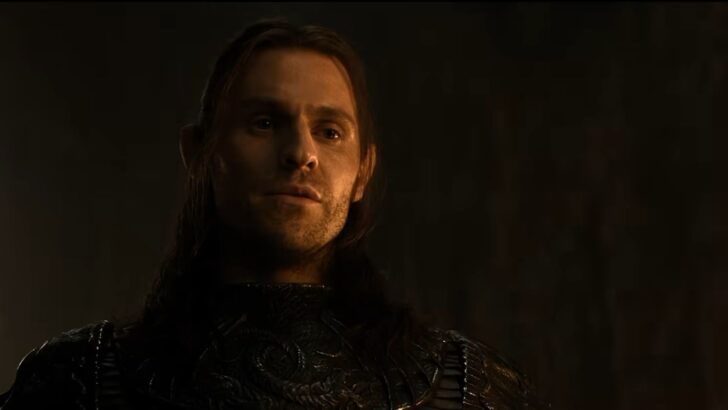
The Rings of Power Season 3 Episode 5, “The Lady of Lórien,” is another good episode, and Charlie Vickers remains by far its greatest asset. The series has become leaner and more confident whenever Sauron gives its many plotlines a shared dramatic center. This episode also discovers something equally valuable: personal relationships create vulnerability, vulnerability creates difficult choices, and those choices make the immense politics of Middle-earth feel human.
There are lingering problems, especially another helping of visual language borrowed from Peter Jackson’s film trilogy. Even so, Elrond’s history with Elros gives Númenor new emotional weight, and Galadriel’s reunion with Celeborn finally provides the cost of her obsession with Sauron.
What Happens in Rings of Power Season 3 Episode 5?
Sauron tortures Marnûkh to learn where Galadriel and Celeborn fled after Gundabad. The Orc gives up their destination when Sauron threatens his five children, only to learn that they have already been killed. Galadriel and Celeborn try to reconnect while traveling through the Greenwood, but Sauron’s continuing psychological hold on Galadriel helps turn their brief reunion into another separation.
In Númenor, Elrond and Gil-galad appeal to Pharazôn for help against Sauron. A flashback reveals how Elrond’s twin brother Elros chose mortality and the kingship of the island. Elsewhere Gandalf tries to persuade Pallando to oppose Sauron; their confrontation ends with Gandalf captured and carried with Rhûn’s armies. The episode closes with Celeborn in Sauron’s hands and Númenor on the brink of conflict.
Why the Relationship Material Is the Right Change of Pace
Episode 4, “Gundabad,” ended with the violence of Arondir’s death and a painful transformation for Theo. Episode 5 widens the emotional consequences rather than trying to compete with another shock every five minutes. It opens in torture, then lets its other major movements revolve around reunions, family history and promises that may be impossible to keep. This is a welcome development for a show that has sometimes mistaken the number of parallel storylines for narrative richness. Here the quieter material has consequences that carry all the way to the larger war.
The dramatic architecture is easier to appreciate if we ask what each major relationship is testing. Sauron and Marnûkh test whether a father can resist a tyrant who holds his children hostage. Elrond and Elros test whether a shared history can survive divergent visions of the future. Galadriel and Celeborn test whether love can withstand the long psychological reach of an enemy. Gil-galad and Elrond test whether military necessity justifies betraying a founding principle. Gandalf and Pallando test what happens when two people who share a mission disagree on whether victory is possible. That is a coherent pattern of pressure, and it helps the whole hour feel as though it belongs to one story.
Charlie Vickers Makes Sauron Terrifying
Goodness gracious, Charlie Vickers. His performance has evolved from Halbrand’s carefully concealed intentions through Annatar’s seduction to a Dark Lord who barely needs to disguise his appetite for domination. The consistency is Sauron’s belief that he alone understands the order the world requires. Vickers can turn an apparently polite question into a threat because the character already sees the other person’s freedom as a temporary inconvenience.
The interrogation of Marnûkh is the proof. Those enormous bass-heavy thuds as Sauron approaches make his footsteps feel physically inevitable, and then the scene gradually abandons physical intimidation for something much crueler. The minute he names Marnûkh’s children, he finds the prisoner’s deepest vulnerability. Sauron has already murdered them and intends to deny their father even the escape of death. The character’s objective—total obedience—is expressed through action and performance rather than exposition.
Elrond and Elros Give Númenor a Heart
Robert Aramayo’s work as both Elrond and Elros might be the episode’s most moving performance. Elros makes a hopeful choice to become mortal and establish Númenor; Elrond experiences that same choice as the beginning of a permanent loss. Neither brother is behaving irrationally. They simply inhabit different relationships with time, duty, grief and what makes a life meaningful.
Now the trip to Númenor means something beyond military negotiation. Elrond has arrived in the living legacy of a brother who believed humanity could build a beacon of hope, and Pharazôn’s court threatens to make his oldest fear come true. This is how backstory should function in a series: it changes the dramatic stakes of a scene in the present. The interaction with Isildur also becomes richer because it grows from a shared understanding of what loss can leave behind.
Robert Aramayo Gives Elrond a Brother—and a Permanent Wound
Let me spend a little more time on the opening flashback between Elrond and Elros, because I thought it was wonderful. It begins with Elrond drawing their mother. The image tells us that these brothers are already shaped by absence, even before the scene introduces another loss. Elros arrives with news of an island rising from the sea, and the exchange feels like two brothers teasing one another about the future. Elrond guesses that his twin has fallen for a mortal woman. Elros plays along for a beat before revealing that the Men of Númenor have asked him to be their king and that he has chosen a mortal life. Aramayo’s expression shifts as Elrond realizes what this means. A happy conversation about a new beginning becomes an argument about an unavoidable goodbye.
What I particularly love is how the scene refuses to make Elros’ choice seem frivolous. Elrond accuses him of trading immortality for a crown. Elros corrects him with the gentle absurdity of a scepter and then explains that he wants to serve friends who helped save Middle-earth. His hope is completely persuasive: he believes these people can build a beacon in the West. Elrond’s fear is just as persuasive. He has already lost family, and now the person closest to him is voluntarily accepting an end that Elrond will never be able to prevent. The actors—both of them Robert Aramayo—manage to make the difference between their worldviews feel almost physical.
The entire conversation is built around what the Gift of Men means to the two brothers. To Elros, mortality makes room for a journey into an unknown future. To Elrond, it promises the immediate suffering of the people left behind. When Elros speaks of the dawn that follows sunset, Elrond answers from the perspective of grief. The scene finds its power in that disagreement. Elros can mean every word of his promise that he will always be with Elrond, and Elrond can know that the literal promise will someday fail. There is no villain in the exchange. The heartbreak is a consequence of two good people making irreconcilable choices.
That is why bringing Robert Aramayo back as Elros is such a smart decision. It turns shared physical appearance into a storytelling mechanism. Pharazôn later remarks on Elrond’s resemblance to Númenor’s first king, but Elrond has arrived looking for evidence of his brother’s ideals in a kingdom that no longer resembles them. He sees Elros everywhere in the iconography of the place and almost nowhere in its behavior. The past is suddenly an active antagonist to his hopes. Númenor gets the emotional dimension it has needed since its introduction.
Galadriel and Celeborn Finally Explain Her Obsession
Galadriel has spent much of this series treating the pursuit of Sauron as the organizing purpose of her life. Celeborn’s survival forces us to confront what that purpose cost her. When he reveals that he saw her during the fall of Thangorodrim, her admission that she saw him and pushed the image away is devastating. It suggests that her need to hunt Sauron became so overwhelming that she could no longer trust an opportunity for happiness.
The contrast between their responses to captivity and grief is lovely. Celeborn survived imprisonment by preserving small moments of joy and a belief in Galadriel’s possible happiness. Galadriel enjoyed far more freedom but remained psychologically captive to her enemy. That makes Sauron’s face intruding upon her moment with Celeborn a particularly effective image of violation and guilt.
The Opening Torture Scene Is a Masterclass in Power
The hour begins with an extraordinary little negotiation, and it gives Vickers the kind of material he knows exactly how to exploit. Marnûkh is broken physically, lying in front of the most dangerous creature in Middle-earth, and still finds a way to make jokes. When Sauron offers him a chance to speak, the Orc invokes Adar. The moment tells us that Marnûkh has something left that Sauron has failed to possess: loyalty to a dead leader and a shred of independent will. He cannot win a physical contest, so he refuses the psychological terms of the interrogation. The humor is his last available weapon.
The scene then performs a carefully calibrated change in tactics. Sauron has worked out that Galadriel sent him looking in the wrong direction. The question is geographic, and Marnûkh can plausibly hide the answer for a few more breaths. Then Sauron starts speaking about Orcs as fathers. He makes the grotesquely casual observation that even he has fathered so many children he cannot tell them apart. Watch the manipulation: he invites Marnûkh to accept a shared biological fact and uses it to narrow the distance between them, right before destroying the prisoner’s emotional defenses. The realization that Sauron knows the exact number of his children turns a tactical secret into a paternal nightmare.
There is an especially nasty precision to Sauron’s choice of information. He threatens to start with the oldest or the youngest, and he mentions the youngest daughter’s kind eyes. Suddenly Marnûkh’s family exists as individual people inside the scene. The audience does not need to meet them for the threat to become horrifying. Marnûkh supplies the location of Galadriel’s escape, hoping obedience will protect the people he loves, and only afterward learns they are already dead. The reveal destroys the bargain he thought he was making. His final request is to join them in death; Sauron refuses and promises him a future of compulsory service once the Master Ring is completed. Sauron has found a way to make surviving the interrogation the punishment.
This is why I keep saying Charlie Vickers is the best thing to happen to this series. The performance understands the power of stillness. The ominous low-frequency sound of Sauron’s approach supplies the physical dread, and Vickers supplies the dreadful certainty that there will be no merciful outcome. His vocal control makes each apparently conversational question an escalation. The scene is brutal, efficient and genuinely revealing about the One Ring’s purpose. When Sauron talks about making Marnûkh live to obey, the audience can understand the horror of the Ring before the object itself even exists.
Pharazôn Understands the Price of an Alliance
The journey to Númenor begins with a familiar diplomatic imbalance: Gil-galad urgently needs a fleet, and Pharazôn knows it. The king keeps his visitors waiting, controls the ceremonial entrance, makes a joke of Elrond’s resemblance to Elros, and dismisses the Elves’ carefully chosen Gondolin wine as unsuitable for dinner. These details establish his objective long before the negotiation states it aloud. He wants the Elven High King to recognize him as a fellow sovereign while also feeling sufficiently desperate to accept his terms. For a man whose authority remains contested at home, the visiting Elves are a political opportunity.
The dinner scene has an interesting mixture of serious political writing and conspicuous visual homage. Pharazôn enjoys his food while the Elves talk about the approaching war, and the imagery strongly recalls Denethor’s meal in Peter Jackson’s The Return of the King. I can understand why the filmmakers chose the reference: a ruler’s appetite makes an immediate visual argument about detachment from suffering. The problem is that a recognizable reference can draw attention away from the specific dramatic psychology of the character in front of us. Pharazôn already has a terrific defining behavior—he treats every crisis as leverage. Letting that distinctive quality drive the filmmaking would make him more unnerving in his own right.
What the script does get right is the bargain. Pharazôn offers a thousand ships in exchange for Gil-galad commanding Míriel and the Faithful to surrender. It is a beautifully corrupt proposition because both sides can defend their immediate goals in seemingly reasonable terms. Gil-galad is thinking about the survival of the Elves; Elrond is thinking about the integrity of the kingdom his brother founded; Pharazôn is thinking about consolidating his reign. The scene finds genuine conflict by placing those objectives inside the same room. The best moment arrives when Elrond refuses to be used as the instrument of his brother’s dream being dismantled.
What Does “The Lady of Lórien” Mean?
The episode title points toward the woman Galadriel may become. During his imprisonment, Celeborn sustained himself with a vision of her as the wise Lady of Lórien, an ideal that belongs to the future Middle-earth audiences recognize. The dramatic importance is the distance between the Galadriel he imagined and the exhausted, obsessed person she fears herself to be. His faith in that future gives her a possible identity beyond Sauron.
Continue exploring our full Rings of Power Season 3 guide, Celeborn’s story, and the Gift of Men.
Full NerdClan craft analysis follows in the protected portion of this hybrid KJR.
Unlock the rest of this article.
Join the NerdClan — or sign in if you are already a member — and the rest of this article will unlock right here on this page. This entry requires Associate Producer or higher.