, and
Listen right here
Full spoilers for Loki Season 2.
I’m going to say it right off the jump: Loki Season 2 is the only Multiverse Saga installment that treats its rules like they can actually hurt someone. That’s why it lands.
This season doesn’t win you over with trivia. It wins you over by putting a character in a vice and tightening until the story forces an irreversible choice.
The Thesis
Loki Season 2 makes the multiverse breakable by turning it into a load-bearing system — and making Loki the failure point.
The Tool
Load-Bearing Rules are story rules with weight. You can’t hand-wave them. They force a decision that costs something real.
Single Point of Failure is the weak spot the whole system depends on. Once the story builds one, the opponent doesn’t need to beat everyone. He just needs to break that spot.
Moral Debt is the payment schedule. You can buy safety with control. You can buy freedom with chaos. Either way, the bill arrives.
On Screen
1) Load-Bearing Rules
A rule becomes load-bearing when the story corners a character into two bad options and makes him choose.
The finale earns that corner. Loki loops and loops and loops. He treats the Loom like a machine with a fix. Train harder. Tweak the sequence. Optimize Victor Timely’s path. Get the timing perfect.
And the show keeps answering him with the same image: spaghettification. The Loom kills the plan. Every time.
That repetition matters because it takes “multiverse rules” out of the abstract and turns them into physics. Step into that radiation, you die. Fail to solve the throughput problem, everything dies. No speech changes it.
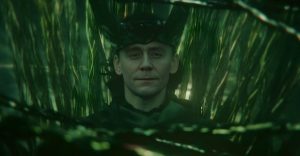
Then the Citadel scene flips the whole season from problem-solving into decision. He Who Remains says, “The outcome to this equation… it remains the same. You lose.”
Loki answers with the hinge line: “I’ll change the equation. I’ll break your loom.”
That’s acceptance. Loki is finally treating the rule like a rule. Not a puzzle you can hack. A system you either obey or replace.
And the exchange is clean because He Who Remains isn’t doing cartoon villain talk. He’s doing body-count math. “Make the hard choice. Break the loom and you cause a war that kills us all. Game over.”
Then he lands the moral argument with the line that turns the knife: “Every moment of peace you’ve ever experienced was yours because I was here alone at the end of time.”
Safety came from control. Peace had a price. Loki is being asked if he’s willing to pay a different one.
In his book Story, Robert McKee frames the design question that matters: “Who are these characters? What do they want? What stops themhat are the consequences?” (Robert McKee, Story).
Loki stops being “lore” the moment it commits to that last word.
2) Single Point of Failure
Once Loki decides to break the Loom, the episode has to prove the cost physically. So it does.
Loki walks out onto the gangway where everyone else gets torn apart. He doesn’t delegate the sacrifice, or throw a TVA employee at the problem. Loki’s choice is to take the radiation himself.
He steps into the storm that keeps turning people into string and keeps walking anyway.
Then he grabs the timelines with his hands and drags them into a new shape.
That action beat is the whole argument. Loki doesn’t repair the machine. Loki replaces the machine.
And the story makes a hard structural promise here: the multiverse survives because one being is holding it together forever.
One being. One station. Infinite consequences if those hands let go.
That is a Single Point of Failure disguised as a crown. Any opponent worth the name goes upstream once he sees it.
3) Moral Debt
The finale doesn’t pretend Loki found a clean solution. It shows you what he buys and what he pays.
He Who Remains offers control with blood on the floor. Loki chooses freedom with blood on the floor. Neither path is free.
The difference is who pays, and whether the story admits the cost on screen.
Loki ends the season alone, holding everything together, because freedom in this system requires permanent payment. That is Moral Debt in plain terms. You can delay it, rebrand it, or even argue about it. But, you still pay it.
John Truby gives language for why this feels like design instead of coincidence: “The designing principle is what organizes the story as a whole. It is the internal logic of the story…” (John Truby, The Anatomy of Story).
Loki Season 2’s internal logic is simple: the multiverse survives only if someone accepts the cost.
Once that’s the logic, the next move writes itself. If one person is holding everything together, the next saga-level conflict will target that person.
The Takeaway
A multiverse rule matters when it forces a character to pay a cost that can’t be undone.
So What
Here’s why this matters for Doomsday without any rumor math. Marvel needed a villain engine after Kang. Loki Season 2 hands them one because it creates a system with leverage.
A systems villain doesn’t need to outfight the Avengers. He needs to find the load-bearing element and build pressure around it until the heroes start making desperate trades.
Loki is that element. He is the job. He is the weak spot.
- What moves us toward Doomsday: Loki becomes a reachable failure point for the entire multiverse system. That invites an opponent who attacks infrastructure instead of trading punches.
- What doesn’t and why: multiverse vocabulary without enforced cost. If the rule never corners a character into a real decision, the saga loses pressure.
We opened with a blunt craft question: do these multiverse rules actually matter, or are they just flexible language Marvel can swap whenever it wants?
The proof beat at the start is Loki in the Citadel refusing the loop’s math: “I’ll change the equation. I’ll break your loom.”
The proof beat at the end is the price: Loki replaces the machine and becomes the permanent cost of keeping the multiverse alive.
Those two beats are the arc of the argument. Load-bearing rules force irreversible payment. Single points of failure turn that payment into leverage for the next opponent.
If your story introduces a rule and never makes anyone pay for it, the audience stops believing in the stakes. If you make the rule expensive and show who pays, the audience leans in, because the story can no longer hide.
Next time you watch anything — Marvel or not — track the cost of the rules.
The cost of the rules always reveals character.
And character, not spectacle, is what makes a story stick.