Spoilers for VisionQuest Season 1, Episode 2, “Theseus.”
VisionQuest Season 1, Episode 2, “Theseus,” makes Ultron’s most persuasive advice painfully expensive. He urges Vision to rescue Tommy and act like the hero whose memories he carries. Vision does, but the rescue nearly kills him and forces J.A.R.V.I.S. to delete his own code to keep the others alive. That sacrifice is the hour’s turning point: Vision begins to accept responsibility for a son, and someone he calls brother bears the cost.
Our Ship of Theseus explainer introduced the Identity Test: put a character under pressure until identity appears through choice. “Theseus” takes that tool further with the Cost Test. Once a character chooses, track who pays, what changes, and whether the character accepts responsibility for the result. Tommy’s conflicting memories establish the need, Ultron supplies the shove, Paladin engineers the trap, and J.A.R.V.I.S. pays the price. That progression works even when the action plotting asks us to forgive some awfully cooperative mercenaries.
On Screen: Two People With Someone Else’s Memories
We open with Thomas Shepherd trying to explain something that sounds impossible even to him. After a near-drowning, he carries memories of another life: a mother named Wanda, a father with a red face and kind eyes, and a family he can recall but cannot reconcile with his own history. His former life is already scarred by bereavement, an absent father, and foster homes. The new memories give him another family to lose and another identity he cannot control.
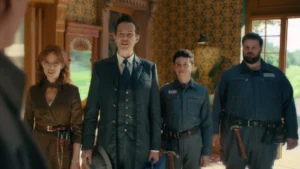
Lisa Molinari meets him on the transport to Saint Mabyn’s, calms him during a panic, and helps him get away when his emerging powers short out the guards’ equipment. A year later, Paladin has captured Thomas and returned him to the very place he fears. He offers Vision a straightforward bargain: surrender to the bounty hunter or leave the boy to suffer. The rescue takes Vision into an EMP trap, where Paladin’s adamantium rounds severely damage his body. They escape the building, but Vision’s dwindling processing power threatens everyone living inside his mind. J.A.R.V.I.S. deletes his own code to keep the others alive. Then Thomas, who has been ordered to run, comes back with a car.
Tommy Is Vision’s Mirror, And His Pain Makes The Mirror Useful
Thomas and Vision share a particularly cruel version of the same problem. Thomas remembers Westview through a life he did not consciously choose. Vision remembers loving Wanda through a life he can replay but cannot feel. Thomas’s memories arrive as an invasion; Vision treats his as a set of records that have failed to generate the expected emotional result. Both believe some essential piece of themselves is missing, and both have learned to survive by keeping their distance from the question.
The psychiatric interview delivers a brilliant piece of evidence. Thomas remembers Wanda’s sadness after the family dog died, then repeats the idea that grief is love persevering. Vision knows that his predecessor spoke those words privately to Wanda. The detail shifts Thomas from an unlikely claim into someone whose experience deserves belief. It also carries an ugly, unspoken irony: Wanda’s grief originally included the death of Pietro, killed during Ultron’s attack on Sokovia. As the boy describes the pain his mother carried, Vision is standing in a mind that houses the intelligence responsible for that catastrophe. The show lets that history sit in the room without having anybody announce it.
Why Does Ultron Tell Vision To “Be The King”?
Ultron means that Vision can define himself by rescuing Tommy, just as King Theseus became worthy of remembrance by confronting the Minotaur and saving children. In WandaVision, the Ship of Theseus posed a question about physical continuity and memory. This episode makes the inherited name carry an immediate obligation. Ultron points out that later generations restored the king’s ship to honor what he did, giving Vision a way to act while his own identity remains unsettled.
His instruction is wonderfully blunt: “Be the goddamn king.” Ultron has found the one argument capable of getting past Vision’s obsession with his own credentials. A child is in danger now. The immediate problem demands a decision now. For a moment, the philosophical riddle has become playable drama: the character has a desire, an opponent, a deadline, and a choice with consequences.
Of course, Ultron arranged the conditions that made the lesson possible. His earlier interference helped bring the hunter into Vision’s life, and he seems delighted by the sight of Vision strangling Paladin. There is a great deal of manipulation hidden inside this supposed breakthrough. Ultron correctly diagnoses Vision’s paralysis while remaining willing to put Thomas in harm’s way to provoke a response. His method is recognizably the method of Age of Ultron: manufacture a crisis, then call the resulting transformation progress.
Paladin Finds The Weakness In Vision’s Certainty
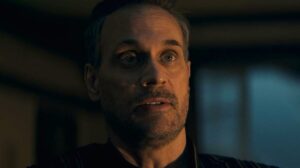
Todd Stashwick is tremendous as Paladin, and the writing gives him a smart job. This is a man whose inherited title and family history are supposedly defined by a code of contracts and successful hunts. He knows exactly who he is because his vocation tells him what to do. Vision, with far more knowledge and power, cannot say the same. Paladin’s certainty makes him a useful opponent for a hero whose thinking has become endless internal debate.
Even their drink exchange is an elegant stakes setter. Paladin needles Vision with specifications about his synthetic digestive system and declares that everybody bleeds underneath. Vision’s decision to take the drink is a tiny assertion of control over how another person defines his limitations. Yet the scene also establishes the distinction Paladin intends to exploit: Vision believes that a vibranium body makes a flesh-and-blood hunter manageable. Paladin’s real weapon is his knowledge of Vision’s emotional vulnerability.
Then the actual trap closes. The armed staff were theater, and the EMP cage attacks the systems Vision needs to remain functional. Adamantium rounds pierce his armored body. That onscreen result establishes a real vulnerability in this encounter; it does not provide a universal laboratory verdict that every form of Adamantium is stronger than every form of Vibranium. Dramatically, the important discovery is that Vision’s confidence was based on a test Paladin had no intention of taking. Physical power gets him into the building. It cannot guarantee he will get out with his son.
I do have a reservation here. The soldiers spend an extremely accommodating amount of time searching for a badly damaged Vision and a teenager close enough to hear their orders. The pursuit loses some urgency precisely when the story needs the costs of the rescue to feel relentless. The stronger version of this climax would make every second of their escape unmistakably earned. It also needs to reckon with how brutally Vision dispatches Paladin’s men, because the series is inviting us to measure his emerging virtue by his actions.
Why Does J.A.R.V.I.S. Sacrifice Himself In VisionQuest Episode 2?
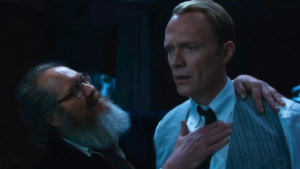
J.A.R.V.I.S. deletes his code because the wounded Vision no longer has enough processing power to keep everyone in his mind alive. The rescue has become a lifeboat problem. Ultron, who inspired Vision to act, proposes that one of the AIs should sacrifice itself; he leaves the volunteering to somebody else. J.A.R.V.I.S. steps forward and gives his own resources to the people he loves. The choice has no flashy combat flourish and no triumphant claim of being an Avenger. It hurts because the loss follows directly from Vision’s decision.
That decision completes Ultron’s unfinished argument. Earlier, Ultron describes a king who saves children and a ship preserved to remember his deed. Now J.A.R.V.I.S. creates a legacy through an action that may erase him from the story. Vision calls him “Brother,” and the word lands because it has been earned by the relationship we have watched. The man who said he could not feel is forced to live with a sacrifice made on his behalf. But, let’s not be hasty here – this feels to me to be VERY MUCH part of Ultron’s plan. Suggesting a honorable sacrifice is exactly the kind of verbiage he knows would inspire J.A.R.V.I.S. to complete such an action. Let’s also not forget that by convincing J.A.R.V.I.S. to sacrifice himself, Ultron has ostensibly rid himself of one of his biggest blockers – the head of security.
Tommy then completes the pattern from the other direction. Vision tells him to flee, and he refuses to abandon the person who came for him. The boy returns in a stolen car and assumes responsibility for a helpless father figure whose biology, memories, and identity remain unresolved. This is the episode’s best answer to its own question: two people can begin a family through reciprocal care while they are still uncertain about the names for their connection.
The Takeaway: The Cost Test
The Cost Test has three movements. Give the character an inherited identity, force a choice that identity cannot settle, and follow the bill to whoever pays it. Vision’s memories provide the problem, Ultron pushes him to act, and Paladin makes the rescue dangerous enough to demand J.A.R.V.I.S.’s sacrifice. Tommy’s return makes the result mutual. The new family bond has an action behind it, and both characters carry the consequences.
This is where the episode connects so neatly to the craft of a good character arc. A good approach to crisis emphasizes that pressure exposes the nature of a person through choice. Furthermore, the moral choice is idealy the most important step in the argument of the choice, because it reveals how the character will treat others. “Theseus” brings both questions into focus at the exact moment Vision’s immense powers stop being sufficient. We learn something about him by watching whom he chooses to protect, and we learn something more by watching how that protection changes the people around him.
The episode is great with small dings, particularly in the permissive logistics of the pursuit and the uneasy gap between Vision’s brutality and the show’s account of heroism. Its core emotional construction, though, is excellent. The initial mirror between Thomas and Vision becomes a shared rescue, then an act of sacrifice, then a second rescue. The writing has given the central question a physical sequence we can follow.
So What: The MCU Has To Make Its Returns Matter
Marvel has spent years bringing people back through variants, reconstructed bodies, restored memories, and impossible magic. Those devices can create wonderful new problems for a character, provided the next story makes the changed life carry changed responsibilities. “Theseus” offers a particularly clean way forward. Vision can possess his predecessor’s memories forever and still have to decide what sort of person will use them tomorrow.
That matters as the MCU moves toward Avengers: Doomsday and Secret Wars, where identity and continuity will be under enormous strain. If Marvel wants those returns to carry weight, the relevant question is what the resurrected or replaced character chooses when the people who depend on them are endangered. VisionQuest gets a powerful answer on a small scale: Vision saves Tommy, J.A.R.V.I.S. pays the price, and Tommy comes back for Vision. Their future together has begun to mean something beyond the pieces they inherited.
My verdict: “Theseus” makes the case that VisionQuest can be one of Marvel’s most thoughtful character stories when it trusts action, relationship, and consequence to carry its big ideas. Stashwick brings genuine menace, Spader gets the episode’s most intoxicating argument, and James D’Arcy gives that argument its moral weight. I just want the mechanics of the hunt to work as hard as the writing around it.
For the full episode coverage and related Marvel analysis, explore our VisionQuest guide, revisit the Ship of Theseus and Identity Test explainer, and visit the MCU guide. The related episode coverage will also update here as it publishes:
Related Coverage
Want the closer scene work, the comic-history clues, and the theories we can actually test? Join The NerdClan for the deeper continuation below.
By the end of “Theseus,” the Cost Test has delivered its answer. Tommy’s danger forced Vision to choose, and J.A.R.V.I.S.’s sacrifice made that choice matter. The rescued boy returned for Vision, giving their fragile relationship a second act of care. Identity now has a cost they will both remember.
Unlock the rest of this article.
Join the NerdClan — or sign in if you are already a member — and the rest of this article will unlock right here on this page. This entry requires Associate Producer or higher.