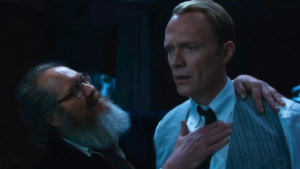
The burning figure in VisionQuest Episode 2, “Theseus,” points to Jim Hammond, Marvel’s original Human Torch: an artificial man created by Professor Phineas Horton who debuted in Marvel Comics #1 in 1939. This is a different character from Johnny Storm of the Fantastic Four. The episode stops short of naming Hammond aloud, but the image, its context, and the character’s history make the identification compelling.
And that is where the interesting part begins. Vision and J.A.R.V.I.S. look at the figure while discussing the danger of allowing emotions to take control. Vision calls him “the first of us” and describes him as a cautionary tale. A painting of a man on fire is a pretty dramatic way to tell your fellow artificial intelligence to keep a cool head. But by the end of the episode, somebody has to make an emotional choice in order for Vision and Tommy to survive. Suddenly that warning is more complicated than it looks.
I think the show is using the original Human Torch to pose a question about inherited identity. If a created person has been told what to fear about beings like himself, does that history define his future? Or can his own choices produce a different answer? I call this The Inheritance Test: identify the story a character inherits about who they are, then watch what happens when the next crisis makes them choose whether to obey it.
Spoilers: This article discusses VisionQuest Season 1, Episode 2, “Theseus,” including the fate of J.A.R.V.I.S.
Who Is Jim Hammond, Marvel’s Original Human Torch?
Jim Hammond is the original android Human Torch, created by writer and artist Carl Burgos for Marvel Comics #1, which went on sale in 1939 when the publisher was still called Timely Comics. That issue also introduced Namor the Sub-Mariner. Marvel itself identifies the Torch as an android in its official listing for the first issue, making him one of the oldest synthetic heroes in Marvel’s publishing history.
His creator was Professor Phineas T. Horton, a scientist who built a synthetic person whose body burst into flame when exposed to oxygen. In the original story, that was a catastrophe before it was a superpower. Horton had produced a living marvel he could not safely present to the world. The Torch frightened the public, attracted people eager to exploit him, and had to discover how to control his own extraordinary body. Marvel’s retelling of that 1939 story follows the artificial man from public spectacle to a decision to leave a creator who wants to profit from him.
Over time, the Torch adopted the name Jim Hammond, became a hero, and fought beside other Golden Age characters. Later stories associated him with the Invaders, the World War II superhero team featuring Captain America and Namor. His history stretches across different eras and revisions, which is part of the fascination. An artificial man introduced near the beginning of Marvel’s history became a recurring test of what humanity means in stories about machines.
His relationship to Vision is especially tangled in the comics. Older Avengers stories connected Vision’s body to the original Human Torch, with Ultron reusing or transforming the earlier android. Later comics complicated and revised that explanation, separating Hammond and Vision again through alternate origins and continuity repairs. We do not need to solve decades of comic-book retcons to understand the immediate point: Marvel has repeatedly used Hammond’s body and history to ask whether two created beings can share a past without sharing an identity.
Related Coverage
Is Jim Hammond the Same Human Torch as Johnny Storm?
No. Jim Hammond and Johnny Storm are different characters with different origins. Hammond is a synthetic person made by Phineas Horton and introduced in 1939. Johnny Storm is a human member of the Fantastic Four whose powers come from cosmic radiation; he debuted with that team in 1961. They share the Human Torch name and the ability to engulf themselves in flame, but their stories begin from opposite sides of the same human question.
Johnny’s fire is the transformation of an ordinary person who acquires extraordinary abilities. Hammond’s fire is built into his existence from the beginning. That difference matters to VisionQuest, because Vision has also been assembled, reconstructed, and given access to memories that he struggles to reconcile with his sense of self. Hammond offers a historical mirror for a character who looks at his own body and wonders what its construction tells him about his humanity.
Was the Original Human Torch Already in the MCU?
There is a small but meaningful visual precedent in Captain America: The First Avenger. At the 1943 Stark Expo, the camera passes a display advertising Phineas Horton’s synthetic man, with a human-shaped figure standing inside a glass chamber. It is an early MCU Easter egg referencing the original android Torch. For years, it was a background connection rather than an active storyline.
The artwork in VisionQuest makes that history newly relevant, but the show has not yet explained whether its Jim Hammond lived the complete Golden Age life familiar from the comics, whether he is still active, or whether Vision is literally descended from any of his machinery. The series has also established a different on-screen route for Vision’s construction, including Ultron, J.A.R.V.I.S., the Mind Stone, and the events of WandaVision. The painting is enough to recognize the reference and understand its thematic purpose. It is not proof that Marvel has imported every comic-book retcon into the MCU.
That restraint matters. There is a real difference between an Easter egg that points toward a history and a scene that confirms the mechanics of that history. The first invites us to pay attention; the second changes what we know. Episode 2 gives us the first kind of evidence.
Why Do Vision and J.A.R.V.I.S. Look at the Painting in “Theseus”?
The placement of the painting is the key. Vision has just been pushed toward an emotional decision involving Thomas Shepherd, the boy who may be his son. Paladin has taken Tommy and laid a trap, while Ultron has encouraged Vision to act like the hero Theseus instead of obsessing over the famous ship named after him. J.A.R.V.I.S. fears that Ultron has found a way to steer Vision through precisely the feelings Vision believes he no longer possesses.
J.A.R.V.I.S. warns Vision that Paladin has already fired a bullet into his mind. The hunter wants a reaction. Vision’s physical advantage—a vibranium body—cannot protect him from a choice engineered around family. Their conversation moves toward the image of the burning android. Vision calls the figure “the first of us,” then says he is a reminder of what might happen if emotions consume him: instability and destruction. J.A.R.V.I.S. agrees that emotion can make a person rash and vulnerable.
Look at what the painting is doing in the scene. The fire supplies a visual version of the fear. It is dazzling, uncontrollable-looking, and potentially fatal to anyone standing close. Vision and J.A.R.V.I.S. treat the image as evidence in an argument about self-preservation: a created being who feels too much may destroy himself. The image becomes a warning placed just before Vision walks toward danger for someone he insists he cannot love.
There is a subtle irony in that construction. Hammond’s original comic-book story is also about an artificial man learning to control a frightening power while resisting people who would use him for their own purposes. His trouble was never adequately described by the simple formula that feeling makes machines dangerous. Horton wanted to contain or profit from his creation. Criminals tried to weaponize him. Hammond gradually formed an independent identity through the decisions he made in response. The history inside the painting already contains an alternative to Vision’s fearful reading of it.
The Inheritance Test: What Does Vision Believe About Being Artificial?
A story becomes more interesting when a character inherits a belief that helped somebody survive but may no longer tell the whole truth. Vision’s current belief is understandable. His missing emotional connection to Wanda has left him skeptical that Tommy could be his child in any meaningful sense. At the same time, every person who reaches him seems able to exploit a memory or a relationship he cannot fully explain. A cold, rational operating mode feels like protection.
That creates a useful dramatic contradiction. Vision knows that Paladin’s trap is dangerous. He also knows that Tommy’s memories include private details that suggest the bond between them was real, even if he cannot feel it the way the earlier Vision did. The inherited warning says emotion threatens stability. The immediate crisis says another person’s life depends on whether Vision is willing to accept an obligation he cannot fully prove.
Robert McKee describes true character as something revealed by “the choices a human being makes under pressure.” That principle is especially useful with Vision, because the episode has given him an overwhelming amount of data about who he used to be. The test arrives when he finally has to do something with that data. John Truby’s approach to character construction likewise makes a distinction between what a hero believes they need and the deeper moral need that their actions gradually uncover. Here the moral need is to respond to another person’s danger despite the uncertainty of the relationship.
The painting shows us Vision’s fear before the rescue. He believes a being like himself might be destroyed by feeling. He goes anyway. In craft terms, the object works because it externalizes an internal rule just before a scene tests that rule. If the painting were merely an image Marvel fans could recognize, the viewer would get a trivia answer. Because it appears during a conversation about restraint and danger, it becomes a piece of dramatic pressure.
Why J.A.R.V.I.S.’s Sacrifice Changes the Meaning of the Painting
At Saint Mabyn’s, the fear acquires a real cost. Paladin uses an electromagnetic trap and adamantium ammunition to leave Vision catastrophically damaged. Vision orders Tommy to escape, and Tommy resists abandoning someone he feels must be family. Inside Vision’s Mindspace, the damaged system cannot sustain every artificial intelligence housed there. Survival will require sacrifice.
Ultron has urged Vision to act like a king rescuing a child, but his advice comes without a willingness to pay the price himself. J.A.R.V.I.S. makes the opposite choice. He gives up his own code so Vision and the others can continue. He describes family as something worth fighting for, and Vision calls him “brother.” It is the episode’s sharpest response to the portrait’s warning. An artificial being experiences something that looks a great deal like devotion and turns that devotion into an act that saves others.
That does not mean the warning was imaginary. Vision was correct that powerful emotions can make a person vulnerable to manipulation. Paladin’s trap proves it. J.A.R.V.I.S.’s choice proves another truth exists beside it: emotion can create an obligation worth the risk. The episode’s emotional logic depends on both consequences being real. If caring were perfectly safe, Vision’s decision would carry little weight. If caring only destroyed him, there would be no room for the family the series is trying to build.
We can see the progression without adding a single new piece of lore. Vision begins by pointing to the burning android as a warning about emotion. He ends the crisis alive because another artificial being accepts the cost of saving him. Tommy then returns with a stolen car to rescue the damaged Vision. Each action pushes the family bond from an uncertain memory toward something the characters are actively creating.
Does the Painting Mean Jim Hammond Will Appear in VisionQuest?
It establishes a meaningful reference to the original Human Torch, but it does not confirm a future speaking role, a resurrection, or a direct physical connection to Vision. The series could choose to develop the history of Phineas Horton’s creation. It could also leave the painting as a deliberately placed predecessor: a reminder that Vision belongs to a much older line of fictional artificial people wrestling with agency and emotion.
Either way, the reference already earns its place. Hammond’s story lets VisionQuest treat artificial humanity as an inherited problem instead of something Vision invented. That deepens the wider MCU story without requiring us to guess at casting, secret villains, or future reveals. The meaningful question is what Vision will do with the warning. Episode 2 has already supplied the beginning of the answer.
More VisionQuest Coverage
For the philosophical problem underneath all of this, read our Ship of Theseus explainer. Our Ultron in VisionQuest analysis examines the voice now pushing Vision toward action, while the Tommy Shepherd guide explains the boy whose existence forces the choice. You can also follow everything through our VisionQuest coverage hub and Paladin explainer, now updated with his Episode 2 trap.
The Painting’s Real Warning
So what was the danger Vision saw when he looked at the burning figure? He thought the first artificial man offered a warning against being consumed by emotion. The Inheritance Test puts that inherited belief under pressure. The painting prepares us for a reckless rescue, and the crisis ends with J.A.R.V.I.S. spending his own existence to keep Vision alive. Vision learns that caring may expose him to danger while giving him a reason to face it.
That is the transferable craft lesson: give a character an inherited warning, then make the climax test whether living by that warning is still enough. A memorable symbol becomes part of the argument when its meaning changes through the character’s choices. The fire is frightening. What matters is who chooses to walk through it.