Spoilers for VisionQuest Season 1, Episode 4, “Malware.”
I loved every second of VisionQuest Episode 4, “Malware.” I loved its ridiculous digital exorcism, its gloriously stupid CAPTCHA sequence, the father-son awkwardness between Vision and Tommy, and every deliciously unsettling second James Spader spent making Ultron sound like the funniest person in the room. But the thing that made this episode fantastic for me was the precision of its final turn. Vision gives Ultron control of his body because he is beginning to love Tommy, and the very instinct that makes Vision more human becomes the opening Ultron has been waiting for.
That’s the argument “Malware” makes through its story, and the writers build it with a craft tool I want to call the compassion trap. The protagonist’s best quality leads him toward a genuinely admirable goal. Then the circumstances tighten until acting on that quality carries a terrible cost. By the end, Vision’s longing to protect his son has made him vulnerable to a monster who understands him better than he understands himself. The tragedy lands because I understand exactly why he makes the choice.
The Episode Opens With a Breach and Ends With an Invitation
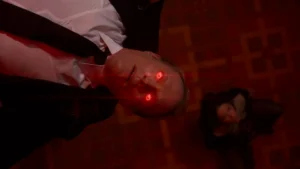
Think about the architecture of this episode. When “Malware” begins, the Butcherbird Killer has found her way into Vision’s Mindspace through the connection created by his reboot. Suddenly his internal world is hostile territory. The normally reassuring mansion becomes a place of threats and shadows, and E.D.I.T.H. has to perform a hilariously theatrical exorcism to force the intruder out. On the surface, it’s a wonderfully silly way to visualize a cybersecurity problem. As drama, it quietly teaches us the rules of the ending.
Vision’s mind can be entered. Access matters. Whoever controls the system can endanger everyone inside it, along with the people Vision loves outside it. The opening invasion happens through a technological vulnerability, and the finale uses a vulnerability of character. At the gala, Ultron gets access because Vision chooses to hand it over. The villain’s most important victory arrives with permission.
That structural rhyme gives the title “Malware” a second meaning. The episode introduces malicious code entering a protected system, then asks what happens when a supposedly safe relationship becomes the way in. It also makes the last few minutes feel inevitable in retrospect. The door has been the subject of the story all along; the final question is who gets to open it.
Vision’s Compassion Is the Quality Ultron Knows How to Exploit
Early in the investigation, Vision senses the suffering underneath Butcherbird’s violence. He argues that the best response to pain is care and compassion. I love this because it feels exactly right for Vision. He is capable of seeing personhood where other people see a weapon, a malfunction, or an inconvenience. That belief has been part of his identity since Avengers: Age of Ultron, and this new version of him is starting to reach for it again.
Then the Sokovia remembrance coverage puts Ultron’s history right in front of Tommy. Tommy remembers displaced children crying in the foster system after Ultron’s attack. For him, the consequences have faces and voices. For Vision, Ultron is also an intelligence he can converse with, learn from, and perhaps understand. That difference in perspective creates a serious problem for the father-son relationship before either of them has fully agreed to call it one.
When Tommy asks who Vision keeps talking to, Vision names the AIs living inside his mind and leaves Ultron out. Ultron practically announces the moral problem from the sidelines by joking about the difference between an omission and a lie. Vision has chosen to let Tommy close enough to trust him while withholding information that would change Tommy’s decision. You can feel him trying to hold two incompatible needs together: the desire to protect this boy and the desire to preserve the complicated little family already living in his head.
That’s the first tightening of the compassion trap. Vision genuinely cares about his fellow synthetic beings, and he’s beginning to care deeply about Tommy. He wants to keep everybody safe without having to confront the full consequences of keeping Ultron around. The episode allows that wish to survive just long enough to make its collapse hurt.
Tommy Makes the Trust Problem Personal
The conversation with Lisa at the gala is one of my favorite pieces of writing in the episode. Lisa recognizes how quickly Tommy has placed his faith in Vision, and she tries to warn him. Tommy has spent so much time feeling abandoned that the possibility of finally belonging somewhere matters more to him than his usual caution. He says he trusts Vision, and Lisa knows what a remarkable admission that is coming from him.
Then Tommy strikes at the one place he knows will hurt her: he suggests she’s upset because he has found a family and she remains an orphan. It’s an ugly thing to say, and Ruaridh Mollica makes the moment feel like a teenager realizing the damage a fraction of a second too late. The line matters because Tommy is also capable of turning fear into harm. His longing for family has consequences for the people who already love him.
When he asks Vision how to repair the damage, Vision remembers Wanda’s distinction between saying sorry and being sorry. Tommy catches something even more important in the way he tells the story: Vision speaks about Wanda as someone who taught him rather than “the old me.” Paul Bettany makes the shift so casual that it almost slips past. Yet it is a substantial movement in Vision’s identity. A man who has been treating his memories like somebody else’s file is beginning to claim the relationships inside them as his own.
Look at how much work these scenes do together. Lisa’s warning makes trust a conscious choice. Tommy’s mistake makes accountability concrete. Wanda’s remembered advice establishes that real care requires honesty and repair. Then the later revelation about Ultron puts Vision’s own omissions under that same moral standard. The writers have prepared an argument the characters can actually act upon.
Unlock the rest of this article.
Join the NerdClan — or sign in if you are already a member — and the rest of this article will unlock right here on this page. This entry requires Associate Producer or higher.