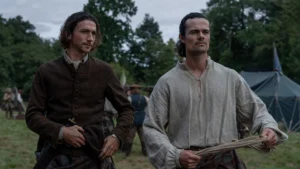
Short answer: Uhtred of Bebbanburg is not a literal historical person, but he is not completely invented either.
Bernard Cornwell’s Uhtred was inspired by real lords connected to Bebbanburg, most importantly an early 11th-century Northumbrian ruler usually known as Uhtred the Bold. The real Uhtred lived roughly a century after King Alfred the Great, which means the warrior we watch fighting beside Alfred in The Last Kingdom is fundamentally a fictional character placed inside real history.
And honestly, that distinction is part of what makes the whole thing work.
Uhtred does not need to be secretly responsible for every important event in the creation of England to feel historically believable. He exists at the point where fiction and history are most useful to each other: the kings, wars and political transformation give his story weight, while Uhtred gives an enormous and complicated historical process one emotional point of view.
If you want to explore our full coverage of the series, start with The Last Kingdom With Mary & Blake, our home for the complete podcast archive and new story analysis.
Was Uhtred Of Bebbanburg A Real Person?
Not exactly.
The Uhtred played by Alexander Dreymon is a fictional Saxon nobleman born into the ruling family of Bebbanburg, captured as a child, raised by Danes and eventually pulled into the orbit of Alfred the Great. His divided identity becomes the central engine of The Last Kingdom: Uhtred is constantly being asked whether he belongs to the Saxon world that gave him his birthright or the Danish world that taught him how to live.
There is no historical record of that man doing those things.
There was no pagan Uhtred of Bebbanburg standing beside Alfred, insulting priests, breaking shield walls and repeatedly saving Wessex while complaining that the king still had not given him what he was promised.
Which, admittedly, feels like something Alfred probably would have found extremely convenient.
But there really were men named Uhtred associated with Bamburgh, the historical fortress behind the show’s Bebbanburg, and one of them became the major inspiration for Cornwell’s character.
Who Was The Real Uhtred The Bold?
The historical figure most closely associated with Cornwell’s hero is Uhtred of Bamburgh, commonly called Uhtred the Bold.
He was an important northern English nobleman whose family controlled Bamburgh. In the early 11th century, Uhtred emerged as one of the most powerful men in northern England and eventually held authority across much of Northumbria.
One of the defining stories attached to him involves a Scottish attack on Durham around 1006. While his father remained at Bamburgh, Uhtred reportedly led the defense, defeated the attacking force and gained significant royal favor afterward.
This is where you can begin to see the connective tissue between history and fiction.
The real Uhtred was a powerful northern warlord connected to Bamburgh whose survival depended on navigating kings, invasions, territorial power and shifting loyalties. That is not the biography of Alexander Dreymon’s Uhtred, but it certainly sounds like the raw material from which you might build him.
Did The Real Uhtred Know Alfred The Great?
No. This is one of the clearest differences between the history and the show.
Alfred the Great died in 899. Uhtred the Bold’s major political and military career belongs to the early 11th century, particularly the years around 1006 to 1016.
They were separated by roughly a century.
So the relationship at the center of the early seasons of The Last Kingdom — Alfred needing Uhtred, Uhtred resenting Alfred, both men slowly recognizing something indispensable in the other — is fiction.
And I would argue that is far more important than simply marking it down as historically inaccurate.
Why The Last Kingdom Needed Uhtred To Be Fictional
This is where the question gets more interesting than whether Uhtred’s name appears in a historical document.
The creation of England is an enormous historical process. It involves Alfred, Edward, Æthelflæd, Æthelstan, Viking armies, shifting kingdoms, marriages, treaties, battles, religion, succession and generations of political change.
That is history.
But history is not automatically drama.
A television story needs somebody who can move through all of that machinery while carrying a personal problem of his own. Uhtred gives The Last Kingdom exactly that.
His goal is beautifully simple: he wants Bebbanburg back.
That gives the series a dramatic spine even as the political map keeps changing around him. Kings die. Kingdoms merge. Children inherit crowns. Danes become Christians. Saxons make alliances with Danes. Enemies become friends and friends become inconvenient political problems.
But Uhtred still wants to go home.
That simplicity is enormously valuable because it allows the show to turn the creation of a nation into the story of a man trying to recover one piece of land.
Uhtred Is The Character Who Can Stand Between Two Worlds
There is another reason a fictional protagonist works so well here.
Uhtred can belong everywhere and nowhere.
If the central character were simply a historical Saxon lord devoted to Wessex, the Danish side of the story would naturally become more distant. If he were simply a Danish warrior fighting the Saxons, Alfred’s project would become the enemy’s project.
Uhtred gets to stand in the middle.
He is Saxon by birth and culturally shaped by the Danes. He understands Alfred while frequently despising the world Alfred represents. He loves people on both sides of the conflict and repeatedly discovers that identity is messier than the kingdoms and religions trying to define him.
That makes him useful beyond plot.
Uhtred is the dramatic argument of The Last Kingdom.
The political story is about separate peoples slowly becoming something we can recognize as England. Uhtred’s personal story asks the same question at human scale: what happens when a person made from competing identities eventually has to decide what he is willing to build?
Was Bebbanburg A Real Place?
Yes.
This part of Uhtred’s obsession has a very real geographical foundation.
Bebbanburg is the historical name associated with what we now know as Bamburgh in Northumberland, and Bamburgh Castle still stands on the northeast coast of England.
That matters because Bebbanburg is not merely a convenient fictional castle invented to give Uhtred something to chase.
The place is real, the northern dynasty associated with it is real, and generations of Uhtreds really were connected to that world.
The details of Uhtred losing Bebbanburg as a child and spending his life trying to reclaim it belong to Cornwell’s fiction, but the deep connection between the name Uhtred and the fortress of Bamburgh is part of the historical inspiration behind the books.
Bernard Cornwell Has A Personal Connection To Uhtred
This may be the best part of the entire story.
Cornwell has explained that he was adopted and later met his biological father. Through that family connection, he discovered a genealogy leading back to the Uhtreds who had ruled at Bebbanburg.
The modern family name had become Oughtred.
Cornwell was already interested in writing about the creation of England, but the discovery gave him something the history alone did not: a way into the story.
He became fascinated by the question of how this family managed to hold onto Bebbanburg through a period of extraordinary political and military instability.
That question eventually helped produce the fictional Uhtred we know.
Which makes the origin of The Last Kingdom oddly appropriate. A story obsessed with ancestry, inheritance, home and the idea that the past keeps reaching into the present was itself sparked by an author discovering his own family history.
What Happened To The Real Uhtred?
The historical Uhtred’s story does not end like the television version.
By 1016, England was facing another major Danish conquest under Cnut. After Cnut’s forces pushed into the north, Uhtred eventually submitted to him.
That did not save him.
Uhtred was summoned to a meeting and murdered, reportedly along with a large group of his men. Medieval accounts connect the killing to Thurbrand, an enemy whose feud with Uhtred’s family would continue into later generations, while Cnut is generally understood to have at least permitted or facilitated Uhtred’s removal.
It is a much darker ending than the heroic mythology attached to Cornwell’s Uhtred, but even here the historical pattern feels strangely familiar.
The real Uhtred lived in a political world where loyalty was not sentimental. Kings needed powerful regional lords until those lords became inconvenient. Alliances could preserve your position for a moment without guaranteeing your future.
That uncertainty is all over The Last Kingdom.
How Much Of Uhtred’s Story Is Actually Historical?
The best answer is: the world around him is far more historical than Uhtred himself.
Alfred the Great was real. Edward the Elder was real. Æthelflæd was real. Æthelstan was real. Guthrum was real. The struggle between Anglo-Saxon kingdoms and Viking armies was real, as were many of the political transformations and battles the story builds around.
Uhtred is the fictional thread Cornwell runs through those events.
Sometimes the character participates in historical moments where no real Uhtred was present. Sometimes real accomplishments belonging to other historical people are redistributed so Uhtred can remain central to the drama. Sometimes history is compressed, rearranged or personalized because a novel and television series need a protagonist rather than a committee of medieval rulers.
That does not make the history meaningless.
It means The Last Kingdom is doing what good historical fiction often does: using an invented life to give us a way to experience a real historical transformation.
The More Important Truth About Uhtred
So, was Uhtred real?
The Uhtred we love was not.
There was no single warrior living through the entire creation of England, standing beside generations of rulers and somehow finding himself personally necessary every time somebody formed a shield wall.
But there were real Uhtreds. There was a real northern dynasty. There was a real Bebbanburg. There was a real Uhtred the Bold navigating a violent political world in which Saxon and Danish power collided.
And the fictional version takes those pieces and does something dramatically smarter than merely copying a biography.
He turns the history into a character problem.
England is trying to figure out what it is.
Uhtred is trying to figure out what he is.
And both stories slowly become the same story.
Keep Exploring The Last Kingdom With Mary & Blake
We covered The Last Kingdom as television viewers from the perspective of character, theme, structure, performance and story rather than reading ahead in Bernard Cornwell’s novels. You can find our complete podcast archive and growing collection of evergreen guides at The Last Kingdom With Mary & Blake.
Next, we’re digging further into the real history behind Uhtred, Bebbanburg, the creation of England and what the series changed in order to make that history work as drama.
Sources & Further Reading
- Bernard Cornwell, Historical Novel Society interview — Cornwell discusses meeting his biological father, discovering his family connection to the Uhtreds of Bebbanburg and how that became the genesis of the character.
- BBC, The Last Kingdom original media pack — includes Cornwell’s introduction describing Uhtred as a character built from both history and fiction.
- HistoryExtra / BBC History Magazine — historian Ryan Lavelle examines the historical Uhtreds associated with Bamburgh and the differences between them and Cornwell’s protagonist.
- World History Encyclopedia — historical overview of Uhtred the Bold and the series’ treatment of early medieval English history.
- Bamburgh Castle — history of the real Bebbanburg and its connection to Uhtred the Bold and The Last Kingdom.