Full spoilers below for Outlander Season 8, Episode 5, “Send for the Devil.”
When Jamie Fraser says, “Send for the devil,” Outlander is doing something smarter than just introducing another dangerous man with a gun.
It is telling you that the real problem is no longer just Cunningham.
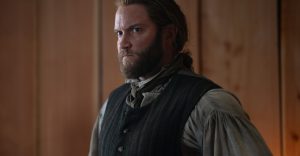
Cunningham is the immediate threat. He is the man Jamie has to survive tonight. Benjamin Cleveland is something larger and uglier: the kind of ally Jamie hates needing. He is not the villain of the episode. He is the cost attached to Jamie surviving it.
That is why Cleveland matters.
Who is Benjamin Cleveland in Outlander?
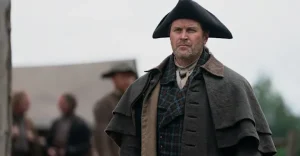
In the show, Benjamin Cleveland is a Patriot militia leader Jamie calls on when things with Cunningham spin beyond negotiation. He is not a British officer. He is not a Loyalist. He is on the revolutionary side. But Outlander frames him as “the devil” because being on the right side of a war does not automatically make a man honorable, gentle, or safe to owe something to.
That is the whole point of the moment.
Jamie is not summoning evil in the cartoon sense. He is summoning force. The kind of force that can solve the immediate problem while creating a larger one. It is the show’s way of saying that the war has now reached the Ridge in a form Jamie cannot control with moral authority alone.
Why does Jamie call him “the devil”?
Because Cleveland represents the version of the Patriot cause Jamie least wants to depend on.
Jamie can live with principle. He can live with sacrifice. He can even live with war, if he has to. What Cleveland represents is something much messier: revolutionary victory through backcountry brutality, intimidation, and the kind of rough justice that starts looking a lot like vengeance when you get too close to it.
That is why the title works.
The devil is not Cunningham, even though Cunningham is the man Jamie is fighting. The devil is the help that comes with a bill attached. Cleveland arrives as rescue, but he also arrives as warning. Surviving tonight means Jamie is now standing closer to the ugliest machinery of the Revolution.
Was Benjamin Cleveland a real historical person?
Yes. Benjamin Cleveland was a real historical figure — a North Carolina Patriot militia colonel associated with the southern backcountry war during the American Revolution. He was born in 1738 in Virginia, moved to North Carolina in 1769, and became a major local militia leader in the Upper Yadkin/Wilkes County region.
He was not a polished Continental officer in the George Washington mold. He was a frontier strongman. A backcountry fighter. A man whose power came from local authority, physical presence, and a willingness to do harsh things in a harsh war. That distinction matters, because it helps explain why Outlander does not introduce him like some clean patriotic folk hero.
What was the real Benjamin Cleveland known for?
Historically, Cleveland is most famous for his role in the southern militia war against Loyalists and for his connection to the Battle of Kings Mountain in 1780. Historical sources also make clear that he had a fierce reputation for his treatment of Tories. NCpedia describes him as a symbol of Patriot suppression of Loyalists in the Upper Yadkin, while the American Battlefield Trust notes that he became known as the “Terror of the Tories.”
That reputation was not just colorful rhetoric. The National Park Service’s page on the “Tory Oak” says the tree got its name because multiple Loyalists were hanged from it under Cleveland’s authority. That is not mythic, symbolic violence. That is the documented kind.
So if you are wondering why Outlander treats Cleveland with such dark dramatic energy, that is why. The real man was effective, important, and rough enough that history remembered the roughness.
Why does Kings Mountain matter so much here?
Kings Mountain is the real historical gravity behind Cleveland’s arrival.
The Battle of Kings Mountain, fought on October 7, 1780, is widely treated as one of the major turning points in the southern campaign of the Revolution. The National Park Service and other historical sources describe it as a Patriot militia victory that shifted momentum in the South. Benjamin Cleveland was one of the important militia leaders tied to that campaign.
That means Cleveland is not just random historical wallpaper the show tossed in for flavor. He is attached to one of the Revolution’s most consequential southern turning points. In story terms, his presence tells you Jamie is moving toward a part of the war that will be bigger, bloodier, and morally harder to keep at arm’s length.
So what does Cleveland’s arrival mean for Jamie?
It means Jamie’s old way of holding the world together is under pressure.
Up to this point, Jamie has still been trying to manage conflict through local authority, personal loyalty, and the moral power he has built on the Ridge. Cunningham challenges that directly. Cleveland escalates it. Cleveland’s presence says, in effect: local order is over. Now you are dealing with the war in its raw backcountry form.
And that is exactly the kind of thing Outlander loves to do to Jamie Fraser. It forces him into situations where surviving honorably becomes harder and harder. Cleveland is not just a historical cameo. He is a dramatic problem. He embodies the version of the Patriot cause that feels dangerously close to becoming the very thing Jamie has spent his life resisting.
Is Cleveland supposed to be a villain?
Not exactly.
That is what makes him more interesting than a standard antagonist. Cleveland is not there to be “the bad guy.” He is there to complicate what “the good side” even means. He is an ally, but not a comforting one. A Patriot, but not a polished one. A rescuer, but one whose rescue immediately creates moral debt.
That makes him much more valuable to the story than a simple villain would be. Cunningham is easy to hate. Cleveland is harder. He asks the more dangerous question: what happens when the people fighting for your side start using methods you do not want to bless, but cannot afford to reject?
What is the cleanest way to understand him?
If you want the simplest read, it is this:
Benjamin Cleveland matters because he represents the Revolution as Jamie least wants to see it — not as noble principle, but as backcountry survival with a Patriot badge on it.
That is why Jamie calls him “the devil.”
Not because Cleveland is secretly on the wrong side. Because he is what the right side looks like when war gets dirty enough.
FAQ
Was Benjamin Cleveland a real person?
Yes. He was a real North Carolina Patriot militia colonel and an important backcountry leader during the American Revolution.
Was Benjamin Cleveland British or Loyalist?
No. He was a Patriot, not a British or Loyalist figure.
Why is Cleveland important in Revolutionary War history?
He is strongly associated with anti-Loyalist militia actions in North Carolina and with the Patriot victory at Kings Mountain, a major turning point in the southern campaign.
Why does Outlander make him feel so ominous?
Because the historical Cleveland had a harsh anti-Tory reputation, and the show is using him to represent the morally brutal side of the Patriot cause that Jamie now has to reckon with.
This Week’s Outlander Coverage
- Episode Review: Outlander 8.05 Recap & Reaction: Buck Saves the Day in “Send for the Devil”
- Recap & Reaction Podcast: Outlander 8.05 Recap & Reaction: Buck Saves the Day in “Send for the Devil”
- Listener Feedback: Outlander 8.05 Listener Feedback: Buck Love, Ben Chaos, and Amaranthus Distrust
- Fan Temperature Check: Where The Ridge Stands This Week: Finally Alive, Still Messy
- Explainer: Did Claire and Jamie Really Do the Right Thing by Hiding the Truth From Buck in Outlander?
- Explainer: Does Amaranthus Know More Than She’s Saying in Outlander Season 8?
- Explainer: Why Did Claire Save Cunningham in Outlander 8.05 – Send For The Devil?
- Knee Jerk Reaction: KNEE-JERK REACTION | Outlander Season 8 Episode 5: Send for the Devil Finally Lights the Fuse
- Outlander Season Guide: Outlander Season 8 Episode Guide, Reviews, Podcasts & Fan Reactions
Outlander Season 8 Coverage
Want the full picture? Visit our Outlander Season 8 Episode Guide for every review, recap, listener feedback episode, explainer, and companion post from the final season.
What do you think?
Do you think Cleveland will become the most dangerous “ally” Jamie has had in a long time? And does calling him “the devil” feel dramatic, or perfectly earned?
Want to send your take to the show? Leave us a voicemail on SpeakPipe.
Slàinte Mhath. 🏴