This Week’s Outlander Coverage
- Episode review: “Abies Fraseri”
- Recap & reaction podcast
- Listener feedback episode
- Where The Ridge Stands This Week
- What is Claire’s blue light in Outlander?
- Who is Amaranthus in Outlander?
Full spoilers for Outlander Season 8 Episode 3, “Abies Fraseri.”
Kilt Rating: 4.0 / 5
The best version of “Abies Fraseri” is great. The most frustrating version is here too. That push-pull is what makes the hour interesting, even when it gets messy.
At its best, this is Outlander doing what it has always done well. It takes private pain, social pressure, and erotic tension and lets them collide in scenes that feel lived-in instead of overdesigned.
Jamie and Claire’s fight feels like an actual marriage under strain. Fanny continues to function as the emotional receipt for adult conflict. William and Amaranthus get one of the most subtext-heavy exchanges of the episode.
However, “Abies Fraseri” also asks the audience to absorb a massive mythology swing a little too quickly. That rush keeps one of the hour’s biggest moments from landing with the full weight it wants.
Why Claire’s Blue-Light Scene Is So Risky
That swing, of course, is Claire’s blue-light moment. To be fair, this does not come out of nowhere. Outlander has been laying mystical track for Claire for years.
Master Raymond. Adawehi. The aura language. The white-hair prophecy. The show has earned the right to revisit that material.
So the problem is not that Outlander suddenly remembered it is a magical show. The problem is pacing and dramatic calibration. Claire reviving that baby, or at least dragging her back from the absolute threshold, is already enormous.
The episode then wants to connect that moment to Faith, Master Raymond, and Claire’s larger purpose. That is a lot of emotional and mythic freight to pile onto one sequence.
Once Faith enters the conversation again, the episode starts playing with fire. Faith is not just a mystery-box detail waiting to be unlocked. She is one of the deepest wounds in the entire series.
Because of that, “Abies Fraseri” cannot tug that thread only because the mythology needs an upgrade. It has to do it because the emotional cost of the question matters. That is why the sequence feels debatable instead of transcendent.
The idea is rich. The handling is a little too eager.
Jamie and Claire Get the Best Scene of the Episode
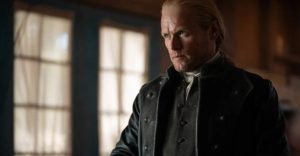
That said, the hour rebounds hard whenever it gets specific about character. Jamie and Claire arguing over Lord John works because Jamie is not noble here. He is petty. Humiliated. Jealous in a way that makes perfect emotional sense, even if it does not flatter him.
Claire is right to insist she did nothing wrong. Jamie is right that he cannot stop seeing it. That tension feels real because nobody is speaking in grand symbolic terms.
Instead, they sound like two people trying to survive a bruise neither one knows how to ignore. Late-season Outlander can sometimes drift toward operatic abstraction. This scene keeps its feet on the ground.
Fanny’s material works for similar reasons. She hears conflict and immediately assumes she is disposable. That is trauma writing with receipts.
She does not need a long speech explaining her worldview. Her body and her assumptions do it for her. Still, the show is starting to lean a little too hard on the brothel callback as a repeated note.
It still works emotionally. But it is getting close to becoming the only register the character is allowed to play. That would be a mistake, because what makes Fanny compelling is not just what happened to her. It is how quickly she translates every room into a test of whether she is safe.
William and Amaranthus Steal the Hour
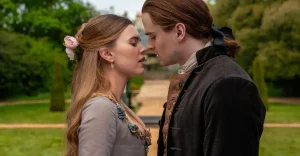
Then there is William and Amaranthus, the stealth MVP of the episode. The scene begins with a setup that could have gone very broad: awkward entrance, shirtless William, a waistcoat fitting, and some fluttery period-drama energy.
Instead, the writing and direction settle into what the scene is really about: fit, compatibility, desire, and evaluation. “Let’s see if it fits” is doing far more than talking about clothes.
Amaranthus is taking William’s measure in every sense. Her hands on his back are practical, but charged. The mirror shot matters because it frames them together before either one is willing to say what is happening.
When she lands on “just right,” the line works because the clothes are not the point. They were never the point.
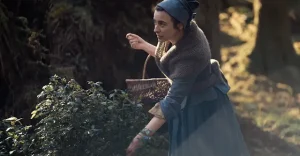
This is also where the production design quietly does character work. Lord John’s Savannah world has texture. The house, the shutters, the curated details, and even Amaranthus’s fascination with beetles and patterning help make her feel like more than “Ben Grey’s widow.”
She has curiosity. Taste. Specificity. As a result, she is being built as a person, not just a complication. That is the right move if William’s story is finally going to become about interior life instead of procedural mystery-solving.
Where “Abies Fraseri” Stumbles
The Cunningham reveal is effective for a different reason. It confirms what the season has been hinting at all along: the threat to Fraser’s Ridge is not just coming from outside forces. It is already inside the walls.
Cunningham matters less as a moustache-twirling villain than as a symptom of drift. Jamie has been absent, distracted, and pulled in multiple directions. Loyalist rot did not wait politely for him to get back. It moved in.
That is a stronger story than “surprise, this guy is bad.”
If the episode has one real structural casualty, it is the cairn scene with Jamie and Fanny. On paper, it is beautiful. Jamie gives Jane a place. He gives Fanny a place to grieve. He turns memory into belonging.
But the episode does not give the moment enough runway. It has barely landed before the plot machinery barges in with Cleveland, dead officers, and coded letters.
All of that story movement makes sense. The problem is placement. The hour keeps stepping on its own smaller, better moments in a rush to keep the larger game board moving.
That is why “Abies Fraseri” is both encouraging and maddening. It contains some of the season’s best scene work so far. It trusts subtext. It lets people be ugly in recognizable ways. It remembers that grief and jealousy are not tidy.
Still, it also wants credit for a huge mythology escalation before the emotional dust has fully settled. When it stays intimate, it sings. When it rushes toward lore, it gets shakier.
Even so, a late-stage Outlander episode that leaves you arguing this much is doing something right.
Outlander Season 8 Coverage
Visit the Outlander Season 8 Episode Guide for episode reviews, recap podcasts, listener feedback episodes, fan reaction articles, and explainers.
Tell Us Your Rating(s)
What was your Kilt Rating for “Abies Fraseri”? Did the blue-light reveal work for you, or was it one big swing too many? Let us know in the comments.
For the full episode cluster, check the Season 8 hub and keep up with the podcast, explainers, fan reaction, and listener feedback coverage.
Slàinte Mhath. 🏴