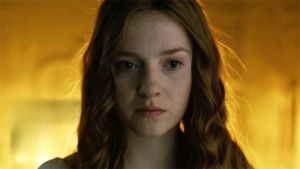
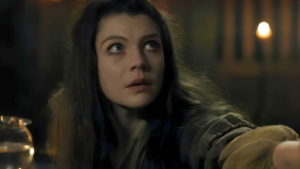
Full spoilers for Outlander: Blood of My Blood Season 1 Episode 7, “Luceo Non Uro,” follow.
As we head back through Blood of My Blood Season 1 before Season 2, this is one of those episodes I like quite a bit more than I love. There is a lot here that works for me: the Jacobite story finally has real political momentum, Ellen gets to weaponize the exact assumptions everyone keeps making about her, Rob Roy arrives without feeling like the show is screaming HISTORICAL CAMEO at us, and Bear McCreary does some absolutely ridiculous work during the escape from House Nairne.
But “Luceo Non Uro” also exposes two craft problems that keep it from becoming one of the season’s stronger hours. The first is a scene-construction problem: the big Jacobite escape is supposed to be operating at maximum urgency, yet the action repeatedly stops so characters can explain future plot mechanics. The second is even more important: Henry’s psychological collapse in Episode 6 barely seems to alter the man we meet in Episode 7.
That distinction matters because this episode is at its best whenever pressure forces somebody to make a choice. It becomes considerably shakier whenever the writing pauses that pressure — or refuses to carry its consequences forward.
Kilt Rating: 3.9 / 5
Getting Back Into Blood Of My Blood Before Season 2?
We have rebuilt the entire Season 1 path so you do not have to remember where the hell everybody was standing eight episodes ago.
Read the complete Season 1 recap · Explore every Season 1 episode · Visit the complete Blood Of My Blood guide · Get ready for Season 2
The Jacobite Story Finally Feels Dangerous
The strongest material in the episode comes from the growing Jacobite problem because the politics are no longer sitting in the background as historical wallpaper. They are actively threatening the characters’ plans.
Dougal thinks he can pledge MacKenzie men and money to the cause. Colum knows that kind of commitment could destroy them politically and financially. Ellen understands that her marriage to Malcolm Grant is now tied directly to whether the MacKenzies can maintain the appearance of loyalty. Malcolm arrives at House Nairne with Redcoats. Rob Roy is standing in the middle of the whole thing. Suddenly several different wants are competing inside the same room.
That is drama because everybody wants something slightly different, and nobody can simply take what they want without affecting everybody else. Ellen wants to stop Dougal without exposing the MacKenzies. Dougal wants to act like the war chieftain he believes himself to be. Malcolm wants to protect the Grant position. The Redcoats want arrests. Rob Roy wants support for the Jacobite cause. Murtagh and Brian are being pulled into a political conflict they have not fully chosen yet.
The episode becomes more alive because the story is no longer asking only, “Who loves whom?” It is asking what those relationships cost once history starts pressing down on them.
And Bear McCreary Is Doing Some WORK
The House Nairne sequence gets an enormous lift from Bear McCreary. Once the Redcoats start making arrests and the entire meeting breaks apart, the score gives the sequence movement, danger and almost a sense of inevitability. The music understands exactly what the scene is supposed to feel like.
Which is why the staging itself bothered me so much.
We have gunfire. Redcoats are making arrests. People are scattering. Everyone in that courtyard understands that being caught in the company of known Jacobites could become a life-changing problem.
And then Ellen and Murtagh basically stop.
The Getaway Scene Stops Being A Getaway
This was one of those moments where I became acutely aware of the writers needing to move pieces into position for the next plot turn.
Ellen has just realized that Malcolm cannot refuse her himself. She needs Isaac Grant to decide she is unsuitable for the marriage. That is actually a smart realization, and it continues something the episode understands very well about Ellen: because she possesses very little formal power, she survives by understanding exactly where everyone else’s power comes from and finding ways to redirect it.
But there is a huge difference between a character realizing something and a character stopping in the middle of mortal danger to explain that realization.
Ellen and Murtagh are standing there while soldiers are barely any distance away, and the scene suddenly needs them to work through the mechanics of the Grant marriage. Ellen essentially lands on the idea that Malcolm cannot deny her, but his father can. Murtagh has time to process Brian’s identity. Ellen has time to threaten Dougal with mutually assured destruction over their respective secrets.
Guys. RUN.
This is where the scene stops being experienced through the characters and starts feeling like a delivery system for information the writers need us to have before everybody leaves the location.
That is the real problem. It is not that the information is unnecessary. Almost all of it matters. The problem is that the scene has established one behavior and then asks the characters to behave according to another.
If soldiers are closing in and arrest means treason, exposure or death, then survival has become the immediate objective. Every choice should now be shaped by that pressure. Dialogue gets shorter. Thought becomes more instinctive. Characters prioritize. People miss things. They misunderstand each other. They make decisions before they have enough information because they do not have the luxury of calmly sorting through all of it.
Instead, the episode briefly gives everybody the luxury of the writer’s room.
And that breaks the spell.
Why The Force Awakens Version Works Better
Say what you will about Star Wars: The Force Awakens, but the early Finn and Rey escape understands this principle beautifully. They are literally running from Stormtroopers while trying to figure out how the hell they are going to get away. Rey points toward one ship, Finn objects, and circumstances immediately force them toward the Millennium Falcon.
The exposition is happening inside the action.
They do not stop running so Rey can explain the strategic value of one spacecraft compared with another. Their information is fragmented by danger because their behavior is being dictated by danger.
That is what I wanted from House Nairne. Ellen absolutely can realize that Isaac Grant is her escape hatch. She could throw some version of that thought at Murtagh while climbing onto the horse. She could reach the realization because Malcolm protects her. She could understand it only after they escape and the adrenaline begins to settle.
But once everybody stops in the courtyard and begins calmly advancing future plot, the sequence loses the very urgency McCreary’s score is desperately trying to give it.
Go Deeper Into Episode 7
Episode 7 is also where several of the season’s bigger character and political threads really start connecting. Read how Dougal becomes the man we know from Outlander, why the Colum/Dougal split matters, why Lord Lovat matters to Brian and Jamie, and what the Stone of Destiny prophecy is really doing.
But The Bigger Problem Is What Happens After Pressure
The House Nairne problem is about what happens when a scene creates pressure and then pauses it. Henry has the opposite problem: Episode 6 puts him through enormous psychological pressure, but Episode 7 barely carries the consequences of that experience forward.
And to me, that is the more interesting craft problem buried inside “Luceo Non Uro.”
Unlock the rest of this article.
Join the NerdClan — or sign in if you are already a member — and the rest of this article will unlock right here on this page. This entry requires Associate Producer or higher.