Our Blood of My Blood Season 1 Episode 6 review breaks down “Birthright,” an episode that finally makes Davina emotionally legible and gives Henry one of his most ambitious character turns — but also pushes the suffering so relentlessly that tension sometimes turns into noise.
At its best, “Birthright” understands that pressure matters because of what it forces people to reveal or choose. Davina’s history changes the way we read her cruelty, Henry’s grief fractures his relationship with reality, and one quiet moment of tenderness becomes more powerful precisely because the rest of the episode is so oppressive. The problem is that the episode does not always trust those character turns to carry the weight on their own.
Full spoilers for Outlander: Blood of My Blood Season 1 Episode 6, “Birthright,” follow.
Watch Our Blood Of My Blood Episode 6 Recap & Reaction
Listen To The Podcast
Subscribe To Outlander Cast
APPLE PODCASTS YOUTUBE SPOTIFY
Catching up on Blood Of My Blood?
Visit our complete Blood Of My Blood Season 1 Episode Guide for every episode, podcast, explainer, and fan reaction.
Blood Of My Blood Episode 6 Recap
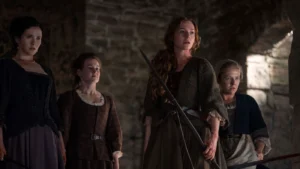
Julia goes into labor, and the room around her quickly turns into a nightmare of fear, superstition, shame, and accusation. Davina initially appears to be driving much of that cruelty, but the episode finally reveals the history underneath her behavior. Once we see what Lord Lovat did to her and what surrounded Brian’s birth, her volatility becomes much easier to understand even if it is no easier to excuse.
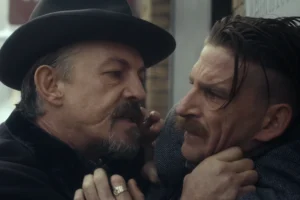
Meanwhile, Henry is told that Julia is dead. Instead of treating the news as an ordinary grief beat, “Birthright” lets Henry’s reality begin to collapse around him. His memories of war, his trauma, his displacement in time, and his desperate attachment to Julia begin bleeding together until the distinction between past and present becomes increasingly unstable.
Why Davina Finally Works In “Birthright”
The strongest thing “Birthright” does is finally give Davina a point of view sturdy enough to organize her behavior. Earlier episodes sometimes made her feel as though she were ricocheting between cruelty and vulnerability according to whatever a scene needed from her. Here, the flashbacks give that contradiction an internal logic. Shame, humiliation, survival, motherhood, and Lord Lovat’s power have all become tangled together inside her.
That does not redeem Davina, and it should not. What it does is clarify her. There is an enormous difference between explaining why a character behaves badly and asking the audience to forgive the behavior, and “Birthright” is much stronger when it stays on the explanation side of that line.
Her eventual decision to clear the room and help Julia therefore feels like an actual character turn rather than a writer flipping a switch. Julia’s desperation collides with Davina’s own history, and Davina is finally forced to confront the pattern she has been participating in. That is the episode using pressure correctly: the crisis forces somebody to make a choice.
Go deeper into Episode 6:
Henry’s story becomes one of the strangest and most divisive parts of “Birthright.” We broke down exactly what the episode is doing with his fractured reality and why the scene with Seema is more complicated than a simple infidelity plot.
Read: What Happened To Henry In Blood Of My Blood Episode 6? →
Henry’s Breakdown Works Because It Comes From Character
Henry gets the episode’s boldest material, and it works better than much of the ritual-horror surrounding Julia because the series has actually prepared us for his collapse. Henry has never been okay. His experience of war, his time displacement, his emotional dependence on Julia, and his increasingly fragile relationship with the world around him have all been putting cracks in the foundation.
So when Arch Bug tells Henry that Julia is dead, Henry does not simply become sad. His system fails. Reality slips, the past invades the present, and the episode begins expressing his grief through his point of view instead of simply having him explain how devastated he feels. That is where the episode gets weird for character rather than getting weird simply because it wants a creepy image.
The scene with Seema is still messy, and it is supposed to be difficult. The story asks us to hold Henry responsible for what happens while also understanding that he is not functioning inside an ordinary emotional reality. Some viewers will reject that distinction completely, which is understandable. But dramatically, the choice at least grows out of a fracture the series has been building rather than appearing because the plot suddenly needs Henry to make a shocking mistake.
Arch Bug Is More Dangerous When He Looks Human
Arch Bug quietly gets one of the episode’s best villain beats because his apparent empathy toward Henry briefly makes him feel human. That does not redeem him. It makes him more effective. A villain who does nothing except advertise his villainy eventually becomes easy to read; someone capable of understanding grief well enough to weaponize it is much harder to dismiss.
The lie about Julia therefore works on two levels. It destroys Henry because it attacks the exact wound Henry cannot withstand, but it also tells us something about Bug. He does not merely know how to hurt people physically. He understands where the emotional pressure points are.
Where “Birthright” Pushes Too Hard
The birthing chamber is where the episode’s instincts begin working against one another. The underlying situation is already horrifying: Julia is vulnerable, isolated, surrounded by people who believe they understand what her body and her baby mean, and trapped inside a power structure she cannot control. That is enough pressure to build an extraordinary sequence.
Instead, “Birthright” repeatedly adds more volume. The chanting, wailing, accusations, shame, and increasingly theatrical atmosphere eventually start flattening the tension rather than escalating it. Pressure works best when each new complication narrows the available choices. Here, the episode sometimes mistakes making the room louder for making Julia’s situation more dramatically specific.
That distinction matters because the strongest scenes in “Birthright” are almost always the ones in which characters actually have to do something with the pressure. Davina has to decide whether to repeat what was done to her. Henry’s mind tries to survive information it cannot process. Those turns create consequence. A room full of people continuing to be horrible can absolutely create misery, but misery by itself is not the same thing as progression.
The Quietest Scene May Be The Most Important
The candlelight-and-cake moment works precisely because the episode finally allows the story to breathe. After so much cruelty, noise, fear, and ritual, the scene returns to something ordinary and human. Tenderness suddenly has texture again because the episode has spent so long depriving us of it.
That moment also reminds us what all of this suffering is theoretically protecting: the possibility of warmth, intimacy, family, and a life that is not entirely controlled by power. “Birthright” needs that contrast. Without it, the episode risks becoming emotionally monochromatic, where every scene is simply another variation on pain.
What “Birthright” Gets Right — And What Holds It Back
“Birthright” is at its strongest when birth becomes a crisis engine that forces character truth. Davina finally becomes understandable without becoming innocent. Henry’s breakdown makes his internal damage visible. Arch Bug becomes more dangerous because he understands exactly what Henry needs to hear. Those choices deepen the people rather than merely increasing the amount of suffering surrounding them.
Where the episode struggles is in trusting those choices. It repeatedly pushes toward more ritual, more screaming, more discomfort, and more overt intensity when the quieter character turns are already doing better work. The result is an episode with several genuinely strong ideas that occasionally obscures them by insisting that we feel the pressure instead of simply letting the drama create it.
More Blood Of My Blood Episode 6 Coverage
- What Happened To Henry? — Henry’s fractured reality, Julia’s supposed death, Seema, and what the episode is actually showing us.
- Is Lord Lovat Really The Father Of Julia’s Baby? — the Episode 6 accusation, Julia’s pregnancy, and what the show establishes about the baby’s parentage.
- Where The Clans Stand This Week — how the fandom reacted to “Birthright” and why the episode split the room.
Keep going through Blood Of My Blood.
Episode 6 is one piece of a much larger prequel story. Use our Season 1 hub to move through every episode, or head to the complete Blood Of My Blood guide for characters, mythology, time travel, family connections, and our full Outlander Cast archive.
Blood Of My Blood Season 1 Episode Guide →
Complete Blood Of My Blood Guide →
Outlander Cast Podcast Hub →
Join The Conversation
Did “Birthright” work for you as a pressure-cooker episode, or did the birthing chamber push past tension and into melodrama? And where do you land on Henry’s story: tragic, frustrating, disturbing, or some combination of all three?
Leave a comment or send us a voicemail at SpeakPipe.com/MaryAndBlake.
Pull up a chair.
The Nerd Clan is where the deeper Mary & Blake conversation lives: bonus podcasts, extended analysis, community discussion, and all the increasingly obsessive Outlander nerdery that does not stop when the credits roll.
Slàinte Mhath. 🏴