
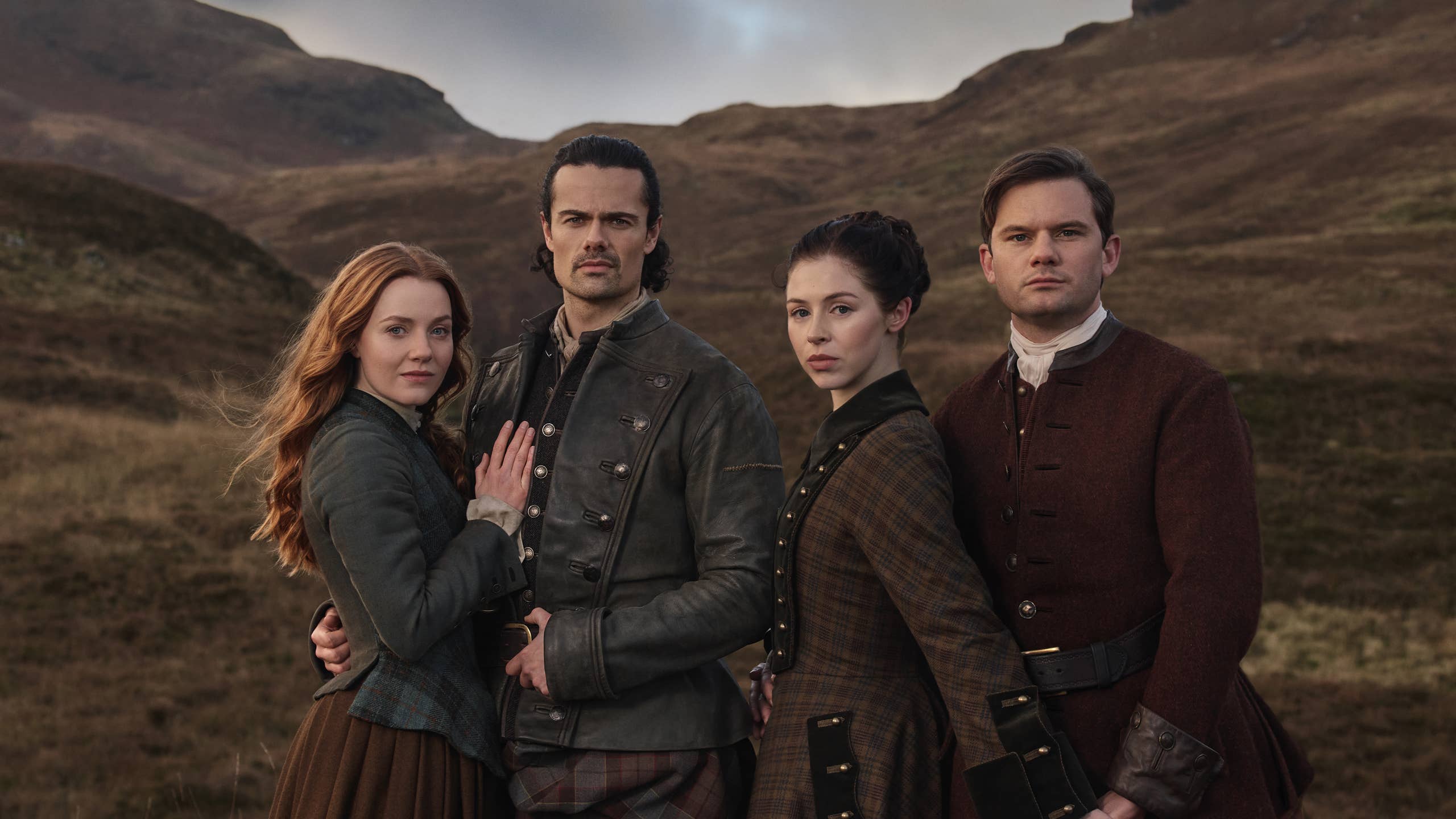
The Outlander prequel might be a victim of its own success. After examining STARZ’s finances, subscriber numbers, production strategy and cancellation history, I’m increasingly concerned that the network is prepared to move on from Outlander.
I’ve spent the better part of my adult life talking about Outlander, and I never thought I’d write the following sentence: I think there’s a very real possibility that we’ve just watched the last episode of Outlander television ever produced.
As of November 28, 2026, STARZ has neither officially renewed nor canceled Outlander: Blood of My Blood for Season 3. The second season concluded on November 27, and while the creative team clearly has more story to tell, I’m leaning toward the possibility that we won’t get another season.
My concern has surprisingly little to do with the quality of the show. In fact, I think the prequel has finally started figuring out what kind of television series it wants to be. Harriet Slater has become an absolute force, the production has established its own visual identity, and there are elements of the second season that demonstrate the enormous creative potential of this particular corner of the Outlander universe.
Unfortunately, I’ve also been reading STARZ’s quarterly earnings reports. Yes, friends. This is what I do for fun. Somewhere in Scotland, a Highland cow is judging my life choices.
But buried within those financial reports and conversations between STARZ executives and Wall Street analysts is a story considerably more interesting than the usual speculation about television ratings. It’s the story of a company attempting to fundamentally reinvent itself, and a beloved franchise that might have been built for a version of that company that no longer exists.
The more I understand STARZ’s business strategy, the less confident I become about Blood of My Blood Season 3. So grab a dram, pull up a chair, and indulge me as we spend a little time examining the most terrifying villain ever introduced into the Outlander universe: corporate finance.
Will There Be a Season 3 of Blood of My Blood?
If you forced me to make a prediction today, I’d put the likelihood of a third-season renewal at approximately 45%. That’s an educated editorial guess based on publicly available information, rather than an actual statistical forecast. I have no inside knowledge of negotiations between STARZ, Sony or the creative team.
| Blood of My Blood Season 3 | Current status |
|---|---|
| Official renewal | Not announced |
| Official cancellation | Not announced |
| Release date | Not announced |
| Filming start date | Not confirmed |
| Episode count | Unknown |
| Creative plans | The producers have discussed potential future storylines |
| My renewal prediction | 45% |
The reason I’m skeptical comes down to a fundamental question about what STARZ wants to accomplish over the next several years. I believe Blood of My Blood was commissioned to solve a problem that STARZ had in 2023. But the company’s priorities have evolved considerably since then, particularly following its separation from Lionsgate in 2025.
To understand why that matters, we need to look at how differently STARZ has handled the renewal of this series compared with virtually everything else in the Outlander franchise.
Why Hasn’t Blood of My Blood Been Renewed for Season 3 Yet?
Remember when STARZ used to hand out Outlander renewals like Oprah handing out cars? You get a season! You get a season! EVERYBODY GETS A SEASON!
In 2016, STARZ renewed Outlander for both Seasons 3 and 4. In May 2018, six months before the fourth season even premiered, STARZ committed to Seasons 5 and 6.
The company demonstrated extraordinary confidence in its relationship with this franchise, and that enthusiasm extended to the prequel. On June 23, 2025, STARZ announced that Blood of My Blood had been renewed for Season 2. Production began in Scotland that very day, using the same facilities that had housed Outlander for much of the preceding decade.
The first episode of Blood of My Blood wouldn’t premiere until August 8. Think about the confidence required to make that decision. STARZ had committed to producing twenty episodes of a television series without a single member of the paying public having watched its premiere.
| Renewal | Announcement |
|---|---|
| Outlander Seasons 3 and 4 | June 2016 |
| Outlander Seasons 5 and 6 | May 2018 |
| Blood of My Blood Season 2 | June 23, 2025 |
| Blood of My Blood Season 3 | Unannounced as of November 28, 2026 |
STARZ has had the benefit of watching two seasons of the prequel unfold. It has considerably more information about the show’s commercial performance than it possessed when it enthusiastically commissioned Season 2. Yet the company hasn’t publicly committed to another installment.
There are perfectly ordinary explanations for a delayed renewal. Contracts, production schedules, international distribution agreements and budget negotiations can complicate the process. The absence of an announcement immediately after the finale is hardly evidence that somebody has already pulled the plug.
But within the context of STARZ’s historical relationship with Outlander, the change in behavior deserves our attention. Especially when you consider how successful the prequel appeared to be when it first arrived.
Are Blood of My Blood’s Ratings Good Enough for Season 3?
One of the more remarkable accomplishments of Blood of My Blood was the commercial success of its first episode. During STARZ’s August 2025 earnings call, CEO Jeffrey Hirsch revealed that the series premiere ranked third among STARZ series debuts for new subscriptions. Its viewership also surpassed the final episode of Outlander Season 7 by 40%.
That’s a hell of an accomplishment. Imagine being tasked with building a television show that inherits the audience of Jamie and Claire Fraser without having Jamie and Claire Fraser in it. You’re effectively asking millions of people to transfer twelve years of emotional investment into an entirely new cast of characters.
Hollywood has spent considerable amounts of money discovering how difficult that can be. The initial performance of Blood of My Blood suggested that Outlander had become something larger than its two original stars. That’s an incredibly valuable discovery for any entertainment company.
The trouble comes when we attempt to assess Season 2 using the same measurements. At the time of writing, the second season has a 100% critic score on Rotten Tomatoes, compared with an 88% score for Season 1. The critical reception is encouraging, although the available review sample is relatively small.
And there’s a fundamental misunderstanding about what that number represents. Rotten Tomatoes scores measure the proportion of critics who gave a production a positive review. A 100% score could mean that every critic thought the show was pretty good. It doesn’t necessarily mean they all thought it was the greatest achievement in human civilization since the invention of indoor plumbing.
More importantly, Rotten Tomatoes can’t tell us how many people paid to watch the show. For STARZ, the measurements that really matter are considerably different:
- How many people subscribed specifically to watch Season 2?
- How many viewers returned from Season 1?
- How many completed the season?
- How long did those viewers remain paying subscribers?
- What else did they watch while subscribed?
- How much revenue did their subscriptions generate relative to the cost of acquiring and retaining them?
I haven’t found publicly disclosed, comprehensive Season 2 figures that answer those questions. STARZ did acknowledge the prequel positively in its October 2026 earnings call, and entertainment-industry reporting identified the series as one of several programming contributors to the company’s improved quarterly performance. That’s good news.
But we have no reliable way to isolate how much of that financial improvement came from Blood of My Blood. And STARZ has recently made it considerably harder for us to investigate.
STARZ Has Stopped Telling Us How Many Subscribers It Has
At the end of 2025, STARZ reported approximately 17.63 million paying subscribers in the United States. Here’s how its domestic subscriber base had changed during the preceding year, according to its fourth-quarter earnings release.
| US subscribers | December 2024 | December 2025 |
|---|---|---|
| Streaming | 11.77 million | 12.66 million |
| Traditional television | 5.91 million | 4.97 million |
| Total | 17.68 million | 17.63 million |
The company had successfully added nearly 900,000 streaming subscribers over the course of the year. Unfortunately, its traditional television business was losing customers even faster. STARZ was essentially running up a down escalator.
Beginning in 2026, the company stopped routinely reporting its quarterly subscriber totals, choosing instead to emphasize revenue and profitability. That’s an important philosophical change, and there’s actually a perfectly reasonable business argument for making it.
Imagine Mary and I launch our own streaming service. It’s an entertainment paradise featuring Scottish period dramas, Bridgerton, Harry Potter arguments, Mary singing Disney songs, and an unreasonable amount of me talking about LOST. We attract a million subscribers by charging everyone a dollar per month.
We’ve officially got a million-subscriber business. Sounds impressive, right? Except a competing service with 100,000 customers paying ten dollars per month generates exactly the same subscription revenue. Depending on the costs involved in serving and acquiring those customers, the smaller service might be a considerably more attractive investment.
The streaming industry spent years obsessing over subscriber growth. Wall Street eventually started asking an uncomfortable follow-up question: when exactly are you going to make money from all these people?
STARZ’s response to that question is particularly relevant to Outlander because the value of our fandom depends enormously on how long we maintain our subscriptions. Which brings us to Droughtlander.
Droughtlander Is Actually a Multimillion-Dollar Business Problem
There’s a word in the subscription business that should be familiar to every Outlander fan, even if you’ve never heard it before. Churn.
Churn describes the rate at which customers stop paying for a subscription service. If you’ve ever subscribed to STARZ for an Outlander premiere and canceled it after the finale, congratulations. You’re churn.
And STARZ knows exactly who you are. During the company’s October 29, 2026, earnings call, Jeffrey Hirsch specifically discussed the relationship between programming consistency and the retention of Outlander and Power viewers.
“When you have shows on the air every week for the Power audience or the Outlander audience, churn is really low.”
He explained that gaps between relevant shows encourage customers to cancel and eventually resubscribe. We’ve been making Droughtlander jokes for years. It turns out Droughtlander is a legitimate subject of discussion on Wall Street.
Consider two hypothetical STARZ subscribers.
| Subscriber behavior | Annual revenue at $10/month |
|---|---|
| Subscribes for three months of Outlander | $30 |
| Remains subscribed for the entire year | $120 |
Both people could be equally passionate Outlander fans. One might own every book, attend every convention, have a portrait of Sam Heughan hanging in the bathroom and know more about eighteenth-century Scottish agricultural practices than the actual people who lived there.
From STARZ’s perspective, however, the customer who stays subscribed throughout the year generates four times as much revenue in this example. That’s why television companies increasingly care about something called customer lifetime value: the economic value of a customer over the duration of their relationship with the business.
It’s also why STARZ is interested in creating longer seasons of certain shows and developing complementary programming that appeals to the same audiences. The more weeks of relevant programming the network can offer, the more opportunities it has to keep those subscription payments coming.
And this is where I think the end of the original Outlander creates an unexpected problem for Blood of My Blood. When STARZ had two Outlander productions, the possibility existed to stagger their releases, creating more consistent engagement with the franchise throughout the year.
With the original series finished, the entire burden of maintaining that television relationship now rests on the prequel. If it takes twelve to eighteen months to produce ten new episodes, STARZ still faces enormous gaps in programming for its dedicated Outlander audience.
The commercial question becomes whether spending millions of dollars on another season of Blood of My Blood represents the most efficient way to keep those customers. And the company might have found a better answer.
The $3 Million Problem: The Television Show Outlander Fans Should Know About
There’s a television series called Fightland that I suspect most Outlander fans have never watched. Nevertheless, it might be one of the most important television shows to understand when considering the future of Blood of My Blood.
Fightland represents STARZ’s first internally owned original series following its separation from Lionsgate. The company has been particularly enthusiastic about the economic advantages associated with the production.
During the October earnings call, Hirsch estimated that Fightland delivered approximately $3 million in net cost savings per hour compared with production economics under the company’s previous parent. He also explained that owning original programming allows STARZ to generate additional revenue through international distribution agreements.
This is an enormous development. Most viewers tend to assume that when a television show says STARZ Original at the beginning, STARZ owns that television show. But the entertainment industry is full of complicated arrangements between production companies, distributors, broadcasters, streaming platforms and international licensing partners.
The Outlander franchise is produced by Sony Pictures Television and its production partners. STARZ is its American television home, but the franchise’s commercial rights extend beyond STARZ. The prequel, for example, is distributed through MGM+ in the United Kingdom and Stan in Australia.
Think of it this way. Imagine I own a restaurant that serves the greatest cheesecake you’ve ever eaten. People drive from Massachusetts, Connecticut and New York just to get their hands on this cheesecake.
Business is booming. There’s only one complication: I don’t own the recipe. Another company makes the cheesecake, sells it to me, and earns additional money by distributing it to restaurants in other markets.
I’m benefiting enormously from having this product in my restaurant. But somebody else controls a considerable portion of its long-term commercial value. Now imagine I develop my own cheesecake that costs less to produce. I can serve it in my restaurant, sell it to other establishments, license the recipe, and potentially earn money from it for years after its initial introduction.
You can probably see where this is going. STARZ believes it can improve its financial performance by owning more of the television programming it distributes.
The difference in production economics described by Hirsch for Fightland alone illustrates the potential scale. Across a hypothetical ten-hour production, a $3 million per-hour saving would amount to $30 million. That is an illustration of the business model, rather than a claim about what Blood of My Blood costs or how much STARZ could save by canceling it.
The larger point is that an internally owned show could theoretically attract fewer viewers than a licensed production and still be a better financial investment. And STARZ has openly discussed its intention to own approximately half of its 2027 programming slate, with the value of that owned library increasing as more productions enter the marketplace.
We’re witnessing the early stages of a fundamental change in how STARZ approaches the television business. Outlander was built under a different arrangement, and its immense popularity doesn’t automatically exempt it from the consequences of that change.
How Much Does Blood of My Blood Cost to Make?
Unfortunately, I haven’t been able to verify a reliable, standalone production budget for Blood of My Blood Season 2 or its individual episodes. Any website confidently throwing around a precise figure should be able to show you where that figure came from.
What we can establish is that the series has many of the characteristics associated with expensive high-end television production. Consider the amount of money involved in creating a single scene at Castle Leoch.
The costumes, wigs, furniture, weapons, candles, tapestries, food, lighting, performers, historical consultants, camera equipment and production personnel all need to be organized, paid for and coordinated.
Someone has to make the costumes. Someone has to maintain the costumes. Someone has to make sure Dougal hasn’t accidentally destroyed the costumes while declaring war on somebody for the seventeenth time.
Then you’ve got horses, location filming, transportation, stunt coordination, visual effects, editing, music, insurance and the multitude of other expenses associated with producing a historical drama.
The great advantage of Blood of My Blood is that it inherited an established Scottish production ecosystem. Its second season began filming on the same stages previously used by Outlander, and Screen Scotland has supported the prequel through production and skills funding.
The United Kingdom also provides a substantial financial incentive for eligible high-end television productions through its Audio-Visual Expenditure Credit, which offers a 34% taxable credit on qualifying expenditure. The actual financial benefit depends on the applicable rules, qualifying costs and taxation.
Those advantages could make continuing the prequel considerably more attractive than launching an entirely new historical production from scratch. But the budget of the television series and the amount STARZ ultimately pays to distribute it are separate financial considerations.
The overall production might involve international partners, financing arrangements, tax incentives and licensing revenues that change the economics for each participating company. STARZ’s specific financial commitment to another season remains undisclosed. That’s why I believe any renewal decision could depend as heavily on the agreement Sony and STARZ reach as it does on the number of people watching the show.
The $600 Million Budget: STARZ Has Changed the Rules
STARZ completed its separation from Lionsgate in May 2025. The network is now an independent, publicly traded business that must demonstrate its ability to generate cash, control expenses and create value for shareholders on its own.
Its latest financial results and accompanying earnings call provide some interesting context.
| STARZ financial metric | Q3 2026 |
|---|---|
| Total quarterly revenue | $322.4 million |
| Operating loss | $21.2 million |
| Adjusted OIBDA | $44.2 million |
| Net corporate debt | $600.7 million |
| Projected 2026 unlevered free cash flow | $100–120 million |
| Expected full-year cash content spending | Below $600 million |
STARZ is also targeting a 20% adjusted OIBDA margin during the second half of 2027. These are the company’s own reported figures and management targets.
For those of you whose eyes have just glazed over, allow me to explain. STARZ has a considerable amount of debt, a business undergoing a major transformation, and a management team that has made specific promises to investors about improving financial performance.
Adjusted OIBDA is one of the company’s preferred measures of operating performance. It excludes certain expenses and accounting items, so a positive adjusted OIBDA can coexist with a reported operating loss.
The overall direction of the company is encouraging. But accomplishing its financial objectives requires careful decisions about where to invest its money. This is called opportunity cost.
Every dollar STARZ commits to Blood of My Blood is a dollar that cannot simultaneously be committed to another original series, an international acquisition, a marketing campaign, debt reduction or some other business priority.
The prequel could be profitable and still lose out to another investment that management believes offers a better return. That’s an uncomfortable reality for television fans because we tend to evaluate the success of our favorite shows through their storytelling, popularity and cultural significance.
The business evaluates them within an entire portfolio of competing opportunities. And STARZ has explicitly identified reducing content costs and increasing ownership as important components of its financial future. Which makes the cancellation of another historical drama particularly relevant to this conversation.
The Ghost of Spartacus: STARZ’s Most Alarming Recent Cancellation
If I were an Outlander fan looking for a recent television cancellation that should genuinely concern me, I would look at Spartacus: House of Ashur. The original Spartacus franchise was an important part of STARZ’s early identity as a premium cable network. It attracted a dedicated audience, established recognizable mythology and became a property that the company could revisit years later.
House of Ashur attempted to capitalize on that relationship by introducing a fresh story within the established universe. Sound familiar? Both House of Ashur and Blood of My Blood are historical dramas that require considerable production resources. Both were designed to build on existing franchise awareness. Both were attempting to extend the commercial life of properties STARZ had helped establish.
And here’s the really interesting part. In its fourth-quarter 2025 earnings report, STARZ identified House of Ashur as one of the original productions contributing to its subscriber growth.
On May 22, 2026, STARZ canceled the series after one season. The company had publicly acknowledged a commercial benefit from the show only a few months before deciding against continuing it.
We don’t have enough financial data to establish whether the economics of Spartacus and Blood of My Blood are directly comparable. Their audiences, production arrangements and costs may be substantially different.
But the precedent should challenge a common assumption about television renewals. A show can successfully acquire subscribers and still fail to justify the financial commitment required for another season.
| STARZ series | Outcome |
|---|---|
| Outlander | Eight seasons |
| The Serpent Queen | Canceled after two seasons |
| Power Book II: Ghost | Ended after four seasons |
| Spartacus: House of Ashur | Canceled after one season |
| Blood of My Blood | Two seasons; future unconfirmed |
STARZ canceled The Serpent Queen in October 2024, despite having renewed the historical drama relatively early in its original run. Power Book II: Ghost concluded after four seasons even as STARZ continued developing other programming within the Power franchise.
There is clearly a willingness within STARZ to discontinue recognizable properties when management decides that its investment should go elsewhere. In March 2024, Hirsch publicly discussed the increasing costs associated with television shows as they progress through additional seasons. His comments emphasized the economic advantages of developing newer programming, including franchise spinoffs, to replace increasingly expensive established productions.
Which brings us to perhaps the most uncomfortable interpretation of Blood of My Blood.
My Hot Take: Blood of My Blood Might Have Already Served Its Purpose
I want you to consider the possibility that STARZ never needed Blood of My Blood to become another eight-season Outlander. The company knew that its flagship series was approaching the end of its life. It had an enormous audience that needed somewhere to go, an established production infrastructure in Scotland, and an opportunity to extend the franchise using a fresh cast.
Commissioning the prequel gave STARZ a bridge from the end of the original series into its next phase of programming. It created another reason for Outlander fans to subscribe in 2025 and 2026. It offered continuity during a period of significant corporate change and helped maintain the relevance of the franchise while the company developed its future slate.
Those are meaningful commercial accomplishments. But what if the primary financial value of Blood of My Blood was always going to be concentrated in those transitional years? That’s my theory.
The prequel might have fulfilled an important business function without ever needing to become a long-running television institution. Consider how differently we evaluate its success if we think of it as a bridge rather than as a permanent replacement for Outlander. Its first season delivered an exceptional premiere. Its second season offered the audience a new installment of the franchise after Jamie and Claire’s television journey concluded.
During that same period, STARZ was establishing its independence, restructuring its programming portfolio and developing a new model for producing and monetizing television. The company can now evaluate whether continuing to invest in the Outlander franchise offers greater value than directing those resources toward its emerging slate of programming.
We don’t know what STARZ executives privately intended when they commissioned the series, so I wouldn’t suggest that cancellation was always part of some secret master plan. But I think the possibility that Blood of My Blood has already delivered much of its original strategic value deserves considerably more attention.
We want it to be the beginning of another great television journey. STARZ might ultimately decide that it was a successful conclusion to the last one.
The Fatal Flaw in STARZ’s Strategy
Here’s where I think STARZ could make an enormous mistake. I’ve spent much of this article explaining the potential financial logic behind moving away from Outlander. But there’s a difference between replacing a television show and replacing the relationship people have with it.
Let’s return to that hypothetical restaurant. I can stop serving somebody else’s cheesecake and introduce a new dessert that costs less to produce. The financial model might look fantastic.
Except all those people driving from three states away might have been coming specifically for the cheesecake. My alternative dessert could be excellent. The customers might even acknowledge that it’s excellent. They still might stop coming to my restaurant.
This is what makes Outlander such an unusual commercial property. For more than a decade, Mary and I have talked to people whose relationship with Outlander extends far beyond watching television. Entire communities have been formed around it. People have traveled to Scotland, made lifelong friendships, discovered new interests, and developed routines centered on experiencing this story together.
That kind of relationship takes years to establish. STARZ publicly identifies women and underserved audiences as central to its programming strategy. Outlander represents one of its most recognizable connections to those audiences. And the company’s own CEO acknowledges that regularly serving the Outlander audience helps reduce subscriber churn.
STARZ can commission another romantic drama. It can purchase another historical series. It can develop an entirely different property that costs considerably less to produce. Whether any of those productions can establish the same emotional relationship with this audience is another question altogether.
There’s a tremendous difference between the money STARZ saves by canceling Blood of My Blood and the money STARZ might lose because it no longer offers the television show that keeps a particular audience coming back.
The company has access to considerably more information about that audience than any of us do. Perhaps its internal data suggests that the viewers will remain subscribed for other shows. But I wouldn’t underestimate how difficult it is to transfer the emotional investment of an Outlander fan to an unrelated television property.
Ask anybody who’s ever tried to find another television show to fill the void left by Jamie and Claire.
When Could Blood of My Blood Season 3 Be Released?
There is currently no confirmed release date for Outlander: Blood of My Blood Season 3. STARZ has not announced a renewal or a production start date.
The historical production timeline gives us some perspective, however.
| Production milestone | Date |
|---|---|
| Season 2 production began | June 2025 |
| Season 1 premiere | August 8, 2025 |
| Season 2 premiere | September 18, 2026 |
| Season 2 finale | November 27, 2026 |
| Season 3 production | Unconfirmed |
Season 2 had approximately fifteen months between the start of production and its premiere. Its early renewal allowed filming to begin before the audience even watched the first season.
Season 3 would face a different timeline. If STARZ commissioned another season relatively soon and production began in early 2027, a late 2027 release would be an ambitious possibility. A 2028 premiere might be more realistic based on the previous production cycle, depending on filming, post-production and scheduling.
Those dates are speculation based on the existing production history. Neither has been announced by STARZ. The longer the renewal process continues, the more difficult it becomes to imagine a relatively short Droughtlander. And we’ve all been through enough of those.
What Would Change My Mind About Blood of My Blood Season 3?
There are legitimate reasons to remain optimistic. The prequel has demonstrated an ability to attract subscribers, it aligns with STARZ’s target audience, and its established production infrastructure potentially gives it economic advantages over a comparable new series.
The involvement of Sony and international distribution partners could also help make a third season financially attractive under the right circumstances. I’d become considerably more optimistic if we learned that:
- Season 2 retained or exceeded the first season’s commercial audience.
- Sony and STARZ had reached a new production or distribution agreement.
- Preparations for filming a third season were underway.
- STARZ identified continued Outlander programming as an important part of its future slate.
I would also consider a shorter third season, or a specifically designated final season, to be a plausible outcome. If STARZ believes there’s value in providing a satisfying conclusion to the franchise while limiting its financial exposure, a negotiated final installment could represent a reasonable compromise.
Personally, I would take that deal in a heartbeat. There is still a considerable amount of story to tell, and I’d much rather see Matthew B. Roberts and his creative team given the opportunity to conclude their story deliberately than leave these characters suspended in perpetual uncertainty.
My Prediction: Has Blood of My Blood Reached the End of the Road?
After reviewing the evidence, I remain skeptical. Here’s how I would characterize the commercial circumstances surrounding the renewal decision.
| Renewal factor | My assessment |
|---|---|
| Outlander franchise recognition | Strong advantage |
| Season 1 subscriber acquisition | Strong advantage |
| Audience alignment | Strong advantage |
| Existing production infrastructure | Advantage |
| Subscriber retention potential | Advantage |
| Season 2 commercial performance | Insufficient public data |
| Current production budget | Undisclosed |
| Lack of an early renewal | Concerning |
| STARZ’s financial objectives | Concerning |
| Recent cancellation history | Concerning |
| Shift toward owned programming | Major concern |
| Future of the original franchise | Major uncertainty |
I’d give another season a 45% chance of happening, and even if that renewal arrives, I would be surprised to see the kind of open-ended commitment that STARZ once afforded the original Outlander.
My prediction is driven primarily by the company’s evolving business strategy. STARZ is becoming a different organization, with different financial incentives and a different vision for the long-term value of its programming. Blood of My Blood has to establish its place within that vision. I hope it does.
Explore more of our Outlander coverage: Our complete Blood of My Blood Season 2 episode guide collects our podcasts, reviews, explainers and reactions. You can also explore our Blood of My Blood franchise guide for everything we’ve covered throughout the series.
The Cruel Irony of Blood of My Blood
There’s something particularly frustrating about the timing of this entire situation. The prequel has spent two seasons attempting to discover its own identity, learning how to utilize its actors, developing its visual language and establishing relationships with an audience that understandably arrived carrying the emotional baggage of another television series.
It takes time to do those things well. One of my favorite television shows, LOST, had episodes in its second season that I would happily erase from existence. There are stretches of some of the greatest television series ever produced during which the creative teams were still discovering the full potential of the stories they were telling.
Outlander itself benefited from having the institutional commitment and creative runway necessary to evolve into something that transcended its original premise. I worry that Blood of My Blood may never receive that same opportunity.
And perhaps there’s something appropriately tragic about the idea that a television series built around the conflict between love, obligation, power and financial interests now finds itself at the mercy of those very same forces.
Brian and Ellen spend their lives trying to establish a future together in a world where their personal desires are constantly weighed against the economic interests of powerful families. Their love has to justify its existence within a system that measures human relationships through land, wealth, alliances and inheritance.
More than three hundred years later, the people telling their story might be facing a remarkably similar problem. There is enormous value in what Outlander has created. You can see it in the friendships, the communities, the conventions, the conversations and the memories that have accumulated over twelve years. You can see it in people who have never met each other gathering around a shared love of this fictional world.
How exactly do you quantify that? How do you assign a financial value to something that has become part of somebody’s identity? How do you predict the lifetime worth of a relationship that hasn’t finished developing?
STARZ has spent more than a decade teaching us that love can transcend time, geography, history and death itself. I suppose we’re about to find out whether it can survive a quarterly earnings report.
Slàinte Mhath.