Prefer the full podcast discussion? Listen to our recap & reaction episode here.
This Week’s Bridgerton Season 4 Coverage
- Podcast Recap & Reaction: Bridgerton Season 4 Episode 1, “The Waltz”
- Fan Temperature: The Latest Gossip From The Ton This Week: “The Waltz”
- Explainer: Who Is Sophie Baek in Bridgerton Season 4? Why the Lady in Silver Reveal Matters
- Explainer: Why Queen Charlotte Still Needs Lady Whistledown in Bridgerton Season 4
- Season Hub: Bridgerton Season 4 Episode Guide
Full spoilers for Bridgerton Season 4, Episode 1, “The Waltz,” below.
“The Waltz” works because it understands the one thing this season absolutely could not afford to screw up: Sophie cannot just be Benedict’s fantasy. She has to feel like a person before she feels like a prize, and that is where this premiere quietly wins. Yes, the episode gives you the silver dress, the candlelight, the masquerade, the giant Violet Bridgerton production-design flex, and the full Bridgerton storybook glow. But the reason the hour actually lands is because Sophie arrives with nerves, wit, caution, and an immediate sense of interior life. She is not just beautiful. She is specific. And once the episode reveals who she really is, the whole thing stops being a fairytale and starts becoming a story with actual stakes.
That is the thesis here. “The Waltz” is strongest when it moves past shimmer and lets class pressure, social performance, and character contradiction do the real work. The romance is viable because Sophie works. The season is viable because Sophie’s reveal gives the romance consequence.
Sophie is the thing that makes the premiere real
From the jump, Sophie feels more grounded than the world she is entering. That is a good thing. It gives the episode tension. She is nervous without being passive, observant without being over-written, and game enough to step into this insane masquerade while still carrying the feeling that she knows she does not belong there. That balance matters because if she were just another Bridgerton fantasy object, Benedict falling for her would feel weightless. Instead, she feels like somebody who has had to learn how to read rooms before she ever got the luxury of enjoying them.
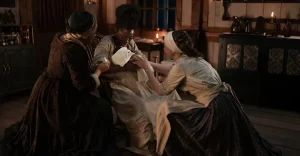
And that is why the ending reveal is the best thing in the episode. Once we learn Sophie is a maid, “The Waltz” instantly gets sharper. The show is no longer asking, “Will Benedict find the mystery woman?” It is asking, “What happens when the woman Benedict cannot stop thinking about exists in a part of his world he has probably never had to truly see?” That is a much better question. It gives the season backbone.
Benedict and Sophie have chemistry. Benedict’s instant lock-in is another story.
This is where the episode is a little split against itself.
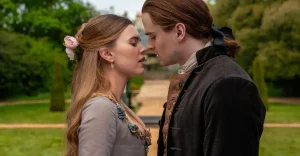
On the one hand, Benedict and Sophie absolutely work once they start talking. The terrace scene is the proof. That is the moment where the episode stops running on visual shorthand and starts trusting the actual dynamic between them. It gets quieter. It gets more intimate. Sophie becomes less of a dream image, and Benedict becomes less of a poster for yearning. Their banter has some air in it. Their conversation feels curious instead of pre-packaged. That is the version of the romance I buy.
What I do not fully buy is the initial stop-dead-in-his-tracks moment.
I understand why the show does it. This is Bridgerton. We are dealing in heightened feeling, romantic iconography, and the full Cinderella machinery. Fine. But the episode itself spends a lot of time telling us exactly where Benedict is at the start of the season. He is drifting. He is unserious. He is still moving through sex, pleasure, and obligation like a man who wants freedom more than commitment. So when he sees Sophie and the show basically goes full Dream Weaver on us, it feels less like character truth and more like the production insisting I should already be there.
Now, to be fair, Bridgerton has always made the argument that rakes rake until they find the right person. I get it. That is the house style. But “The Waltz” would have been stronger if Benedict’s recognition had played as intrigue first and destiny second. A beat of “who are you?” lands better than an instant romantic detonation. Because again: once he actually talks to her, I am in. The chemistry is not the problem. The speed of the myth-making is.
The masquerade is nonsense. The symbolism is good.
Mary is right to call out the masquerade logic, because yes, it is ridiculous. These people have known each other forever. A tiny mask is not witness protection. The idea that everyone is suddenly shocked by identities they should absolutely be able to clock in five seconds is one of those things you just have to accept with a raised eyebrow and a drink in your hand.
But even with that silliness, the masquerade still works as a storytelling device because the symbolism is doing real labor. Everyone is performing. Everyone is managing how they are seen. Sophie hides because she has to. Benedict hides because he has not figured out who he is when the performance of the rake stops being fun. Penelope now lives in the weirdest position of all: she is publicly Lady Whistledown, which means she is technically exposed, but that exposure creates a whole new form of mask. The woman may be known, but the motive behind every line she writes is now up for permanent negotiation.
That is where the episode gets interesting. Not in the practical mechanics of the ball, but in the idea that everybody here is trying to survive by controlling perception.
Penelope, the Queen, and the new problem of public Whistledown
One of the smartest choices in the premiere is refusing to treat the Lady Whistledown reveal as an ending. Instead, it turns it into a new trap.
Penelope should theoretically be freer now that the secret is out. But she is not. She is more exposed, more political, and more easily used. The Queen does not want Whistledown gone. She wants Whistledown useful. That is a better, thornier dynamic than just repeating old secrecy games. It also fits the season’s larger concern with performance and social choreography. Sophie is performing status for one night. Benedict is performing ease when he is clearly restless. Penelope is performing agency while entering a setup that could make her more of a royal instrument than an independent voice.
That gives the premiere a little more under the hood than it first appears to have.
The production design and music are doing a lot of the heavy lifting — thankfully, they are good enough to do it
If there is one area where “The Waltz” leaves absolutely no ambiguity, it is this: Bridgerton remembered how to be Bridgerton again.
The masquerade looks incredible. The flower work is outrageous. Violet’s whole event feels like she looked at subtlety, laughed, and kept decorating. The set dressing, choreography, and visual texture all feel much more alive than they did when the show occasionally drifted into expensive-but-flat territory. This premiere has actual shape. It has movement. It has that specific Bridgerton quality where the room itself feels like it is participating in the seduction.
The music helps because of course it does. “Life in Technicolor” is exactly the right song for Sophie’s arrival. It gives her entrance propulsion, wonder, and the sense that she is stepping into a world so bright it almost feels unreal. “DJ Got Us Fallin’ in Love” is shamelessly on the nose, but Bridgerton has always known that on-the-nose works when the confidence is high enough. And honestly, it is the right kind of obvious. It tells you exactly what mode the sequence is in and dares you not to smile. “Never Let You Go” quietly does more work than it first seems, especially once you look at how the episode threads emotional vulnerability through both romantic and social scenes. That is a strength of Bridgerton at its best: the music is not just garnish. It is thesis support.
So where does that leave the premiere?
In a good place. Not a flawless one. But a good one.
“The Waltz” does not fully solve Benedict yet, and I think that matters. If this season wants the romance to feel lasting instead of decorative, it is going to have to keep earning his turn toward depth rather than assuming one glittery look did the whole job for it. But Sophie is already there. She is already compelling. She already brings real social tension into the frame. And because of that, the season has something sturdier to build on than just mood.
That is why I come away positive on the premiere. Not because every beat works. Not because every fairytale shortcut lands. But because the episode puts the right pressure points on the table. It understands that chemistry is not enough by itself. It understands that class is the real story engine here. And it understands that if Benedict is going to fall for Sophie, the season will only matter if it also forces him to confront the world that made someone like Sophie invisible in the first place.
That is a real story. And for a Bridgerton premiere, that is more than enough to make me want the next dance.
Keep Reading This Week’s Coverage
- Podcast Recap & Reaction: Bridgerton Season 4 Episode 1, “The Waltz”
- Fan Temperature: The Latest Gossip From The Ton This Week: “The Waltz”
- Explainer: Who Is Sophie Baek in Bridgerton Season 4? Why the Lady in Silver Reveal Matters
- Explainer: Why Queen Charlotte Still Needs Lady Whistledown in Bridgerton Season 4
- Season Hub: Bridgerton Season 4 Episode Guide
And if you want the faster, looser, full-spoiler conversation version of all this, the podcast recap is right here.
Slàinte Mhath.