
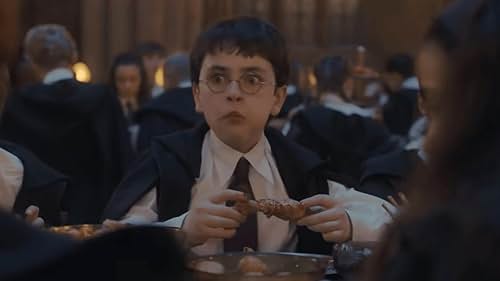
HBO’s first Great Hall feast clip changes three specific things from Harry Potter and the Philosopher’s Stone: the students chant Dumbledore’s name, Harry asks Ron a question he asks Percy in the book, and Dumbledore and McGonagall have a new conversation about James Potter. Those differences are worth explaining because they reveal how the new television series may develop Hogwarts, Harry’s friendships, and the people who knew his parents.
The banquet itself comes from Chapter 7, “The Sorting Hat.” Harry arrives at a school he barely understands, meets the traditions of the wizarding world, and discovers the extraordinary abundance of a Hogwarts feast. HBO preserves that central experience while adjusting the scene’s dialogue and perspective. Here’s what the clip actually changes, what it keeps, and what we still need to see in the finished episode.
Watch the Official HBO Harry Potter Start-of-Term Banquet Clip
The official preview is about a minute and a half long. Watch it first, then come back for the comparison. For our opinion about the performances, food effects, color grading, and the music, read our Great Hall Knee-Jerk Reaction.
Change 1: The Hogwarts Students Chant Dumbledore’s Name
One of the clearest additions is the hall full of students pounding their tables and chanting for Dumbledore. The scene has the energy of a school ritual. Hogwarts feels rowdy, communal, and already familiar with the man standing at the head of the room.
The chant does not appear in the first novel’s welcome feast. Chapter 7 introduces Dumbledore through a wonderfully odd, very short speech. Harry’s surprise at the headmaster’s eccentricity belongs to the experience of meeting this school for the first time. HBO’s chant tells us how the returning students feel about Dumbledore before Harry has a chance to form his own opinion.
There’s a useful piece of character writing in that choice. The children in the hall have relationships with Hogwarts that Harry has yet to develop. If the show lets us experience their familiarity alongside Harry’s astonishment, the school becomes a lived-in community while remaining strange and wonderful to its newest arrival.
Change 2: Harry Asks Ron About Dumbledore Instead of Percy
In the book, after Dumbledore’s peculiar introduction, Harry turns to Percy Weasley and asks whether the headmaster is a bit mad. Percy answers with affection and respect for Dumbledore’s intelligence. It’s a charming early clue to the school’s culture, and it lets Harry talk to an older student who knows the headmaster.
In the HBO preview, Harry asks Ron Weasley (Alastair Stout) instead. Ron’s cheerful reply describes Dumbledore as off his rocker. That’s an interesting adaptation choice for another reason: Ron makes a closely related comment much later in the book, in Chapter 17. The show appears to be bringing a sentiment already associated with Ron forward into the first feast.
That repositioning gives Ron an immediate job in the story. Harry understands very little about Hogwarts, while Ron has grown up hearing about magical customs, famous wizards, and his brothers’ school experiences. Their friendship starts developing through this small exchange, and the joke makes Ron feel like someone Harry can turn to when everything around him seems bewildering.
There is a tradeoff. Percy loses a moment that shows his relationship to the institution and his self-important affection for its authority figures. A longer series can develop those traits through other scenes. For now, HBO is prioritizing the Harry-and-Ron relationship, and the choice makes dramatic sense.
Change 3: Dumbledore and McGonagall Discuss Harry’s Father
This is the new scene that interests me most. While Harry eats with his new classmates, Dumbledore (John Lithgow) teases Minerva McGonagall (Janet McTeer) about how pleased she must be that Harry has been sorted into Gryffindor. McGonagall sees James Potter in the boy. Dumbledore reminds her that Harry’s nature is entirely his own.
The staff-table exchange is original to HBO’s adaptation. The first novel usually stays close to Harry’s understanding of the world. We see the professors as he does, but their private conversations about the Potter family remain outside his immediate experience. Here, the camera gives the audience access to memories and feelings that Harry cannot yet hear.
McGonagall’s recognition of James turns the name into a real human relationship. She knew Harry’s father as a student, and she is now watching his son begin the same journey. Dumbledore’s response introduces a question that will follow Harry for years: How does a child decide who he is when so many people have already decided what he represents?
This is where the extra room of television could become valuable. The adult characters have histories with each other, with Harry’s parents, and with the school. Their relationships can deepen Harry’s story as long as the series preserves the mystery and emotional uncertainty of seeing Hogwarts through his eyes.
Is the Food Appearing on the Tables Accurate to the Book?
Yes, in its central idea. In the novel the feast appears suddenly on the Hogwarts tables, offering Harry an astonishing spread of food. HBO stages the moment with Dumbledore snapping his fingers and dishes materializing across the tables.
The snap and the specific effects are television choices. The essential story beat is the abundance. Harry has spent his childhood feeling unwanted in the Dursley household, and his first Hogwarts meal offers him a place where food, friendship, and wonder seem available in extraordinary quantities.
I love the way Dominic McLaughlin plays Harry’s surprise at that first bite. The visual effects aren’t entirely convincing to my eye, and we unpack that craft issue in the KJR. The emotional idea behind the feast comes through clearly.
Did HBO Cut the Floating Candles or Dumbledore’s Welcome Speech?
The short preview cannot establish that either element has been removed from the finished episode. Some readers have noticed that the released footage does not show the familiar floating-candle imagery or Dumbledore’s strange introductory words. Those are reasonable questions, especially for an adaptation that invites comparisons with the book.
Absence from the promotional clip is not proof of absence from the full episode. HBO has shown us a selection of the banquet, and we have not yet seen the complete sequence in its final context. The same caution applies to pacing: the rapid movement from the chant to Harry and Ron to the professors could reflect the edit prepared for this preview.
We’ll revisit the missing details after the December 25, 2026 premiere, when the whole scene can be evaluated fairly.
The Bigger Question: What Kind of Harry Potter Adaptation Is HBO Making?
These changes all point toward a broader view of Hogwarts. The chant establishes school culture. Ron’s answer helps establish the central friendship. Dumbledore and McGonagall’s conversation reveals the adults’ memories and expectations. Each addition gives the audience a different perspective on the place Harry has just entered.
The strongest adaptation decisions earn their time by making a relationship more legible. Ron’s humor makes his friendship with Harry believable. McGonagall’s warmth makes James Potter feel like someone the adults actually knew. Dumbledore’s observation gives us an emotional lens for the boy who will spend years navigating his inherited fame.
That’s the standard I’ll use when we review the full episode. A new scene can serve the original story beautifully when it strengthens the character relationships and deepens the consequences of the world Harry is discovering. The Great Hall clip offers some promising evidence of that approach.
HBO Great Hall Book Changes: Quick Answers
Was the Dumbledore chant in Harry Potter and the Philosopher’s Stone?
No. HBO’s students chanting for Dumbledore is an addition to the welcome-feast sequence.
Who did Harry ask if Dumbledore was mad in the book?
Harry asked Percy Weasley in Chapter 7. In HBO’s clip, he asks Ron, whose response draws on a sentiment Ron voices later in the novel.
Was Dumbledore’s conversation with McGonagall about James Potter in the book?
No. The private discussion, including Dumbledore’s observation about Harry having his own nature, is new dialogue for the TV series.
Does the preview prove HBO removed the floating candles?
No. We need the complete premiere episode to determine which book details appear in the finished scene.
More Potterverse Coverage From Mary & Blake
Read our Great Hall Knee-Jerk Reaction for the performances, score, and production design. The HBO Season 1 guide will hold the premiere and all eight episodes, while our Sorcerer’s Stone chapter guide lets you read along with the source material. Our HBO Harry Potter series guide tracks the wider adaptation.
Which change are you most interested in? The Dumbledore chant, the shift from Percy to Ron, or the new conversation about James Potter? Tell us in the comments.
Get Harry Potter Updates From Mary & Blake
Get Potterverse podcast drops, Harry Potter episode coverage, explainers, adaptation analysis, theories, and the stories worth talking about as we head back to Hogwarts.
Reference reading: Radio Times coverage of the HBO clip; Harry Potter Lexicon on the Chapter 7 feast; Harry Potter and the Philosopher’s Stone, Chapters 7 and 17.