
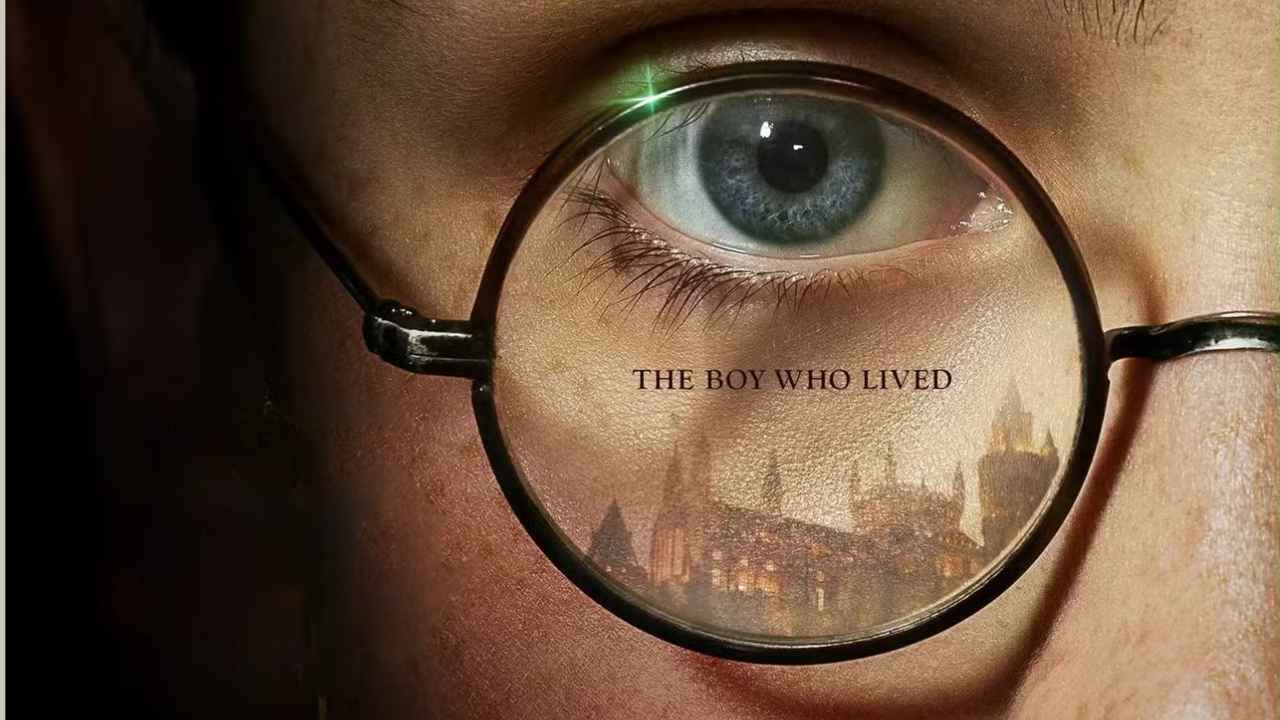
HBO has finally offered a glimpse of its new Hogwarts Castle for Harry Potter and the Philosopher’s Stone, and the most revealing decision in the October 29, 2026 poster is where the castle appears: reflected in the glasses of Dominic McLaughlin’s Harry Potter. His eye fills the frame. His lightning-shaped scar sits above it. Below the words The Boy Who Lived, Hogwarts glows in the darkness.
We’ve spent 25 years recognizing Hogwarts by its towers, bridges and silhouette. HBO could have introduced its version with a sweeping, unobstructed image. Instead, the marketing places the castle inside Harry’s field of vision. To us, that is the image’s real storytelling promise: we are being asked to discover an enormously familiar world alongside the child who needs it most.
There is another tension in the composition that makes it even more interesting. Harry is looking toward a world where everyone already knows his name, yet almost nobody knows who he really is. The poster brings the hope of finding a home and the burden of becoming a legend into the same frame.

What Does HBO’s New Hogwarts Castle Actually Look Like?
The poster reveals a nighttime view of Hogwarts reflected in Harry’s round glasses, with illuminated windows and a clustered silhouette of steep roofs and towers. It evokes the wonder of the first-years’ approach across the lake in the 2001 film while suggesting that this version of the school may have a different architectural layout. Because we are studying a small, distorted reflection, its precise geography, tower heights and resemblance to the movie castle remain hard to establish.
That limitation matters. Fans are already trying to identify the Great Hall, Astronomy Tower and different wings, but the poster does not offer enough visual information to confirm those placements. An AI-generated image discussed in a Wizards Rest breakdown attempts to expand the reflection into a complete castle. It is an imaginative fan reconstruction, not an official HBO reveal. The actual design deserves to be judged when we can see more than a reflection in a lens.
Why Reveal Hogwarts Through Harry’s Glasses?
Look at the visual hierarchy. The most recognizable building in the Wizarding World occupies a fraction of the poster. Harry’s face, eye and scar dominate it. The castle’s small scale pulls us closer, asking us to imagine what the school means to the person looking at it instead of simply admiring what the production designers have built.
That is a point-of-view choice, and point of view shapes the audience’s emotional relationship with a story. We know what Hogwarts looks like. Harry, at this stage of his journey, has only just discovered that this extraordinary place exists. The reflection gives us access to his anticipation while preserving some of the mystery for his arrival. It invites longtime fans to recover a feeling they may have forgotten: the uncertainty and wonder of encountering Hogwarts for the first time.
There is also something lovely about putting a vast fantasy world in such an ordinary object. Harry’s glasses belong to a neglected child who has spent years being made to feel small. Through those same glasses, he can now glimpse a future larger than the one the Dursleys allowed him to imagine. It is an elegant visual bridge between Privet Drive and Hogwarts, and a meaningful way to begin establishing the adaptation’s perspective.
The Boy Who Lived: Harry’s Scar Tells a Different Story From His Eye
The words The Boy Who Lived sit between Harry and Hogwarts. They are also the title of the first chapter of Harry Potter and the Philosopher’s Stone, where the wizarding world celebrates a baby whose personal story it barely understands. The official promotional caption leans into that contradiction: “Everyone in our world will know his name.” The poster introduces Harry as a public figure before he has had any opportunity to decide who he wants to become.
His scar makes the tension physical. To the wider wizarding world, it represents an extraordinary survival and a historic defeat. To Harry, it is the mark of a night that took his parents away and left him to grow up without their love. In the image, the scar and the castle share space with his searching eye. Visually, his past, his possible future and the identity others have assigned him are all present at once.
That creates the fundamental dramatic question of Harry Potter: What happens when a child who longs to belong enters a world that expects him to be exceptional? It is a question the series can explore through friendship, the Sorting, his connection to Voldemort, and the choices that eventually matter far more than the mythology surrounding his name.
Hogwarts Promises Harry a Home. It Will Also Teach Him How Complicated Home Can Be.
Harry begins the story in a house built around rules, appearances and exclusion. The Dursleys treat him as an inconvenience, and the cupboard under the stairs makes that rejection tangible. HBO’s behind-the-scenes material has emphasized the deliberately ordinary design of Privet Drive, even noting the little drawings Harry uses to personalize his cramped space. Production design is already being used to describe a child’s inner life through the places he inhabits.
Against that background, Hogwarts is almost overwhelmingly generous. It offers Harry friendships, adults who recognize his potential, places to explore, and the chance to make choices for himself. The castle can become a home because it gives him room to grow. We need to feel the scale of that emotional change when he first sees it, and then feel how his relationship with its corridors, classrooms and common rooms evolves across the season.
Of course, Hogwarts is also an institution full of secrets, rivalries, prejudice and occasional catastrophic failures of adult judgment. Its warmth and danger exist together. That complexity is essential to Harry’s coming-of-age story: loving a place ultimately involves seeing its flaws and deciding how to act within them. The most effective version of the castle will be able to hold both the comfort of belonging and the unease of discovering that even a magical home cannot protect you from everything.
What the Creative Team Has Actually Said About the Hogwarts Redesign
Director Mark Mylod has explained that the production approached Hogwarts as a real place, one whose architecture accumulated and changed over time. In an official Harry Potter interview, he discussed Georgian influences, naturalism, the possibility of exploring places such as the staffroom, and the additional freedom afforded by long-form television storytelling. Those details offer a much better standard for evaluating the redesign than counting spires in a teaser poster.
There is a related idea running through the production. The official behind-the-scenes breakdown of Finding Harry describes magic as rooted in nature, with foliage and trees entering the castle’s halls and corridors. A separate production account describes the importance of physical connections between spaces, so students can move through a believable school. The intention, at least as expressed by the creative team, is to make the environment feel inhabited and historically layered.
For television, that opens exciting possibilities. A familiar passage can mean something different after a student is humiliated there. A classroom can gradually become associated with trust or fear. The route between the common room and the Great Hall can develop the familiarity of a real school day. The castle’s geography can quietly accumulate emotional history across eight episodes, and eventually across Harry’s years at Hogwarts.
Why Fans Are Divided Over the New Hogwarts Design
One of the most revealing reactions comes from the creator behind a video about the possible castle redesign, who describes a deep attachment to production designer Stuart Craig’s Hogwarts from the films. His concern reaches beyond architecture: that version lives in the theme parks, games, LEGO sets and in the memories of fans who grew up with it. To him, a new castle can feel like a piece of his own Potter experience is being displaced. That is a genuine emotional response, even if the possibility of the old design disappearing from the franchise is speculation.
Elsewhere, viewers are intrigued by a more medieval, compact or historically grounded Hogwarts. In the comments on the Wizards Rest video, some fans see familiar elements from the films or Hogwarts Legacy; others imagine a castle that has grown by adding wings over centuries. The interpretations vary because the evidence is limited. The image offers enough to start an argument and too little to settle one.
We understand the attachment to Stuart Craig’s iconic silhouette. It helped generations of viewers feel that Hogwarts was somewhere they could visit. But HBO’s challenge is to give this Harry, this cast and this long-form story a castle that earns a comparable attachment on its own terms. Architectural fidelity to a previous adaptation is one possible artistic choice. Emotional clarity, continuity of space and a strong relationship between character and setting are the qualities that will determine whether the redesign works.
The Real Test Will Be Harry’s First Arrival at Hogwarts
The poster sets up a lovely visual promise, but an image cannot tell us whether the series will fulfill it. When Harry finally approaches Hogwarts, the crucial choice will be how the camera balances the castle’s grandeur with the boy taking it in. Hold with him long enough to register awe, disbelief and perhaps a little fear, and the reveal can become an event in his emotional life. Turn the moment into an extended display of visual effects, and the audience may admire the design without developing that same attachment.
Then the series has to build on the arrival. The castle should have routes and recurring spaces we come to understand, small details that communicate school life, and places whose meanings change as Harry changes. That is where an eight-episode season has an advantage. It can give Hogwarts the lived-in texture of an institution and the intimacy of a home, while gradually revealing the contradictions beneath its welcome.
We will keep examining those choices as the show approaches its December 25, 2026 premiere. For the full rollout, see our Harry Potter Season 1 guide, our HBO trailer review, and the release and episode schedule. For more character and adaptation conversations, explore The Potterverse with Mary & Blake or get our Harry Potter updates.
The Mary & Blake Take: The Reflection Is the Argument
Our favorite part of HBO’s new Hogwarts poster is the relationship it creates between a boy and a place. One is carrying a legend he never asked for. The other represents the possibility of finally belonging somewhere, while also containing the choices and complications that will shape the person he becomes. The image brings those two stories together before we have watched a minute of the new series.
When Hogwarts finally appears in full, we will have plenty of time to debate its towers. For now, the most meaningful thing HBO has shown us about its new castle is the child looking toward it.