A teaser trailer does not need to prove that the whole show works.
It just needs to prove that the people making it understand what matters.
This Week in Harry Coverage
- Harry Potter HBO Series Guide: Trailer, Cast, Release Date, Podcasts, Reviews & Updates
- Trailer Review: Why This Reboot Might Work
- Everything Confirmed About HBO’s Harry Potter Series
- Harry Potter HBO Cast Guide: Every Confirmed Actor So Far
- Why HBO Is Rebooting Harry Potter Now
- What the Harry Potter Trailer Is Really Telling Us About HBO’s Adaptation Strategy
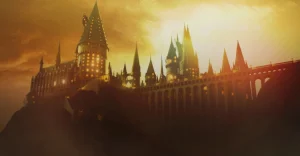
And that is what makes HBO’s first Harry Potter teaser interesting. Not because it looks expensive or because Hogwarts still has enough stone and candlelight to trigger the correct nerve endings in people who grew up on the films. Though, a franchise this large can always generate heat on command. Those things help. They are not nothing. But they are not the point.
The point is that even in a short runtime, this teaser is already showing its hand.
It is making adaptation choices.
Some of those choices are smart. Some are cautious. Some look inherited from the films. And a few of them could become real problems later if the show is not careful. That is the frame that matters here. Not whether the reboot exists or if the trailer made you emotional. Especillay whether a robe or a wand or a staircase looked correct enough to survive a Reddit post.
The better question is this: what is this teaser telling us about how HBO plans to adapt Harry Potter?
And I think the answer is pretty clear.
This show seems interested in restoring the book’s shape. More Privet Drive, childhood deprivation and school-life texture. More period specificity and room for Hogwarts to feel like a lived-in system instead of a greatest-hits backdrop. At the same time, it also looks willing to preserve selective pieces of movie language wherever the films already solved a visual problem too well to ignore.
That is the strategy.
And if I am right, it is the smartest possible lane for this reboot to choose.
1. HBO seems determined to restore the book’s setup, not just race to Hogwarts
The most revealing thing in the teaser is not magical at all.
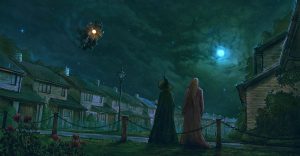
It is how much time and emotional weight the show appears willing to spend on Privet Drive.
That matters because Philosopher’s Stone does not work if Harry’s pre-Hogwarts life is merely inconvenient. It has to feel cramped, humiliating, punitive, and psychologically formative. The Dursleys are the negative space that makes Hogwarts feel restorative later. If Harry’s life before Hogwarts does not hurt, then Hogwarts becomes a cool adventure. If it really hurts, Hogwarts becomes rescue.
And the teaser seems to understand that distinction.
Petunia is a huge part of that. One of the smarter observations floating around the early response to the teaser is that the show seems more interested in her quieter cruelty than the films were. The movies largely let Vernon carry the loud abuse. This looks more willing to let Petunia’s resentment register as its own emotional weather system. That is the right instinct. Petunia has always mattered more than the films had time to let her matter, because her meanness is not random. It is deeply tied to Lily, to envy, to exclusion, to the whole poisonous family dynamic Harry has been dropped into.
That, my friend, is adaptation intelligence.
The same goes for the little material choices. Harry’s broken toys. The hand-me-down clothes. The smallness of the cupboard. The way the trailer appears willing to sit in those conditions instead of rushing through them. One of the strongest readings of the teaser is that it may not even get Harry to Hogwarts until episode three. If that is true, then HBO is making the exact bet it should be making: that setup is not dead time. Setup is the engine.
That is the first real signal of the adaptation strategy. This version is trying to earn Hogwarts, not merely arrive there.
2. The show appears to understand television’s biggest advantage: time
The films had a brutal structural problem from day one. They had to introduce the world, preserve the key emotional beats, keep the mystery legible, move the plot, and make Hogwarts feel magical — all inside feature runtimes. Sometimes that compression produced elegance. Sometimes it produced flattening.
Television changes that math.
And the teaser looks like it knows it.
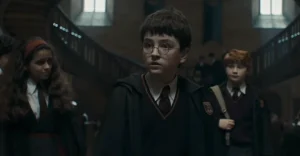
One of the most encouraging things here is how often the footage suggests life between plot points. Common-room texture. Kids screwing around on the train. Snowball fights. marshmallows by the fire. school spaces that look like spaces people actually inhabit, not only rooms we pass through on the way to the next franchise checkpoint. Even the possibility of restored classes like History of Magic matters. Ghosts matter. Binns matters. Quidditch beyond the “one big set piece” model matters. Not because every omitted detail from the books must be restored like sacred text, but because all of that stuff helps Hogwarts become a system rather than a landmark.
That is where television can beat film. By making the world feel more continuous.
The teaser’s smartest promise may be that it wants Hogwarts to feel like a school again. A place with rhythms. Friends. awkwardness. routine. ordinary kid life. The kind of stuff that lets the magical world feel inhabited rather than toured.
That is hugely important, because one of the key things Harry Potter loses when it becomes only iconography is the feeling that the kids actually live there. The school is where the emotional architecture of the entire series gets built. Harry, Ron, Hermione, Neville, Draco, the Weasleys, the teachers — all of it starts working because Hogwarts feels like a place where life is happening all around the mystery, not just in service of it.
That is what the teaser seems to be reclaiming.
3. The show is also signaling that “book-accurate” does not mean “movie-free”
This is where the strategy gets more interesting.
Because if you watch closely, the teaser is negotiating with the film’s existence.
That is probably wise.
There are places where the movie language is so deeply embedded in the cultural memory of Harry Potter that the new series would be stupid not to borrow from it when it helps. The Ollivander line is a perfect example. It feels closer to the movie moment than the exact book phrasing, and honestly, I understand why. That line entered the bloodstream. Sometimes adaptation is not about returning to the source in the most literal way. Sometimes it is about knowing when another adaptation already solved something so memorably that fighting it would be pointless.
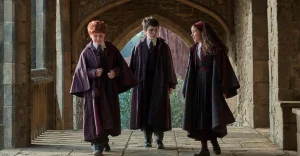
Same thing with the visual coding of the houses. The books are plainer there. The films popularized a much stronger house-branding language. The teaser does not look eager to give that up entirely. Again, that is not a betrayal of the books so much as a recognition that the films built a visual vocabulary the audience now reads instantly.
This matters because I think some people still talk about “fidelity” as if it is a binary switch. It is not. This series is not going to be some untouched transmission of the novels. It is going to be a conversation between the books and the films, with HBO trying to recover what the films had to lose while keeping some of the visual shorthand the films established too well to abandon.
That is adaptation reality.
The question is not whether the show is borrowing from the movies. It obviously is. The question is whether it borrows selectively and intelligently, or whether it starts collapsing back into “the movie, but longer” whenever the pressure rises.
That is the line to watch.
4. The biggest risk is not fidelity. It is tonal calibration
This is the part I think people are most likely to misdiagnose.
The biggest danger for this reboot is not that Harry’s eyes may still not be quite right. It is not that Vernon may not look beefy enough, or a few design elements feel movie-inherited. Those things are fair game for fans to notice. But they are not, to me, the real danger zone.
The real danger is tonal.
One of the smartest things the original films did over time was allow the visual world to darken as the story darkened. Philosopher’s Stone felt warm, bright, and inviting. Later films let the light drain out. That contrast mattered. It helped the audience feel what had been lost.
This teaser is already more muted.
That is not automatically bad. Harry’s early life should not look cheerful. Privet Drive should not be cozy. But the concern is whether the show’s baseline is already too subdued, too prestige-somber, too emotionally flattened under the weight of “serious television.”
Because book one needs warmth.
Not childishness. Warmth.
It needs play. Food. snow. friendship. mischief. oddness. the kind of whimsical, school-year texture that makes Hogwarts feel like deliverance and not just another institution with a nicer production budget. If the whole show starts from a visually restrained, emotionally muted “this is prestige now” posture, then later darkness may have nowhere meaningful to go.
That is the tonal puzzle HBO has to solve.
The trailer suggests the makers understand the wound of Privet Drive. Good. Great, even. But now the next question is whether they understand the cure with equal confidence. Whether Hogwarts can feel abundant, silly, alive, and restorative enough to justify the longing the teaser is building toward.
That is the challenge.
5. The adaptation math is already visible in the Snape material
One of the most useful things a teaser can do is expose what kinds of long-term adaptation choices the show is preparing to carry. And the Snape material does that immediately.
To be clear: I am not interested in reheating the dumbest version of this conversation. A fantasy adaptation can cast beyond literal inherited image memory. That part is fine.
What matters is whether the show understands the structural consequences of the choices it is making.
Snape is one of the story’s central engines of misdirection, resentment, reinterpretation, and eventual emotional reversal. He is how Harry’s assumptions about his father start to fracture, and how the books complicate blame. He is one of the longest-running exercises in audience point-of-view manipulation the series has.
So once you cast that part, the question is not just “is the actor talented?” Of course talent matters, and it does here. The deeper question is whether the series is thinking all the way ahead. To Harry’s suspicion. To the Marauders material. To the visual and emotional implications of the James/Snape history once the show gets there.
That is what I mean by adaptation math.
The teaser does not answer all of that, obviously. It cannot. But it does show that HBO is not playing small. It is willing to make choices that force the later architecture to hold. That can be a strength. It can also become a problem if the show treats each season as its own mood board and forgets what those decisions will mean downstream.
But again, that is what makes the teaser interesting. It is not just showing us a cast. It is revealing how much confidence — or risk appetite — HBO is bringing into the project.
The real takeaway
What the trailer is really telling us is that HBO has chosen the correct lane.
It is not trying to beat the movies at being movies. It is trying to beat them at being an adaptation of the books.
That is a much smarter goal.
The teaser suggests a show that wants to restore the book’s setup, spend television’s time advantage on school-life and world texture, recover the emotional logic of Privet Drive and Hogwarts, and make the wizarding world feel lived in instead of merely remembered. At the same time, it also suggests a production smart enough to know it cannot simply pretend the films never happened. Some of that movie language is going to stay, because audiences have already absorbed it as part of how Harry Potter looks and feels.
That means the real standard for this reboot is not “did they recreate my childhood exactly?”
It is simpler, and harder.
Can HBO use a longer form to return shape, warmth, texture, and emotional specificity to a story that the movies, for all their strengths, often had to compress into pure momentum?
That is the job.
And the best thing I can say about this teaser is that it looks like the people making it understand that.
Not perfectly. Not beyond criticism. But enough that the strategy feels coherent.
And coherence is a hell of a lot more valuable than nostalgia.