
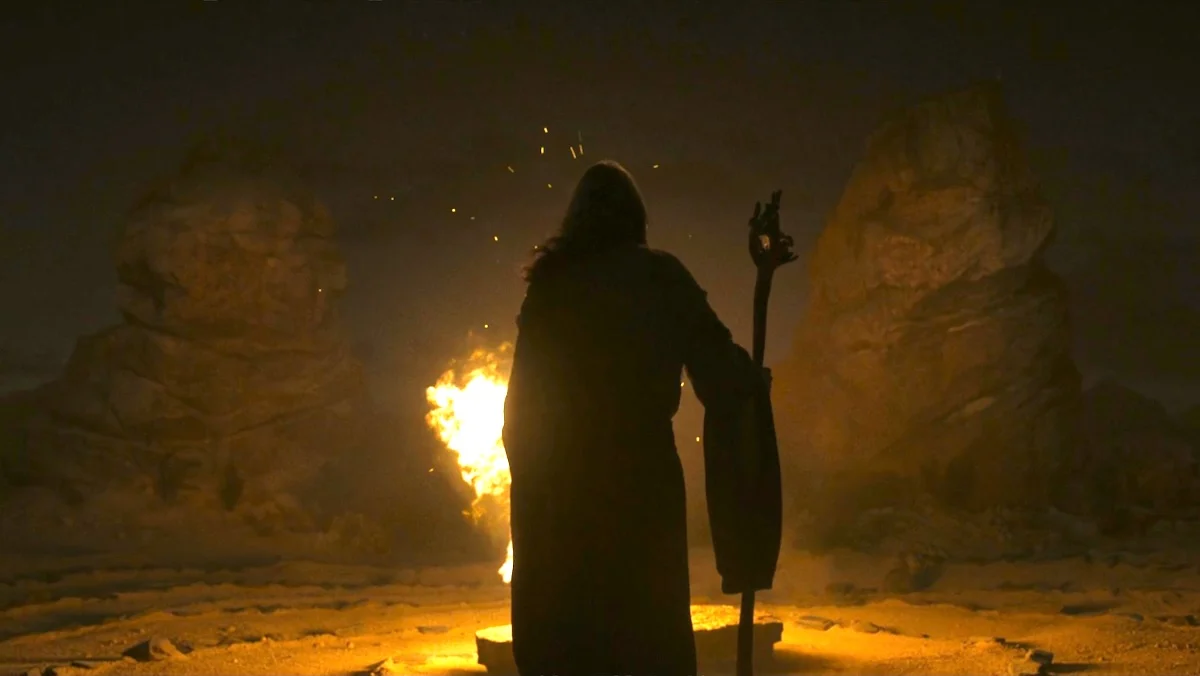
Is the Secret Fire Eru Ilúvatar in The Rings of Power? Season 3 Episode 3 strongly suggests that Gandalf is hearing the voice of Middle-earth’s creator through the Secret Fire, also known in Tolkien’s mythology as the Flame Imperishable. There is an important distinction: in Tolkien’s writings, the Secret Fire is the creative power associated with Eru Ilúvatar, while Eru is the divine being who possesses that power. The episode dramatizes the relationship by allowing the Fire to speak as the creator.
That makes Gandalf’s encounter in “The Secret Fire” an enormous moment for the show. It also reveals why the Dark Wizard matters and connects Gandalf’s new mission to a line he will one day speak in The Fellowship of the Ring.
Spoilers for The Rings of Power Season 3 Episode 3 follow.
What Is the Secret Fire in Tolkien’s Middle-earth?
The Secret Fire, or Flame Imperishable, belongs to Eru Ilúvatar, the supreme creator in Tolkien’s mythology. In the creation story of The Silmarillion, the Ainur participate in the Music of the Ainur, and Eru gives that vision actual existence. The Secret Fire represents the extraordinary power by which things become genuinely real and possess being of their own.
This concept helps explain the central difference between making something beautiful and giving it independent life. Melkor desires the Flame Imperishable because he wants to create according to his own will. His search for it fails because the power remains with Ilúvatar. The desire to possess creation becomes one of the earliest expressions of the domination that will eventually define Sauron.
Tolkien’s mythology leaves room for mystery here. The Secret Fire is connected to divine creative power, but the books do not treat it as an ordinary magical spell or a person who regularly appears to distribute orders. The Encyclopedia of Arda’s Secret Fire reference offers a useful overview of the literary concept.
Who Speaks to Gandalf in The Rings of Power Episode 3?
In the episode, Gandalf follows Tom Bombadil’s guidance and encounters a voice associated with the Secret Fire. It calls him by multiple names, including Olórin, Mithrandir, and Gandalf, and declares that it created the heavens, the stars, and Middle-earth. Gandalf understands that he is addressing a power beyond himself and asks how he can serve.
The language strongly identifies the presence with Eru Ilúvatar’s creative authority. The episode calls the speaker the Secret Fire rather than explicitly having it introduce itself as Eru. The safest reading is that the show has made Eru’s creative power directly audible to Gandalf, giving the scene the dramatic force of a conversation with the creator.
That is an adaptation choice. Tolkien’s account associates the Fire with Eru while keeping the relationship between divine creation and mortal understanding more mysterious. The television series turns that relationship into a scene that can redirect Gandalf’s journey.
Why Does the Secret Fire Tell Gandalf to Save Pallando?
The revelation begins by reminding Gandalf that five Wizards were sent to help Middle-earth. The mysterious Dark Wizard is named as Pallando, one of the Blue Wizards. Pallando was sent to Rhûn with another member of his order, but the episode says he betrayed and murdered his companion in his pursuit of power.
Gandalf has been preparing to defeat him. The Secret Fire instead instructs Gandalf to save Pallando, explaining that both Wizards will be needed to prevent the armies of Rhûn from joining Sauron. That changes Gandalf’s objective and gives Tom Bombadil’s earlier lesson about service a concrete purpose.
For the fuller explanation of that mission, read why Gandalf must save Pallando. Our existing Dark Wizard guide covers the history of the character and the Blue Wizards.
Why Does Gandalf Call Himself a Servant of the Secret Fire?
In The Fellowship of the Ring, Gandalf invokes his service to the Secret Fire during his confrontation with the Balrog in Moria. His words establish the authority he serves and the kind of darkness he is resisting. The Season 3 scene functions as a proposed origin for that identity, with the Secret Fire directly telling him to rise as its servant.
The thematic connection is lovely. Gandalf began this episode wanting enough power to overcome another wizard. He leaves knowing that service may require him to redeem someone he considers an enemy. The challenge ahead is whether he can make that belief meaningful through a difficult choice of his own.
Is the Secret Fire the Same Thing as the Flame of Anor?
The Flame Imperishable and Secret Fire are names for the creative power associated with Eru. Gandalf’s separate reference to the flame of Anor in his later confrontation with the Balrog is less definitively explained by Tolkien. Anor is associated with the Sun, and readers have proposed different interpretations of the phrase.
The show does not need to settle that debate to make the larger connection clear: the power Gandalf serves is fundamentally opposed to the urge to dominate living things.
Continue through our Rings of Power Season 3 guide or listen to The Rings of Power With Mary & Blake for the larger story.
Related Coverage
- Explainer: Why Is Rhûn a Wasteland in The Rings of Power? Pallando’s Crime Explained
- Explainer: Why Must Gandalf Save Pallando in The Rings of Power? The Secret Fire’s Mission Explained
- Knee Jerk Reaction: KNEE-JERK REACTION | The Rings of Power Season 3 Episode 3: “The Secret Fire” — A Familiar Problem
Why the Secret Fire Scene Matters
The episode puts the series’ central question into unusually explicit terms. Sauron wants to repair Middle-earth by controlling it. Pallando wants enough power to restore Rhûn according to his own vision. Gandalf discovers a calling organized around service and the freedom of others.
That argument has considerable potential, although the scene’s burning-bush presentation and direct exposition feel familiar. The most persuasive version of the idea will come when Gandalf has to choose mercy in circumstances that make it costly. We explore that storytelling challenge in our Episode 3 Knee-Jerk Reaction, including a deeper NerdClan craft analysis.