
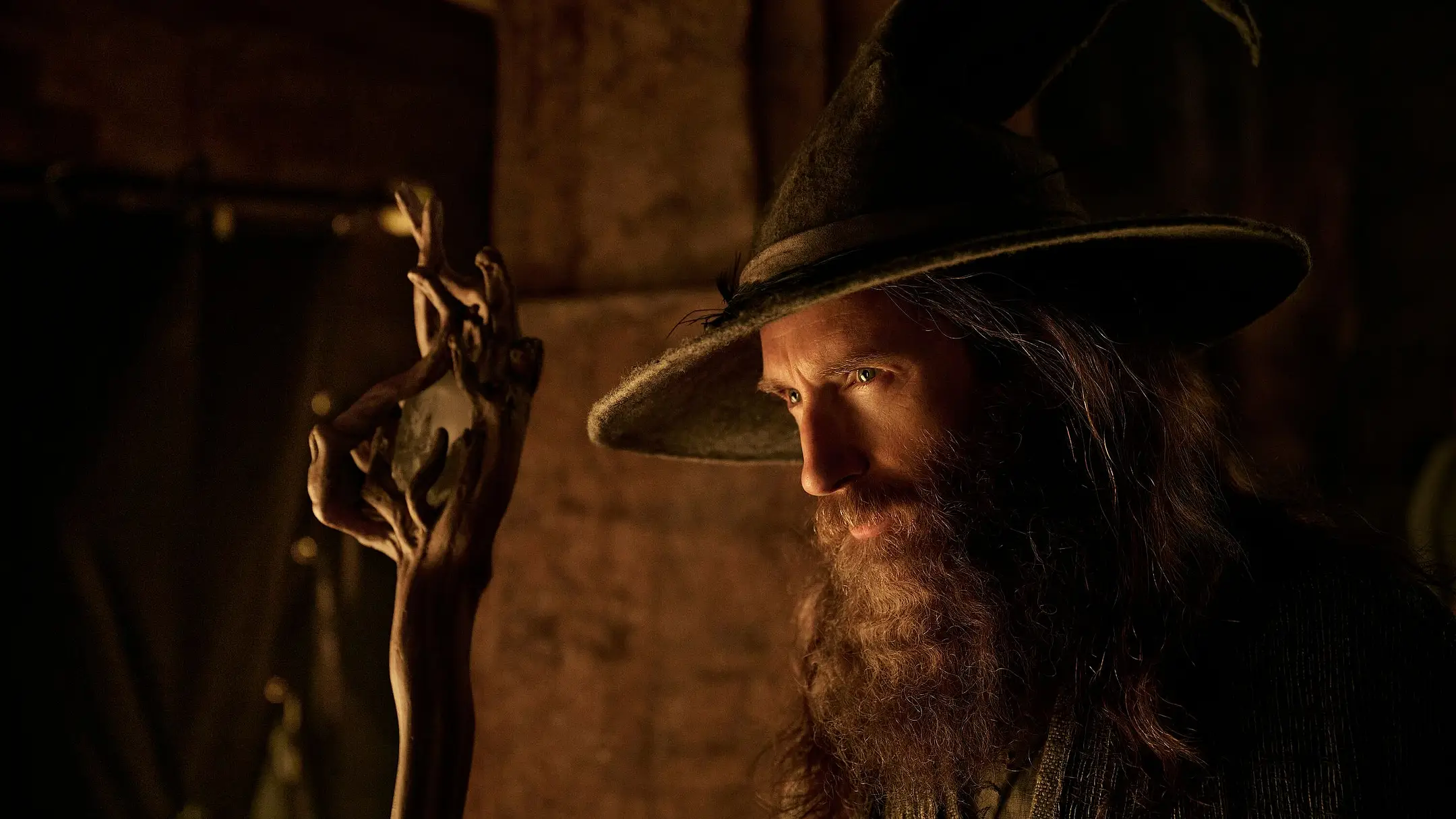
The Rings of Power Season 3 Episode 3, “The Secret Fire,” takes a small but noticeable step backward after two very good episodes. There is plenty here that I enjoy, especially Gandalf’s surprisingly touching relationship with Tom Bombadil and a fantastic confrontation between Khamûl and the Dark Wizard. Unfortunately, the episode also leans heavily on imagery and story beats that we have already seen elsewhere, including a particularly conspicuous trip through The Ten Commandments.
The frustrating part is that the show has spent the beginning of this season establishing a more confident dramatic identity. The characters have clearer desires, the world feels lived in, and the consequences of Sauron’s growing power are increasingly personal. Those qualities remain visible throughout “The Secret Fire,” which makes the reliance on familiar cinematic moments all the more conspicuous.
Written by J. D. Payne and Patrick McKay and directed by Sanaa Hamri, the episode has genuinely interesting ideas about power, mercy, and the possibility of redemption. I just wish it trusted those ideas to generate more of its own storytelling.
Full spoilers for The Rings of Power Season 3 Episode 3, “The Secret Fire,” follow.
The Rings of Power Season 3 Episode 3 Recap: What Happens in “The Secret Fire”?
In Rhûn, Khamûl returns to the Dark Wizard bearing one of Sauron’s Nine Rings and immediately challenges his authority. Their confrontation establishes the frightening power Khamûl now possesses, forcing the Dark Wizard to publicly reframe his humiliation as an alliance between Rhûn and Mordor.
Meanwhile, Gandalf searches for a way to prevent the Dark Wizard’s armies from joining Sauron. Tom Bombadil challenges his desire to master enough power to defeat his enemy, eventually directing him toward an encounter with the mysterious Secret Fire. Gandalf learns that the Dark Wizard is actually Pallando, one of the Blue Wizards, and that his betrayal and murder of his companion devastated Rhûn. His mission is to save Pallando rather than destroy him.
Elsewhere, Galadriel, Arondir, and Marnûkh continue toward Gundabad, with their fragile alliance threatened by Arondir’s grief and suspicion. Elendil and Anárion fall into Kemen’s trap in Númenor, while Sauron learns that a surviving Elven-smith may hold the knowledge he needs to complete his work. The episode ends with the characters converging on Gundabad and Sauron preparing to pursue them.
Tom Bombadil Has Always Been a Storytelling Problem for Me
I’ve never particularly loved Tom Bombadil as a character. I understand his importance to Tolkien’s mythology, and I appreciate why so many readers find him endlessly fascinating. But from a storytelling perspective, I have always found him a little problematic.
Tom exists in a strange space within Middle-earth. He appears to possess extraordinary knowledge and power, seems largely unconcerned by the forces terrorizing everyone else, and speaks as though the universe has revealed something to him that the rest of us have yet to understand. When the story needs wisdom, he can provide it. When the story needs mystery, he can become mysterious. When an explanation might undermine his larger symbolic purpose, his riddles allow that explanation to remain comfortably out of reach.
He feels a little like what I call a narrative god of the gaps. Whenever the dramatic machinery reaches a question that ordinary characters cannot answer, Tom has the potential to occupy that space. His existence offers a convenient source of wisdom without requiring the story to establish the normal limits of his knowledge or abilities.
Of course, there is a legitimate artistic reason for his unusual construction. Tolkien deliberately preserved Bombadil as an enigmatic figure representing aspects of his world that the central conflict could never completely explain. The character’s relationship with nature, song, and freedom from domination gives him a philosophical purpose that extends beyond conventional plot mechanics.
That works differently when translated into an ongoing television drama. The writers have made Tom an important guide in Gandalf’s development, which gives him a much more direct responsibility for the unfolding story. His wisdom now sits at the intersection of an immediate military threat, Gandalf’s personal mission, and the future of Middle-earth.
And yet, somewhat to my surprise, I found his scenes with Gandalf genuinely heartwarming. Rory Kinnear brings a lovely warmth to Tom’s eccentricity, and Daniel Weyman’s mounting frustration provides exactly the sort of character contrast the relationship needs. Gandalf wants urgent answers because people are in danger. Tom wants him to appreciate a different way of seeing the world. Their exchanges have humor, affection, and the feeling of two ancient beings who recognize something important in one another.
I especially enjoyed the possibility that this might be our farewell to Tom for now. His return to the Withywindle and the passing of his hat to Gandalf give the relationship a satisfying sense of transition. Gandalf has acquired something more meaningful than another piece of wizard clothing: a piece of Tom’s identity that may continue to influence the way he approaches the world.
There is an appealing emotional idea here about wisdom being something we carry forward from the people who teach us. I only wish the episode had allowed that idea to do a little more of the dramatic work.
The Secret Fire Scene Borrows Heavily From The Ten Commandments
Oh boy. That Secret Fire sequence was a lot.
Gandalf follows Tom’s guidance, encounters a supernatural flame, and receives a revelation from a divine presence that appears to stand beyond the ordinary laws of Middle-earth. The entire construction immediately evokes Moses encountering God, particularly the cinematic language associated with Cecil B. DeMille’s The Ten Commandments.
The imagery makes a certain amount of sense within Tolkien’s world. The Secret Fire, also called the Flame Imperishable, is associated with the divine creative power of Eru Ilúvatar. The episode strongly suggests that Gandalf is encountering that power in a remarkably direct way. Tolkien’s mythology has deep religious and philosophical foundations, so a story that draws on biblical imagery is operating within an understandable artistic tradition.
My problem comes from how familiar the execution feels. Gandalf arrives seeking answers. The divine presence reveals hidden history, explains the identity of Pallando, describes his betrayal, clarifies the larger danger, and supplies Gandalf with a revised mission. The scene provides an enormous amount of information with an authority that effectively removes any possibility of argument.
The revelation itself is interesting. Gandalf believes he must defeat the Dark Wizard, while the Secret Fire tells him that his mission is to save him. That creates a potentially powerful change in the character’s understanding of heroism. It also connects beautifully with Tom’s earlier observation that true mastery may come through service.
But the drama surrounding that revelation feels awfully convenient. Gandalf receives the answer at precisely the moment he needs it, through a supernatural encounter whose visual language already tells us how important the moment is supposed to be. I can appreciate the theological symbolism while still wishing the writers had discovered a more personal, character-driven way to arrive at the same idea.
Khamûl Absolutely Owns the Dark Wizard
Thankfully, the episode also provides an excellent example of how to communicate extraordinary power through drama. Khamûl’s return to Rhûn is fantastic. The Dark Wizard expects the return of a subordinate carrying the Ring he desires. Instead, Khamûl arrives transformed by Sauron’s power, announces his new allegiance, and demands the throne for himself.
The encounter has an immediate objective for each character. Khamûl wants submission and political authority. The Dark Wizard wants to preserve his position and acquire the Ring. Their confrontation forces those desires into direct conflict, and the resulting display of power changes the relationship in front of everyone.
Watching the Dark Wizard’s staff begin to fracture is wonderfully effective. Here is a being who commands armies, controls acolytes, and has terrorized Rhûn for years, suddenly confronted by someone capable of making him surrender ground. His eventual claim that the confrontation represents a successful alliance is a desperate exercise in saving face. It is a terrific reversal because the balance of power changes through the characters’ actions.
And I LOVE what this does for the Nazgnagôl. The Ringwraiths were already terrifying in The Lord of the Rings, but so much of their fear existed through atmosphere, reputation, and their relentless pursuit of the Hobbits. The Rings of Power is giving us an opportunity to understand their power from the perspective of the people living alongside them. We see the threat, how other powerful figures respond, and the political consequences of their arrival.
Khamûl becomes frightening because the story demonstrates what his power can accomplish. That is exactly the sort of worldbuilding I want from this adaptation. For more context, read our Khamûl character guide and Nazgnagôl explained.
Galadriel, Arondir, and Marnûkh Feel Awfully Familiar
The journey toward Gundabad presents another frustrating example of the show’s dependence on existing Lord of the Rings imagery. Galadriel, Arondir, and Marnûkh form an uneasy traveling party in which an Elf must place her trust in a dangerous, potentially treacherous guide while her companion becomes increasingly suspicious. The similarities to Frodo, Sam, and Gollum are difficult to overlook. Even the group’s physical arrangement and some of its conversations reinforce that comparison.
Then we arrive at the sequence in which they hide from the Nazgnagôl beneath a tree, and suddenly we are revisiting one of the most recognizable images from Peter Jackson’s The Fellowship of the Ring.
I understand the appeal. Those images are extraordinary pieces of fantasy filmmaking, and The Rings of Power belongs to the same cinematic tradition. Familiar imagery can create continuity between different installments of a franchise, especially when the adaptation wants audiences to feel the influence of a shared mythology.
But we have reached a point where the repetition is becoming distracting. This is now the third episode in a row where I’ve felt the show leaning into a major story beat or cinematic reference that immediately reminds me of another production. Each individual example may be defensible, yet the cumulative effect makes me wonder why a series with so much creative freedom keeps reaching for scenes that already have such established identities.
What makes this especially frustrating is that Marnûkh has plenty of potential as an original character. His surprising affection for poetry, his grief for a fallen companion, and his willingness to provoke Arondir over Bronwyn create a fascinating collection of contradictions. There is a meaningful story here about an Orc who can mourn, create something beautiful, behave cruelly, and possibly choose a different future. That deserves room to develop through conflicts unique to these characters.
I would love to see the show trust that material a little more. Our Marnûkh character explainer tracks his larger role in Sauron’s Ring plot.
Sauron Continues to Be One of the Show’s Greatest Strengths
Charlie Vickers remains tremendous as Sauron, and his interrogation of the surviving Elven prisoners provides another strong example of the season’s improved characterization. The scene begins with apparent consideration. Sauron offers water, recognizes a personal object belonging to the prisoners, and presents himself as someone capable of understanding their suffering. His kindness gradually becomes part of a horrifying calculation as he reveals the poison and uses the promise of an antidote to obtain the information he needs.
What makes the sequence particularly effective is the way Sauron exploits the prisoners’ relationship. Their desire to protect one another becomes the mechanism through which he controls them. By the time he has extracted the information about the surviving Elven-smith, his supposed mercy has become another expression of cruelty.
Vickers understands how to make Sauron’s intelligence frightening. The character sees what people love, discovers what they fear losing, and builds a trap around that knowledge. His performance continues to demonstrate why this version of Sauron has become the series’ most compelling creation.
Related Rings of Power Coverage
Follow our Rings of Power Season 3 episode guide for the complete season, revisit our Episode 3.02 Knee-Jerk Reaction and Episode 3.01 Knee-Jerk Reaction, or explore the Rings of Power podcast with Mary & Blake. Our complete Rings of Power episode guide is the broader archive.
Related Coverage
- Explainer: Is the Secret Fire Eru Ilúvatar in The Rings of Power? Gandalf’s Revelation Explained
- Explainer: Why Is Rhûn a Wasteland in The Rings of Power? Pallando’s Crime Explained
- Explainer: Why Must Gandalf Save Pallando in The Rings of Power? The Secret Fire’s Mission Explained
The KJR Verdict: A Good Episode That Needs More Confidence in Its Own Story
“The Secret Fire” has some terrific moments, and I remain invested in where Season 3 is heading. Khamûl’s arrival gives the Nazgnagôl an exciting new dimension, Sauron continues to be marvelous, and Gandalf’s relationship with Tom Bombadil has a warmth I genuinely wasn’t expecting.
My concern is with the creative reliance on familiar dramatic and visual construction. The show has increasingly interesting characters and conflicts, which makes it capable of creating memorable scenes on its own terms. When it reaches back toward The Ten Commandments or Peter Jackson’s films, the recognizable imagery sometimes becomes more prominent than the story developing underneath it.
I still believe great artists steal. I’ve believed that for a long time. But the best artistic borrowing transforms its influences into something that feels inevitable within the new work. Three episodes into this season, The Rings of Power is giving me enough genuinely compelling drama that I want it to show a little more confidence in what it has created.
For the deeper scene-by-scene craft analysis, pull up a chair in NerdClan below. We get into Tom’s narrative function, the Secret Fire’s missed opportunity, Marnûkh’s real moral contradiction, and a possible rewrite of Gandalf’s turning point. Explore NerdClan.
Unlock the rest of this article.
Join the NerdClan — or sign in if you are already a member — and the rest of this article will unlock right here on this page. This entry requires Associate Producer or higher.