This Week’s Blood of My Blood Coverage
- Read the full review of “School of the Moon”
- Listen to our Recap & Reaction podcast
- Read our explainer: Did Ellen and Brian really sleep together?
- Read our explainer: Why are Colum and Dougal fighting?
- Read the fan temperature check: Where The Clans Stand This Week
Full spoilers for Outlander: Blood of My Blood Episode 3, “School of the Moon.”
My Kilt Rating: 4.0 / 5
BomB Impact: 4.5 / 5
I’m just going to say it plainly: “School of the Moon” works because it finally understands that power in Outlander is never abstract. It always gets paid for. In blood, in status, in reputation, in the body, in tomorrow. That is the engine of this episode. Not the cattle raid. Not the flirtation. Not the broad plot mechanics of who might marry whom. The price.
That is why this is the first Blood of My Blood episode that really made the prequel feel load-bearing to me instead of simply adjacent. It is not just filling in mythology. It is clarifying the emotional architecture of the world. We finally see how Castle Leoch became the kind of place where Colum rules in public, Dougal burns in private, and Ellen learns the only way to survive a room full of proud men is to become the smartest person in it without ever being officially allowed to be.
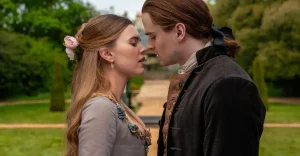
Ellen is the episode’s MVP by a mile. What makes her work here is that the writing stops treating her as a destined romantic figure and starts treating her like a tactician. That is the right move. Her scenes with Ned Gowan are easily the best material in the hour because they are about recognition. Ellen sees the real problem before her brothers do. Colum and Dougal think they are fighting over authority. Ellen understands they are about to hand the clan to somebody else entirely because neither one of them can stop needing to win the wrong argument. That is a sharp character read, and more importantly, it creates real pressure. The episode is not just saying these siblings are different. It is saying their differences could destroy the house.
That is where the BomB Impact kicks in for me too. If you care about the larger Outlander mythology, this episode matters. A lot. The Colum/Dougal arrangement has always been one of those things the original series tells us and asks us to accept. Here, the show finally dramatizes the emotional rot underneath it. Colum gets the legitimacy. Dougal gets the action. One gets the chair. The other gets the wound. That is exactly the kind of split that can define a man for the rest of his life, and the episode is smart enough to let that sting.
Julia’s storyline is more brutal, but it is chasing the same idea from a different direction. She and Ellen are basically running the same spiritual play in different rooms. Both women realize the men around them are not going to protect them. Both make a choice that costs them personally in order to preserve some version of the future. And both choices leave a mark. That parallel is strong. It gives the episode shape. It also helps the Beauchamp side of the story feel less like an obligatory cutaway and more like an echo chamber for the same theme.
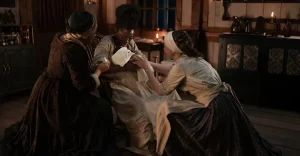
Julia’s decision with Lord Lovett is horrible, and it is supposed to be. The show earns a lot of dread out of the fact that she does not really have a good option. Only a hierarchy of awful ones. That is where the episode is most effective: when it treats survival as a negotiation with cruelty rather than a noble speech. It is ugly. It is compromising. It feels like the world pressing on her. That works.
Lord Lovett, meanwhile, is a loathsome little chaos goblin, but at least he is useful. He exists to turn pressure into contamination. He does not just want power. He wants rot. He wants to infect other people’s futures because his own room is already morally septic. That gives his material a kind of nasty juice, even when the show occasionally pushes it too far into “look how gross he is” territory.
Because this is where the episode wobbles. There are stretches here where the writing and directing stop trusting the material and start leaning on the sledgehammer. The rap battle is the obvious example. It is not fatal. It is not even the worst thing I have ever seen on this franchise. But it is one of those choices that makes you stop watching the episode and start watching the production try to entertain you. That is always a dangerous shift. Same problem with some of the broader bits around Lovett. You do not need to keep underlining the point. We got it.
I also think the episode plays a little too cute with ambiguity in the Ellen/Brian opening. Right now it reads much more like a dream or fantasy than a literal event, and that is fine if the show is building debate. It is less fine if it later wants credit for being “surprising” after using dream-language to hedge its bets. That is a live-wire question, and if the show wants to cash it in later, it needs to do so honestly.
But even with those complaints, “School of the Moon” is the best version yet of what this prequel can be. Not when it is trying to imitate Outlander beat for beat. Not when it reaches for “big moment” noise. When it focuses on pressure, leverage, inheritance, and the intimate price of power. That is the show’s real lane.
And for the first time, it actually drove in it with confidence.
Blood of My Blood Season 1 Coverage
- Episode 3 Review – “School of the Moon”
- Episode 3 Recap & Reaction Podcast
- Explainer: Did Ellen and Brian really sleep together?
- Explainer: Why are Colum and Dougal fighting?
- Fan Reaction: Where The Clans Stand This Week
Tell Us Your Rating(s)
What did you think of “School of the Moon”? Drop your Kilt Rating and your BomB Impact in the comments — and tell me which choice in this episode most changed the way you see the original series.
Looking for all of our coverage of Season 1? Visit our complete Blood of My Blood Season 1 Episode Guide for episode reviews, recap podcasts, explainer articles, and weekly fan reaction pieces.
Slàinte Mhath. 🏴