This Week’s Blood of My Blood Coverage
- Listen to the Episode 4 Recap & Reaction Podcast
- Explainer: What Beltane Means in Blood of My Blood Episode 4
- Explainer: Who Is Maura Grant in Blood of My Blood Episode 4?
- Fan Reaction: Where The Clans Stand This Week
- Blood of My Blood Season 1 Episode Guide
Full spoilers for Outlander: Blood of My Blood Episode 4, “A Soldier’s Heart.”
My Kilt Rating: 4.0 / 5
BomB Impact: 3.5 / 5
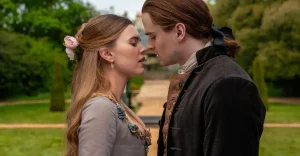
“A Soldier’s Heart” is the first episode of Blood of My Blood that really understands Henry cannot just be “the nice guy looking for Julia.” That version of the character was never going to be enough. This hour makes him messier, sadder, more volatile, and far more interesting by turning his war trauma into story pressure instead of background texture. That is the difference. Trauma here is not a tragic accessory the show pulls out when it wants instant depth. It changes how Henry moves through a room, how he reacts under stress, how he sees danger, and how badly he wants something good without fully believing he deserves it.
That is why the title works. “A Soldier’s Heart” is not just a poetic label slapped on the episode after the fact. It is the organizing principle for the whole hour. Henry’s condition follows him everywhere. It follows him into the brawl. It follows him into the nightmare logic of his body. It follows him into the rent-collecting storyline. It even follows him into intimacy. When he says there is something broken inside him, the episode earns that line because it has already shown us what that fracture looks like. One of the smartest things this show has done so far is refuse to make Henry’s trauma feel like a Very Important Issue-of-the-Week speech. It is embedded in the mechanics of the story.
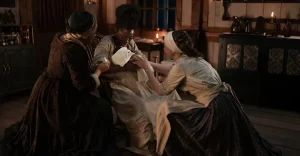
That approach also helps the Beauchamp side of the story keep its edge. Julia is still doing a tremendous amount of heavy lifting here, but at least now Henry feels like he is carrying his share of narrative gravity too. Julia remains the more proactive player — and honestly, she has to be, because she is trapped in Lord Lovat’s world and trying to survive it with almost no margin for error. The nettle-rash scheme is sharp. Her deal with Brian is sharp. Her ability to understand the room, read what people need, and move toward Ellen through the few channels available to her is sharp. She is not just enduring this story anymore. She is playing it.
It also helps that Julia’s intelligence keeps rhyming with Claire’s without becoming a lazy imitation of Claire. The plant knowledge, the problem-solving, the ability to keep multiple truths alive in her head at once — all of that clearly belongs in the same family tree. But the show is finally finding a version of Julia that feels more specific to Julia. She is not just “Claire’s mom, but earlier.” She is someone learning, in real time, how to weaponize composure. That is a much better character than a pure nostalgia delivery system.
The best structural choice in the episode is the Beltane setup. This is where the writing gets genuinely clean. Everyone is being pushed toward the same liminal space for different reasons, and the episode is wise enough to understand how much dramatic energy there is in that. Henry is moving because of duty and desperation. Julia is moving because the stones represent the last place where hope still has shape. Ellen is moving because Beltane offers public cover for private rebellion. Brian is moving because love stories only matter when somebody finally decides to risk something. Put all of that at a festival already associated with transition, mischief, fire, fertility, danger, and the thinning of boundaries, and suddenly the season starts to feel like it has a proper engine.
That is why so much of the hour feels more confident than earlier episodes. The show is no longer just arranging pieces on the board. You can finally see the board. You can see what kind of collision it is building toward. And even the folklore helps. The fairy talk, the superstitions, the ritual around offerings, the stories about people dancing near the stones and losing time — none of that feels ornamental. It reinforces the central idea that this world is built on thresholds: emotional thresholds, political thresholds, temporal thresholds. This franchise is at its best when the mystical and the practical are occupying the same frame, and “A Soldier’s Heart” does that well.
That said, no sacred cows: the episode still has the same sledgehammer problem that has been hanging around this series from the beginning. There are too many moments where you can feel the writing saying, “Please notice how elegantly I am setting this up.” The lottery is a good example. The idea itself is fine. In fact, it is smart. But the mechanics around it are so spelled out that the episode briefly feels like it is storyboarding itself in front of us. Same deal with the St. Anthony medallion. It is not that these objects or devices are bad. It is that the show sometimes introduces them with the subtlety of a marching band.
And then there is Lord Lovat, still pooping his way through yet another episode like the show is under the impression this is prestige television gold. It is not. We got it the first time. He is gross. He is cruel. He is physically decaying in tandem with his moral decay. Understood. Logged. Filed away. We do not need this much toilet-based reinforcement. At some point it stops being character detail and starts feeling like a bit that nobody had the courage to cut.
I also think Ellen still works a little better than Brian does, though this episode narrows the gap. Ellen has force. You feel her intelligence every time she is in a scene. Even when she is playing along, you can see the gears moving. Brian, on the other hand, is still being held back just a touch too much. There are good moments here — especially his insistence on hearing directly from Ellen whether she actually wants Malcolm Grant, which is exactly the right instinct for a man trying not to build a fantasy on secondhand hope. That scene works because it gives Brian a little backbone. But Ellen still arrives more fully formed. She feels like a person with a strategy. Brian still feels like a man the show is carefully unveiling in installments.
Even so, this is a strong episode because it knows what it wants to be about. It is about the cost of survival after violence. It is about the way love has to fight through damage instead of around it. It is about getting all of these people to the edge of a change they may not survive intact. Most importantly, it understands that the most effective way to enrich Outlander is not to hand us trivia. It is to show us the emotional architecture underneath the mythology we already know.
That is what “A Soldier’s Heart” finally starts doing. It takes Henry seriously. It takes Julia’s ingenuity seriously. It uses Beltane like an actual story hinge instead of a decorative pagan flourish. And even when the episode overplays its hand, the hand itself is finally worth watching.
Blood of My Blood Season 1 Coverage
- Episode 4 Recap & Reaction Podcast
- Explainer: What Beltane Means in Blood of My Blood Episode 4
- Explainer: Who Is Maura Grant in Blood of My Blood Episode 4?
- Fan Reaction: Where The Clans Stand This Week
- Blood of My Blood Season 1 Episode Guide
Tell Us Your Rating(s)
Drop your Kilt Rating and BomB Impact in the comments, and tell me this: are you more invested right now in Henry and Julia or Brian and Ellen? And if you want to send a voicemail for the pod, do it here: SpeakPipe.
Visit the Blood of My Blood Season 1 Episode Guide for episode reviews, recap podcasts, fan reaction pieces, and explainers.
Slàinte Mhath. 🏴