Full spoilers for the first trailer for Spider-Man: Brand New Day.
I’m going to say it right off the jump. The best thing about this trailer is that it does not feel built around surprise guests. It feels built around pressure.
Specifically, it feels built around pressure collecting on Peter Parker until the role of Spider-Man starts pushing back through the skin.
That matters because post-No Way Home Peter has had a real story problem. The sacrifice was emotionally huge. The follow-up risk was always that Marvel would treat that sacrifice like weather. Sad, yes. Heavy, yes. But basically static.
This trailer does something smarter. It makes the cost move.
Read Next In This Cluster
- What Spider-Man: Brand New Day Is REALLY Doing With Peter Parker’s Mutation
- Why Spider-Man: Brand New Day Matters for Avengers: Doomsday
- See all MCU Diaries entries here
The Thesis
Spider-Man: Brand New Day works because it turns Peter Parker’s erased identity into a physical problem.
The Tool
The core tool here is Identity Compression. That is when a story takes two parts of a character that were supposed to stay in tension and starts squeezing them until one begins to swallow the other.
In Spider-Man, that split is obvious. Peter Parker. Spider-Man. Person. Symbol. Human need. Hero obligation.
The trailer then adds a second tool: Body as Receipt.
Instead of letting the character explain his damage, the story makes the body tell the truth. If the life is out of balance, the flesh starts carrying the evidence.
That is why the cocoon matters. That is why the failed web shot matters. That is why Banner’s warning matters. For more on that mutation angle, read What Spider-Man: Brand New Day Is REALLY Doing With Peter Parker’s Mutation.
And then the trailer sharpens all of it with Mirror Mentors. Punisher and Bruce Banner are not there just so the audience can clap because the MCU door swung open again.
They are there because each one embodies a broken answer to Peter’s problem.
On Screen
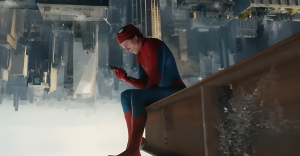
Start with the upside-down image.
Peter is high above New York, hanging there like a thought he cannot shut off. He watches Ned and MJ move deeper into a life that no longer includes him.
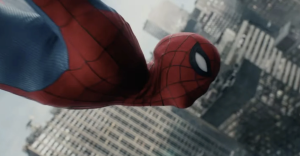
That image is the argument in miniature. Spider-Man can still cling to the city. Peter Parker has nowhere to stand.
The trailer separates usefulness from personhood.
The city still has Spider-Man. The world can still celebrate the symbol. Peter, meanwhile, is reduced to a guy watching his own absence on a phone screen.
That is Identity Compression. The public role keeps growing. The private self keeps shrinking.
That is also why the key-to-the-city beat hits the way it does. In another movie, that could play like victory. Here it lands like irony.
Spider-Man is publicly legible. Peter Parker is socially extinct. The role gets applause. The person gets isolation.
When the trailer cuts from civic recognition to private collapse, it is telling you exactly where the real story lives.
Then the body enters the conversation.
Peter drops. Peter sweats. Peter collapses. Peter wakes up cocooned. The webbing shows up where it should not. He reaches for web shooters and the body answers before the tech does.
Bruce Banner puts a scientific label on the dread when he warns, “If DNA is mutating, it could be enormously dangerous.” That line is useful because it names the danger while the trailer keeps the real meaning on the visual level.
Story Is A Metaphor For Life
In his book Story, Robert McKee says, “Story is metaphor for life.” That is exactly what this trailer understands.
The mutation is not interesting because it is weird. It is interesting because it literalizes Peter’s condition. He has spent four years overdeveloping one identity and starving the other. Now the body is acting like the imbalance is unsustainable.
And that move solves a real franchise problem.
Sadness alone is atmosphere. Mutation is plot.
Once the body becomes unstable, every scene gains a second track. Peter is dealing with a threat out in the world while simultaneously discovering that he may no longer be safe inside himself. That is how you turn aftermath into engine.
The mentor choices make the point even cleaner.
Punisher is what happens when grief hardens into vocation. Bruce Banner is what happens when the monster gets managed, studied, contained, and still never truly goes away.
Peter gets pulled between those examples because he is facing the same human question in a new costume. Do you disappear into the role? Or do you bury the part of yourself that scares you?
In The Anatomy of Story, John Truby writes, “The plot grows from the unique characters.” Good. Because that is what the trailer is finally doing again.
It is not starting with crossover mechanics and looking for a heart later. It is starting with Peter’s unique fracture and letting the spectacle grow out of that wound.
The MJ material matters for the same reason.
The trailer does not need her to remember everything yet. It only needs the emotional gravity to stay alive. The flowers. The almost-recognition. The “friendly neighbor” button at the end.
Those beats keep the missing life present without flattening the story into reunion bait. The absence is still active. It still shapes choice.
The Takeaway
When a franchise wants an old consequence to matter again, the smartest move is to change its form.
Make the cost evolve. Make it leave new receipts. Make the hero deal with it under fresh pressure instead of replaying the first wound at a lower volume.
That is what Brand New Day appears to be doing. Peter already paid emotionally for erasing himself. This movie looks ready to make him pay physically for living inside that erasure.
That is a much stronger engine than simple longing, because it forces action, fear, and choice.
So What
This matters for the bigger MCU because the Multiverse Saga has often struggled to make scale feel personal.
Portals are easy. Consequence is hard.
If Brand New Day can turn identity damage into story pressure this cleanly, it gives Marvel a better template for Doomsday. Bigger stakes only matter when they cash out through bodies, relationships, and decisions people can feel. For more on that larger saga angle, read Why Spider-Man: Brand New Day Matters for Avengers: Doomsday.
It also quietly restores moral debt to the board.
Peter made the right call at the end of No Way Home. That does not mean the bill vanished. It means the bill arrived later.
And that delayed cost is exactly the kind of saga grammar this era has needed.
The craft question here was simple. How do you make Peter Parker’s sacrifice matter again without just replaying the same grief?
You turn the wound into a system under strain. You let Identity Compression push the role harder and harder until the body starts testifying against the life.
The opening proof beat is Peter upside down over the city, alone, watching the life that moved on without him. The later proof beat is Peter cocooned, webbing out of his own body, like the job has finally started carving itself into the organism.
Same wound. More pressure. Higher cost.
That is the transferable lesson. When a character refuses to resolve an imbalance emotionally, the strongest stories make that imbalance show up somewhere physical, social, or moral where it can no longer be ignored.
That is how you make consequence evolve.
Next time you watch anything — Marvel or not — track embodied consequences.
Embodied consequences always reveal character.
And character, not spectacle, is what makes a story stick.