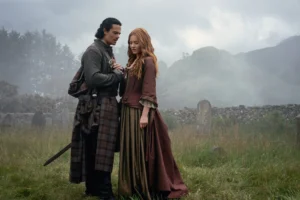
Netflix has officially announced a Bridgerton limited series about young Violet and Edmund Bridgerton. The most compelling part of that news is something every longtime viewer already knows: this love story ends in tragedy. Mary & Blake’s take is that Violet and Edmund’s romance is the original emotional blueprint for the entire franchise, and finally seeing it unfold could change how we understand every Bridgerton child’s search for love.
All of the children are raised with a seemingly impossible standard. They know their parents shared a genuine love match, and they also know that Edmund’s death broke their mother’s heart. Those two facts belong together. The romance that made Violet believe love was worth pursuing is the same romance that taught Anthony to fear losing it.
What Netflix actually announced about the Violet Bridgerton spinoff
On October 8, 2026, Netflix announced a still-untitled limited series exploring young Violet’s early life and her romance with the future Viscount Edmund Bridgerton. Shonda Rhimes and Nicholas Nardini will write, serve as showrunners, and executive produce. Betsy Beers and Tom Verica will also executive produce. Netflix has not announced a release date, episode count, or cast for the new production.
Netflix describes the project as another expansion of the Bridgerton world, following the success of Queen Charlotte: A Bridgerton Story. The announcement comes while Season 5 of the flagship series is in production. Any suggestion that the new show will employ two timelines, revisit Edmund’s death, or cast an actor already associated with young Violet remains speculation at this stage.
Why Violet and Edmund’s romance matters to every Bridgerton child
Violet has always been the family’s emotional reference point. She doesn’t merely want suitable marriages for her children; she hopes they experience the intimacy, companionship, and feeling of being truly chosen that she once knew. Her advice can seem frustratingly idealistic to children navigating scandal, status, and obligation. Yet her belief comes from experience. Edmund is the unseen evidence behind nearly everything she asks them to pursue.
Anthony reveals the other side of that inheritance. After his father’s sudden death, Anthony witnesses his mother’s grief and assumes responsibility for the family before he is emotionally ready. He grows into a man who confuses control with safety, and who initially believes loving someone completely would expose both of them to unbearable pain. His relationship with Kate is powerful because it asks him to challenge a conviction formed by the loss of Edmund.
This is the delicious dramatic contradiction the prequel can explore: Violet knows love is worth the grief because she experienced it; Anthony believes love should be avoided because he witnessed its aftermath. Same family, same event, entirely different conclusions. For more on Anthony’s response, see our Anthony Bridgerton character analysis and our Season 2 ending analysis.
The biggest story-craft challenge: we already know how this ends
A prequel carries an unusual dramatic burden. We know Violet and Edmund will marry, raise eight children, and eventually be separated by Edmund’s death. The outcome of the relationship is fixed, so the writers have to make individual choices, sacrifices, and reversals matter. The tension needs to live inside the courtship: what does Violet want, what does Edmund want, and what must each risk in order to choose the other?
Robert McKee’s concept of dramatic irony offers one way to understand the possibility. Viewers know something the young lovers do not. A tender scene can contain genuine warmth while quietly reminding us how much these two people stand to lose. The audience’s anticipation transforms the texture of even ordinary romantic moments.
John Truby’s emphasis on desire, weakness, and moral need points toward a more demanding test. Violet needs a particular worldview at the beginning of the series that Edmund challenges through action. Edmund must be a fully realized person with his own competing desires and flaws. Otherwise the show risks presenting a series of lovely dates instead of a dramatic story where both characters change.
What the writers should protect about Edmund
The show cannot rely on Edmund’s impending death to do all its emotional work. Bridgerton has already given us the traumatic consequences of losing him, especially through Anthony’s memory and behavior in Season 2. The new series has an opportunity to make that loss more specific by showing Edmund’s choices, personality, humor, and relationship with Violet while he is alive.
Consider the possibility of a small disagreement that becomes a defining turning point in their marriage. If Edmund chooses Violet at a real personal cost, and Violet learns to choose him even when doing so complicates her understanding of social duty, then the relationship acquires dramatic weight. Later, when the family speaks about its lost patriarch, viewers will remember a person rather than a symbol.
Could older Violet be part of the story?
After Season 4, Violet’s relationship with Marcus Anderson leaves her examining what she wants in this new chapter of her life. Netflix’s Season 4 explanation makes clear that she ultimately chooses room for her own growth instead of rushing into another marriage. That opens up an intriguing thematic contrast with a young Violet discovering romantic love for the first time.
A dual-timeline story could place those two versions of Violet in conversation, much as Queen Charlotte examined love and memory across generations. This is a Mary & Blake storytelling possibility, not an announced creative decision. Even without a dual timeline, the emotional echo is fascinating: the woman who taught her children to choose love must continue making choices for herself.
Is the spinoff based on a Violet and Edmund book?
Julia Quinn wrote about Violet in the short story Violet in Bloom, included in The Bridgertons: Happily Ever After. She has explicitly explained that it is not a traditional full-length Violet-and-Edmund romance, partly because she found the prospect of writing toward Edmund’s early death so bittersweet. Our Violet in Bloom book guide unpacks what exists on the page and what a television adaptation would need to develop.
For more about Edmund’s family history and why his death shapes Anthony’s entire arc, read our guide to Edmund Bridgerton.
Our take: the ending is the reason the story could work
If Rhimes and Nardini give Violet and Edmund genuine opposition, decisions, imperfections, and growth, the audience’s foreknowledge becomes the series’ emotional advantage. We will know the heartbreak is coming, but every hard-won moment of happiness will tell us why Violet keeps believing her children deserve the same experience. The writers’ real task is to make us finish this prequel thinking, with a painful kind of gratitude, that we finally understand what the Bridgertons lost.