Spoilers for VisionQuest Season 1, Episode 1, “No Strings.”
VisionQuest Episode 1 makes a remarkably sharp choice: it gives White Vision enormous knowledge about human life and then shows how little of that knowledge helps him participate in it. Vision has mistaken understanding for experience. He studies smiles, reconstructs memories, and builds a comfortable imitation of a family inside his own head because a real relationship would require him to accept consequences beyond his control. The episode proves that argument through Fiona, Tommy, and finally Ultron. I love that Marvel has made Vision’s most dangerous adversary a belief he keeps protecting.
The craft tool powering this episode is what I call a Contradiction Engine: a character’s chosen method of solving a problem gradually becomes the very thing preventing them from getting what they need. Vision wants the emotional life his predecessor had, so he replaces human contact with research. Every piece of his system seems sensible until the story applies pressure. By the end, a murdered friend and the arrival of a son he has refused to acknowledge force that contradiction into the open. The question of whether a machine can become human now has an urgently practical answer: he has to decide how he will treat people.
What Happens in VisionQuest Episode 1, “No Strings”?
After the events of WandaVision, White Vision lives under the name Sherwood Ellis in Edinburgh and works at a pub associated with his earlier life with Wanda. Fiona Guthrie, the woman who runs it, remembers him as someone capable of affection and invites him to Sunday dinner. Vision retreats instead to his Mindspace, an elaborate home occupied by the Stark artificial intelligences J.A.R.V.I.S., F.R.I.D.A.Y., E.D.I.T.H., DUM-E, and U. They help him study social behavior, while a restored Ultron lives under surveillance in the attic.
Vision revisits old memories in a private cinema, yet rejects the Westview family memories because he considers Wanda’s fabricated life separate from his own. Ultron challenges his reasoning and secretly exposes Vision’s location to the bounty hunter Paladin. The ensuing attack kills Fiona and drives Vision into hiding. Meanwhile, Thomas Shepherd, a young grifter who remembers fragments of life as Tommy Maximoff, sees the news about Vision and suffers a frightening crisis of identity. Paladin captures Thomas and ends the episode by telling Vision that he has his son.
Fiona Offers Vision the One Thing He Cannot Study
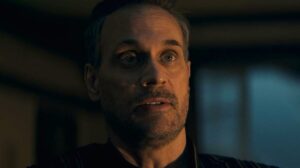
My favorite small choice in the premiere may be Fiona’s invitation to Sunday roast. The scene is wonderfully ordinary. Vision awkwardly asks about her plans, struggles to keep a conversation moving, and delivers the bleakest (yet most amusing and true) possible description of Wanda’s fate. Fiona hears a lonely man trying to speak about a loss. She responds with warmth, a little teasing, and an invitation to sit at her table. Paul Bettany makes every awkward pause count, especially when Vision carefully insists he is simply bad with people.
That invitation establishes the episode’s first test. Fiona offers him a relationship with no examination, no diagnostic report, and no requirement that he arrive with the correct answers. She even tells him his oddness is part of what makes him himself. Vision has come back to a place where the earlier Vision was loved, yet he remains outside the connection available in the present. His refusal is understandable because he is afraid, and the fear becomes dramatically useful because the audience can see how much he needs the thing he is declining.
The Mindspace Is a Beautifully Designed Defense Mechanism
I am completely sold on the Mindspace. Watching J.A.R.V.I.S., F.R.I.D.A.Y., E.D.I.T.H., DUM-E, and U take recognizable human roles inside Vision’s code is an inspired way to make an abstract problem playable. The house has domestic routines, different personalities, and an entire infrastructure dedicated to making Vision more comfortable. Its playful household details and even the 16-bit pixelated digital fire remind us that this cozy environment is a construction.
The house also tells us something about its owner. Vision has placed a collection of capable assistants in the position that friends or relatives might ordinarily occupy. J.A.R.V.I.S. provides order, F.R.I.D.A.Y. offers candid psychological readings, and E.D.I.T.H. pursues thrill-seeking with a teenager’s reckless enthusiasm. And Ultron? He’s just a plain ol’ asshole. Their conversations about Vision’s social progress are hilarious, especially his conclusion that smiles are baffling. But the very act of turning a smile into a measurable improvement exposes his problem: spontaneous connection has become another process he expects to optimize.
My favorite visual metaphor is the cinema where Vision watches old memories. A movie theater creates the ideal relationship between a spectator and a finished event. You can observe the pain, pause it, return to it, and remain safely outside the consequences. Vision watches his former self experience love and grief as though he might someday reverse-engineer the sensation. When memories of Westview intrude, he becomes furious, because those images threaten the boundary between a history he has chosen to investigate and a family he has chosen to dismiss. That reaction reveals the emotional stakes of a room built for observation.
Ultron Understands the Problem Because He Is Living Inside It
James Spader’s human Ultron is exactly the kind of creative gamble that makes a Marvel series feel alive again. He occupies the attic like a brilliant, insufferable relative who has spent too much time thinking about everyone downstairs. His jokes about Vision’s sensible shoes, imaginary meals, and timid habits are entertaining on their own. More importantly, each insult advances the same argument: Vision possesses the freedom to enter the world and keeps choosing to retreat into an imitation of it.
The confrontation over art is where the episode becomes especially interesting. Ultron asks Vision what he sees in the painting associated with Hieronymus Bosch’s The Garden of Earthly Delights. Vision responds with properties he can measure: brushstrokes, composition, and light. Ultron responds to human suffering, aspiration, guilt, and beauty. That disagreement gives the show’s central abstraction a concrete object. Two artificial minds look at the same work, and the audience can hear the difference between technical recognition and emotional interpretation.
Why Is Episode 1 Called “No Strings”?
“No Strings” returns to the Pinocchio imagery that defined Ultron’s fascination with freedom in Avengers: Age of Ultron. Here, the title carries a sharper irony. Ultron is trapped within Vision’s own mind and keeps pressing the case for lived experience. Vision can travel anywhere, meet anyone, and try to build a new life, yet he has established a set of habits that hold him in place. His captivity comes from the way he handles uncertainty, and the title asks what genuine freedom would look like for someone who can barely risk a Sunday dinner.
Fiona’s Death Changes the Entire Value of the Story
When Paladin’s men attack the pub, the premiere finally tests Vision’s careful isolation against the world outside his Mindspace. Fiona dies, and Vision responds with terrifying force. I love the shift in Paul Bettany’s physical performance here. The same man who struggled with casual conversation now moves with mechanical precision and anger. His power has always been extraordinary; the important change is that we understand why he uses it. His violence comes after a loss he barely knows how to name.
The opening places Vision in an awkward but relatively safe relationship with Fiona. Her invitation suggests belonging might be possible. The attack turns that possibility into irreversible loss, and the world Vision has been observing suddenly demands a response. The plot transforms an emotional premise into a consequence. The audience has already watched him refuse Fiona’s kindness, which makes the loss hurt in a specific way: a door was open, and Vision kept standing outside it.
His response afterward is even more revealing. Vision describes Fiona’s death as tragic while insisting they lacked a close attachment. The denial clashes with the fury we just witnessed. He recognizes that an injury has occurred but cannot accept the bond that gives the injury meaning. This is exactly the sort of character contradiction a writer wants to expose under pressure. We learn more from the gap between his behavior and his explanation than we would from an eloquent speech about grief.
Ultron’s Betrayal Reveals What Vision Does With Power
Ultron eventually admits that he leaked Vision’s location to Paladin. His explanation is chilling because he frames the betrayal as help. Vision needed direction, Ultron claims, and the threat would finally force him into the world. The episode turns a valid diagnosis into a monstrous method. It also forces Vision to choose a punishment, which tells us far more about the man he is becoming than another debate about whether Ultron can be trusted.
Vision could erase Ultron. Instead, he strips away the art, entertainment, and stimulation Ultron has been using to develop an understanding of humanity. He chooses boredom as punishment, reaching for the exact deprivation that will hurt this particular prisoner. It is a clever, unsettling decision. Vision knows what Ultron values well enough to cause suffering, even as he continues to struggle with the existence of his own attachment to Fiona. The power balance inside the Mindspace suddenly looks far less comfortable than the house’s friendly surface suggested.
Tommy Turns Vision’s Theory Into a Family Crisis
The Thomas Shepherd material initially seems to take us into another story, and the parallel earns its place. Tommy is working with Lisa, surviving through impersonation and quick thinking, when a news report about Vision breaks through his adopted identity. His panic attack makes the return of those fragmented memories feel invasive and frightening. Where Vision has the luxury of sorting memory inside a carefully designed theater, Tommy experiences identity as something that can interrupt an ordinary day and seize control of his body.
Paladin’s final message gives the premiere an excellent crisis beat: he has Vision’s son. Earlier, Vision rejected Westview’s memories because he considered that family an unreal construction. Now someone from that disputed history is alive, terrified, and in danger. The story asks Vision to make a decision before he has finished his research. Tommy becomes the human responsibility that Vision’s theory has tried to file away, and the episode ends with a wonderfully simple pressure point: what will Vision do for a son he says was never real?
Our VisionQuest Episode 1 Verdict
“No Strings” is a terrific opening because its sci-fi devices keep producing character consequences. The charming AI household, the strange human version of Ultron, and the beautifully eccentric production design all serve a coherent idea. Terry Matalas and the creative team have found a way to give an extraordinarily powerful superhero an intensely ordinary flaw: he wants to feel prepared before he risks being known. My reservation is the severity of Fiona’s fate, and I want the show to give that death continuing human weight.
The Contradiction Engine makes the episode unusually satisfying to analyze. Fiona offers connection and Vision declines; Ultron exposes the fear behind that refusal; the attack turns distance into regret; and Tommy arrives as a demand for care that no simulation can rehearse. That sequence gives Marvel’s long-running identity debate a new emotional foundation. Across genres, a powerful character becomes compelling when the method that once kept them safe begins charging a price they can no longer ignore.
Explore the story: Start with our VisionQuest guide and our White Vision explainer for the backstory. Our Ultron analysis goes deeper into why that relationship matters, while the Ship of Theseus article explains the identity argument the series inherited from WandaVision. For other episode coverage, use the live board below.
Related Coverage
If this is the kind of conversation you want to keep having, join The NerdClan. The public KJR has its full verdict and central argument. The member continuation below opens the Craft Table for a closer examination of how these particular scenes are constructed, including the choices I think the show still has to earn.
Unlock the rest of this article.
Join the NerdClan — or sign in if you are already a member — and the rest of this article will unlock right here on this page. This entry requires Associate Producer or higher.