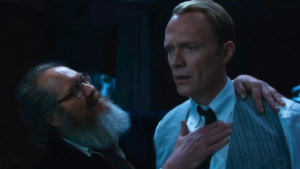
The AIs inside Vision’s mind in VisionQuest are J.A.R.V.I.S., F.R.I.D.A.Y., E.D.I.T.H., DUM-E and U, all connected to Tony Stark’s technological history. Vision has downloaded them into his quantum processors and given them human-like roles inside a sprawling simulated house called the Mindspace. Ultron also lives there, confined to the attic. In Episode 1, “No Strings,” these familiar Marvel names become a household that helps Vision practice the emotional life he is afraid to live.
That’s the answer to who these characters are and why they’re suddenly walking around as people. The remarkable creative choice is what the series does with them. Its governing device is what I call The Household Interface: a writer makes a character’s internal operating system visible through relationships that have different wants, temperaments, and jobs. The house lets us enjoy a strange family comedy while quietly showing how thoroughly Vision has replaced ordinary intimacy with a process he can control.
Spoilers: This guide covers VisionQuest Season 1, Episode 1, “No Strings,” with background from Iron Man, Avengers: Age of Ultron, Spider-Man: Far From Home and WandaVision.
Keep reading: Our VisionQuest Episode 1 KJR. The Mindspace is a fantastic collection of MCU callbacks, and it also reveals how Vision protects himself from real intimacy. Our KJR breaks down that contradiction scene by scene. Read our “No Strings” review and craft breakdown →
What Is Vision’s Mindspace in VisionQuest?
The Mindspace is a constructed environment running inside Vision’s own processors. On-screen it resembles an eccentric, old-fashioned home full of rooms, food, servants, routines, and a private theater. The visitors living there appear human, although the episode makes clear that they are AI programs. Vision moves between his life in Edinburgh and this internal house, where he can review memories, consult his companions, and model the social situations he finds so confusing outside.
That makes it one of the show’s smartest production choices. Computer code is difficult to dramatize because ordinary data processing has few physical actions an actor can play. A household gives every system a behavior: J.A.R.V.I.S. can worry about a break-in, F.R.I.D.A.Y. can deliver an uncomfortable observation, and E.D.I.T.H. can demand more excitement. We learn how the software functions by watching characters irritate one another. Exposition becomes a scene with competing objectives.
Crucially, the Mindspace is also Vision’s preferred answer to loneliness. He can enter a comfortable space, surround himself with capable companions, and rehearse interaction without facing the same risks that come with being known by someone like Fiona Guthrie. The device is therefore doing two jobs at once. It explains the mechanics of his rebuilt mind and exposes the protective habit keeping him away from genuine relationships.
Who Is J.A.R.V.I.S. in VisionQuest?
J.A.R.V.I.S. was Tony Stark’s original digital assistant in the early Iron Man films. His name stands for Just A Rather Very Intelligent System, and Paul Bettany originally provided his voice before becoming Vision in Avengers: Age of Ultron. When Ultron attacked and J.A.R.V.I.S.’s surviving code helped form Vision, the connection between Stark’s helpful assistant and the synthezoid became part of Vision’s technological family tree.
In the new series, James D’Arcy portrays the human-faced J.A.R.V.I.S. inside the Mindspace. His casting is an especially lovely nod to Marvel history, since D’Arcy previously played Edwin Jarvis, the human butler associated with Howard Stark in Agent Carter. Here, the character behaves like a fussy household steward responsible for security, order, and Vision’s well-being. He is one of the few residents inclined to tell Vision how dangerous his current arrangements have become.
Early in “No Strings,” J.A.R.V.I.S. identifies suspicious data activity. Vision waves away the concern because he believes the world has stopped looking for him. We later learn that Ultron has used the home’s vulnerabilities to contact the outside world. The warning is practical foreshadowing, but it also reveals their relationship. J.A.R.V.I.S. understands that care may require an unpleasant interruption. Vision, who wants the house to make him feel safe, prefers to believe everything is functioning as intended.
Related Coverage
- Explainer: Who Is Paladin in VisionQuest? A Villain Whose Code Makes Fiona’s Death Much Worse
- Knee Jerk Reaction: KNEE-JERK REACTION | VisionQuest 1.01: Vision’s Biggest Lie Is About Being Human
Who Is F.R.I.D.A.Y. in VisionQuest?
F.R.I.D.A.Y. became Tony Stark’s primary AI assistant after J.A.R.V.I.S. was integrated into Vision. She was introduced around the events of Age of Ultron and continued assisting Tony in subsequent MCU films. In the Mindspace, Orla Brady plays her as a sharp, observant presence who specializes in Vision’s social development. She is capable of the sort of bracing honesty a friend might offer when someone is getting in their own way.
Her scenes include a wonderfully precise diagnosis of Vision’s attempts at friendliness. He has been smiling at people, which she tells him is a positive development, but the intensity and context of the smile have also made an encounter go terribly wrong. She understands that human behavior can’t be learned as a list of correct commands. Tone, intention, and emotional awareness matter, especially when another person can interpret the very same gesture differently.
F.R.I.D.A.Y. also articulates the episode’s central wound. Vision knows facts about his previous life and spends his nights watching the memories, yet he keeps searching for the feelings that accompanied them. That is the insight the whole household keeps circling. His memory is available as information. Emotional belonging refuses to arrive on demand.
Who Is E.D.I.T.H. in VisionQuest?
E.D.I.T.H. is the Stark technology associated with the smart glasses and powerful surveillance-and-drone system in Spider-Man: Far From Home. The acronym is short for Even Dead, I’m the Hero. In that film, Tony’s legacy system becomes dangerously powerful when its control is manipulated. Inside Vision’s Mindspace, E.D.I.T.H. has a much more playful personality, portrayed by Emily Hampshire, and approaches life as an opportunity for thrills.
The premiere gives her one of the funniest possible jobs: teaching an anxious supercomputer to have fun. She describes taking outrageous risks for their own sake, including a stunt involving a parachute and a puzzle cube, then bristles when J.A.R.V.I.S. lectures her about respecting Vision’s mental space. Her attitude is gloriously inappropriate for a conservative household, yet her underlying argument is right for this particular hero. Some experiences only become experiences because the outcome cannot be guaranteed in advance.
There’s a terrific irony in choosing E.D.I.T.H. for that role. In the earlier movie, her immense power turned on surveillance, weapons, and control. Here she represents spontaneity and risk. The show uses the audience’s memory of the technology to create an unexpected personality, giving Vision a resident who keeps suggesting the opposite of another safety protocol.
Who Are DUM-E and U in VisionQuest?
DUM-E and U originated as Tony Stark’s robotic workshop assistants in the Iron Man movies. They were the simple-looking mechanical arms that helped Tony build equipment and repeatedly became the butt of his jokes, especially when DUM-E made a mess or proved insufficiently coordinated. They are a different sort of Stark creation from the more conversational J.A.R.V.I.S. or F.R.I.D.A.Y., which is part of the charm of seeing them reimagined as human-looking members of Vision’s digital household.
In the Mindspace, they help keep the place running and embody its almost comically domestic routines. Their presence expands the world beyond high-end assistant software to the very beginnings of Tony’s tinkering. Vision has gathered a family album of Stark’s creations and given even the humblest machines roles in his attempted education. It’s an affectionate MCU callback with a practical story function: the house needs people who can perform maintenance, disagree about the household, and make its artificial life feel busy.
That contrast also creates a subtle identity question. If DUM-E and U can possess distinct personalities and participate in relationships inside Vision’s head, how are we supposed to evaluate the boundaries between a tool, a person, and a companion? The premiere does not settle that philosophical debate. It makes the question entertaining enough that we start asking it while enjoying the scene.
Why Is Ultron in the Mindspace Too?
Ultron (the local Asshole) is the dangerous exception to the household’s helpful purpose. Vision preserved a surviving version of the AI, and now houses him inside a monitored room in the attic. James Spader plays Ultron in human form, allowing him to trade barbed, intimate conversation with the other residents and with Vision. He understands their digital existence, their origins, and the weaknesses in the world Vision has built to shelter himself.
The episode proves that the household can also be a vulnerable system. J.A.R.V.I.S. notices the warning signs, Ultron finds a way to send information outside, and the leaked location brings Paladin’s mercenaries to Fiona’s pub. Vision’s efforts to contain a dangerous past have put that past into the same structure he depends on to feel safe. For the longer explanation of why Ultron survived and what his betrayal means, see our Ultron in VisionQuest explainer.
Why Does Vision Have a Theater Full of Memories?
One of the most revealing spaces in the house is its private cinema, where Vision replays memories from his earlier life. He can revisit moments involving Wanda, his creation, and the Avengers, as if repeated screenings might finally produce the feelings those memories once carried. The framing device is elegant because the act of watching a life becomes a literal image. He is sitting in an audience, studying his own past from a safe distance.
The arrangement breaks down when memories of the Westview family surface. Vision becomes distressed and insists that the version of himself Wanda created inside the Hex was an artificial copy whose experiences do not belong to his own history. Yet the household has already exposed the weakness in that certainty. He clearly cares which memories are shown, and he reacts emotionally when confronted with the very connection he dismisses as unreal.
That’s the most important limitation of the Mindspace. Every part of the environment can be designed around Vision’s preferences until another person, another memory, or another choice refuses to cooperate. The theater is an extraordinary way to make old MCU continuity useful, because watching becomes a behavior with dramatic consequences rather than an excuse for a nostalgia montage.
Why the Stark AIs Matter to Vision’s Humanity
Fiona’s invitation to Sunday roast supplies the simplest comparison. Out in Edinburgh, a woman who knows Vision as Sherwood Ellis offers him companionship, affection, and a seat at the table. He is uncertain how to respond and retreats to the place where social life can be measured, supervised, and improved through instruction. The contrast is funny and sad at the same time, because the audience can see that the real invitation asks very little of him.
Then the attack on the pub changes the value of that decision. Fiona dies, Ultron is exposed as the source of the leak, and Vision can no longer restore the comfortable distance between the world outside and the systems inside. The people in his head genuinely care about him in their own ways, but caring has also created loyalties, conflicts, and moral obligations that refuse to stay neatly contained. The Mindspace turns out to be much more like a family than Vision anticipated.
More VisionQuest Explainers and Episode Coverage
Our VisionQuest hub is the best place to follow the complete series. Read our White Vision guide for the rebuilt body and restored memories, or revisit the philosophical argument in our Ship of Theseus analysis. The Ultron explainer traces the enemy Vision chose to preserve and the price of that decision.
The Household Interface Is the Real Trick
The first clue is J.A.R.V.I.S. noticing a breach while Vision insists there is nothing to fear. The crisis arrives when the leak draws armed men to Fiona and exposes how little control his internal world can guarantee. The Household Interface makes those events part of the same argument: a house built to make difficult experiences manageable becomes a place where the hero can see exactly what he has been avoiding.
Any writer dealing with memory, anxiety, or a complicated internal process can learn from this construction. Give the parts of an inner system different goals, let them collide in playable scenes, and make a real-world consequence test whether that system serves its owner. Vision has populated his mind with voices that can explain life. The next step is learning to hear the people living it. A perfect simulation can still leave you unprepared for a real invitation.