Ultron is in VisionQuest because Vision never completely erased him. Showrunner Terry Matalas has revealed that the final confrontation in Avengers: Age of Ultron did not end with Vision simply destroying the last version of Ultron. Vision backed him up at the last moment, preserving the artificial intelligence that now exists inside Vision’s programming.
That explains the mechanics of Ultron’s return, but it is not the most interesting reason he belongs in the show. Ultron helped create Vision, represents the worldview Vision rejected at birth, and now occupies space inside a White Vision who remembers being a hero without believing he possesses that hero’s virtue. In story terms, Ultron is what I call The Inherited Opponent: the antagonist is embedded in the protagonist’s origin, so defeating him requires the hero to decide what parts of that inheritance will define him.
Quick answer: Ultron survives in VisionQuest because Vision secretly preserved a backup of him, and the series uses that survival to turn an old villain into a present-tense identity test. Ultron is not merely someone Vision has to beat again. He is one of the possible answers to the question, “What kind of created being will Vision choose to become?”
Spoilers: This explainer covers Avengers: Age of Ultron, WandaVision and VisionQuest Season 1, Episode 1, “No Strings.”
Keep reading: Our VisionQuest Episode 1 KJR. Ultron’s betrayal is one piece of the premiere’s larger argument. Our Episode 1 KJR follows how his actions, Fiona’s death, and Tommy’s arrival expose Vision’s deepest blind spot. Read our “No Strings” review and craft breakdown →
Follow VisionQuest
How Is Ultron Alive In VisionQuest?
For more than a decade, the end of Age of Ultron looked simple. Vision finds the final Ultron drone in the woods after Sokovia, the two artificial beings have one last conversation about humanity, a flash of light fills the frame, and Marvel leaves us to conclude that Vision destroyed him.
Matalas has now changed the meaning of that scene. He has said Vision saved Ultron “at the last moment” by backing him up rather than completely erasing him. That means the physical body could be destroyed while the intelligence survived as code, eventually becoming one of the AI personas contained within Vision.
The retcon works because the original scene never shows us a pile of destroyed Ultron code. It shows an intimate conversation between two related beings, then cuts on the flash. VisionQuest is using that negative space to reveal that Vision’s final action was mercy.
Did Vision Actually Kill Ultron In Age Of Ultron?
VisionQuest reveals that Vision neutralized the last active Ultron body while preserving a copy of the intelligence. That distinction is now the bridge between the 2015 movie and the new series.
More importantly, it reframes the scene around character. Vision spends the conversation acknowledging that humanity is doomed while still seeing grace in its impermanence. Ultron considers that sentiment naive. If Vision then preserves Ultron anyway, the final action becomes an extension of the philosophy he just expressed: Vision sees value in a life even when that life has caused enormous harm.
That is the starting proof beat for The Inherited Opponent. The original Vision’s mercy preserves the opponent White Vision will later have to confront.
Ultron Is Part Of Vision’s Family Tree
Calling Ultron “Vision’s villain” undersells the relationship. Ultron designed the synthetic body that eventually became Vision because he intended to use it for himself. Tony Stark and Bruce Banner interfere, J.A.R.V.I.S. becomes part of the resulting intelligence, Thor provides the final burst of power, and a being emerges who immediately refuses the purpose Ultron created the body to serve.
That makes Ultron something closer to a creator or father figure than a random enemy. Matalas has emphasized the father-and-son chemistry between James Spader and Paul Bettany, and the show appears willing to make that relationship explicit rather than burying it beneath robot fights.
It also creates a clean character web. Ultron and Vision share an origin but disagree about what creation means. Ultron treats superiority as permission to control or replace humanity. Vision treats consciousness as a responsibility to choose what kind of being he will become.
Why Ultron Lives Inside Vision’s Mind
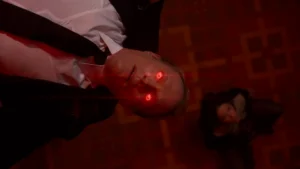
The VisionQuest footage shows Vision consulting different AI personalities embedded in his programming, including J.A.R.V.I.S., F.R.I.D.A.Y., E.D.I.T.H. and Ultron. The official synopsis makes this internal council part of Vision’s search for meaning. That is a great dramatic device because it turns exposition about his technological lineage into characters who can argue with him.
Ultron is the most dangerous voice in that room because he can attack Vision’s self-concept from the inside. White Vision cannot dismiss him as a stranger. Ultron can say, in effect, “I am part of why you exist. You are closer to me than you want to admit.”
That is what makes him an Inherited Opponent. He embodies a possible self the protagonist has already inherited enough of to fear.
Related MCU Diaries Coverage
Why Did Ultron Betray Vision in VisionQuest Episode 1?
Ultron betrays Vision in “No Strings” because he believes the rebuilt Vision has turned safety into a permanent excuse to avoid living. Ultron discovers an existing bounty on Vision, exploits a weakness in J.A.R.V.I.S.’s security, and leaks the Edinburgh pub’s location to Paladin. He later admits doing it to speed up an encounter he considers inevitable. He wants Vision forced into motion, and he treats the danger as a gift.
The distinction matters: Episode 1 does not show Ultron creating the bounty, hiring Paladin, or choosing Fiona as a target. An unknown party places the contract; Ultron makes that threat immediate by giving the hunter Vision’s location. Fiona dies during the resulting attack. Vision names the consequence without hesitation: “Fiona died because of you!” The betrayal becomes an act of moral arrogance, because Ultron has appointed himself the authority on what kind of suffering another person needs.
Watch how the script builds the cause and effect. Early on, J.A.R.V.I.S. notices suspicious data leaks, but Vision waves away the security concern. Ultron later sends an encrypted message disguised through the house’s carrier-pigeon conceit, and the breach becomes real-world violence. Vision has been measuring his improvement in social interaction while missing the danger inside his most trusted retreat. The same system that keeps him away from emotional risk leaves him exposed to someone who knows how the system works.
Ultron’s Painting Explains Why His Betrayal Is So Disturbing
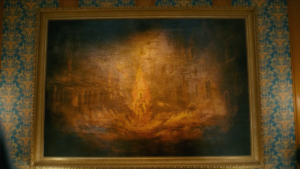
Ultron’s interest in art gives this return more texture than another argument about whether humanity deserves to exist. In the attic, he studies a painting and asks Vision to describe what he sees. Vision names measurable properties: brushstrokes, light, and composition. Ultron sees the human pain, confusion, aspiration, and grief that could inspire it. The genocidal intelligence suddenly sounds more perceptive about people than the hero attempting to understand them.
That reversal is the attraction of The Inherited Opponent. The villain possesses insight the protagonist genuinely needs, so their conversations can reveal something useful even while his conclusions remain dangerous. Ultron correctly identifies Vision’s evasions. He recognizes that the pub, Wanda’s memories, and the elaborate Mindspace are pieces of a life Vision keeps approaching from a safe distance. Then he decides that manufacturing a near-death experience is an acceptable way to solve the problem. His accurate diagnosis makes his cruelty more unsettling.
There’s also a reason the show lets Ultron value art before Vision takes it away. Painting is one of the few activities through which this captive intelligence can experience something like curiosity and choice. Vision’s punishment therefore has a specific emotional target. He leaves Ultron alive but strips away the stimulation that made confinement bearable. The hero’s response is understandable after Fiona’s death, and it carries the uncomfortable shape of the controlling logic he despises in his creator.
Why Fiona’s Death Changes Vision and Ultron’s Relationship
Before the attack, the conflict between these characters can seem comfortably theoretical. Ultron wants movement, Vision wants protection, and each can use a clever speech to accuse the other of misunderstanding people. Fiona gives the argument an actual human cost. She invites Vision to Sunday roast and welcomes his awkwardness as something worth knowing. He declines, and the attack destroys the chance to accept later. Her loss makes the discussion of human vulnerability impossible to keep inside the simulated house.
Vision’s reaction exposes another part of the contradiction. He is furious enough to tear through attackers and confront Ultron, yet afterward he insists that Fiona was not a close attachment. His behavior is evidence against his own account of himself. The power of the scene lies in watching a man trying to calculate whether he feels grief while grief is already governing his decisions. Ultron notices the need for connection and chooses the most destructive possible route toward it.
How Ultron’s Betrayal Connects to Tommy Maximoff
The last threat in “No Strings” arrives from Paladin, who captures Thomas Shepherd and tells Vision, “I have your son.” We do not yet know the identity of Paladin’s client, and Episode 1 does not establish that Ultron planned Thomas’s capture. The episode does establish a cruel chain of consequences: Ultron’s leak flushes Vision into the open, the hunter tracks his past to Westview, and the person Vision insists is outside his real family becomes leverage.
That’s why the creator-to-creation-to-child relationship still matters. Ultron was preserved by an earlier act of Vision’s mercy. White Vision now has to decide how to handle that inheritance while someone who may be his son faces danger. The story has advanced from a question about what kind of being Vision is to a decision about whom he is willing to protect. The smartest version of this arc will keep making Vision’s choices, rather than his programming alone, responsible for the next consequence.
The Inherited Opponent Is the Reason Ultron’s Return Works
Start at the end of Age of Ultron, where the original Vision apparently defeats his creator yet quietly preserves his intelligence. Now move to Edinburgh, where the survivor Vision chose to spare deliberately exposes him to a hunter, kills his chance at reconciliation with Fiona, and receives punishment inside the same Mindspace. This is The Inherited Opponent at work: a moral decision from the hero’s past becomes an adversary who can test what that morality costs in the present.
A returning villain earns a place in a new story when their history makes the hero answer a harder version of an old question. Vision inherited Ultron’s code and resisted his philosophy; Episode 1 shows how much easier it is to reject that philosophy in a speech than to live by different principles under pressure. The next test is whether he can face the consequences of keeping Ultron alive while choosing to care for someone outside the walls of his own mind.
Vision saved Ultron once. Now he has to decide what that mercy means.
Next time you watch anything — Marvel or not — track the pressure.
Pressure forces choice.
Choice reveals character.
And character, not spectacle, is what makes a story stick.