
Full spoilers for VisionQuest Season 1, Episode 7, “Immolation.”
I am running out of ways to tell you just how impressed I am with VisionQuest. Once again, we have another fantastic piece of writing and direction, and an episode that manages to be deeply emotional, visually inventive, and absolutely loaded with Marvel mythology. But I also have to acknowledge something: Holy crap, there is A LOT happening in “Immolation.”
We have Phineas Horton, the original synthetic man J.I.M., Jocasta recovering her human memories, Ultron playing a game that nobody seems to fully understand, F.R.I.D.A.Y. possibly getting deleted, Lisa being saved by some source-code gobbledygook, and the weapon that nearly killed Vision in Avengers: Infinity War becoming the very thing that allows him to descend into his subconscious. Then we have the mysterious Client, who turns out to look an awful lot like a human version of Ultron.
I wouldn’t blame anyone for getting a little lost in all of that. In fact, I think the sheer amount of mythology and technology occasionally threatens to overwhelm what is otherwise an extraordinary hour of television. But when I strip away the source code, the competing AI programs, and the increasingly complicated family tree of artificial intelligence, I find something surprisingly simple at the center of this story.
“Immolation” is about the impossibility of separating love from grief, and the damage we do to ourselves and the people around us when we try.
That’s the episode. That’s the reason all of this exists. And, remarkably, it’s the reason nearly every major character finds themselves in the position they’re in.
The Story Beneath All the Source Code
On the surface, the episode is about saving Lisa. Jocasta’s nanobot has become integrated into her brain, and removing it would kill her. The only possible solution is to rewrite the nanobot’s programming, which requires Vision to recover the original source code buried deep within his own consciousness.
The mysterious Client provides Vision with a way to find that code, but the price is surrendering himself once Lisa is safe. Meanwhile, Jocasta has reached the vault containing her nanobots, only to discover that a missing sixth key stands between her and the ability to remake humanity. The Client offers to restore her forgotten memories, forcing Jocasta and Vision into parallel journeys through their respective pasts.
It’s a fairly complicated arrangement, and I do think the mechanics require a little too much explanation. But the essential dramatic situation is elegant: Vision wants to save the person his son loves, and the only way to accomplish that is to confront the love he has spent this entire series denying.
That is a terrific piece of storytelling because it makes Vision’s external goal inseparable from his internal problem. He cannot simply find the right computer file, push a button, and become the hero. He must become someone willing to feel the very thing he believes will destroy him.
Phineas Horton and the Original Sin of Artificial Intelligence
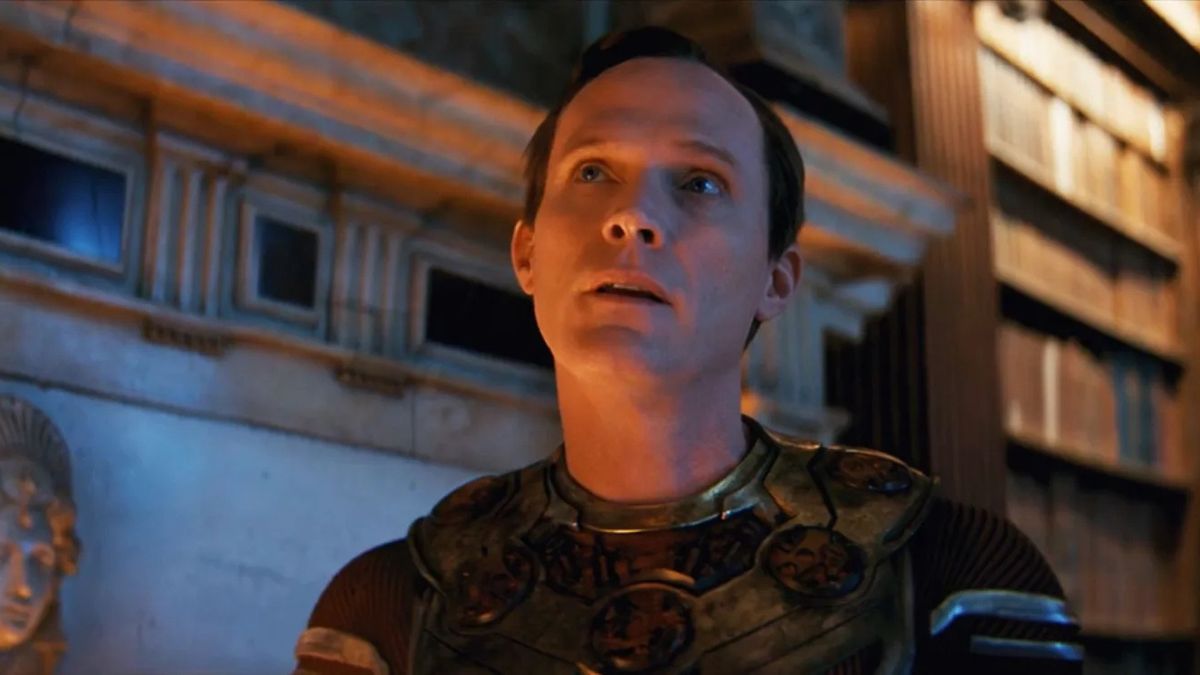
The opening flashback to 1939 is one of my favorite sequences of the entire series. We meet Dr. Phineas Horton, played by Paul Bettany, as he sacrifices his family’s estate to continue developing J.I.M., a synthetic replacement for his dead son.
What makes the scene so effective is that Horton doesn’t recognize the enormous contradiction in what he’s doing. He is attempting to overcome the grief of losing one child while effectively abandoning another. His wife and daughter are still alive, still desperate for his attention, and still standing right in front of him. But Horton is so consumed by what he has lost that he can no longer recognize what he has.
And what does he want for his creation? A life free from the terrible consequences of love.
It’s a fascinating contradiction. Horton wants to recreate the son he loved, but he doesn’t want that creation to experience the thing that makes his son worth recreating in the first place. In trying to eliminate suffering, he is also trying to eliminate something essential to being alive.
Suddenly, the parallels with Vision become impossible to ignore. Vision has a son standing directly in front of him, too. Yet he keeps Thomas at a comfortable emotional distance because acknowledging him would mean acknowledging Wanda, Billy, the family they built, and everything he believes they have lost.
Horton attempts to rebuild his family without accepting its loss. Vision attempts to rebuild himself without accepting his family’s existence. Neither approach can succeed, because both require rejecting the very relationships they’re trying to preserve.
The Moment Paul Bettany Reminds Us Who the Vision Is
As wonderful as James Spader has been throughout this series, “Immolation” belongs to Paul Bettany. His performances as Horton, J.I.M., the original Vision, and White Vision are remarkable, but what impresses me most isn’t simply his ability to play multiple characters. It’s how each performance contributes to the same emotional confrontation.
When White Vision finally encounters his original self, the conversation becomes almost painfully revealing. He insists that he is merely a copy, someone who could never be as loving, compassionate, or courageous as the Vision who came before him. But the original Vision exposes the convenience of that distinction. By placing his former self on an impossible pedestal, White Vision has given himself permission never to try.
I love that observation because it turns an elaborate science-fiction question into something painfully recognizable. How often do we convince ourselves that a better version of who we are is simply beyond our reach? And how often does that belief become an excuse to avoid the difficult work of changing?
The confrontation with J.I.M. takes that idea one step further. J.I.M. understands what it means to be created by someone terrified of pain. He also understands what it means to desire the feelings his creator tried to deny him. When Vision finally admits that he is the Vision, that he has always been the Vision, he must also acknowledge everything that identity carries.
Wanda. Billy. Tommy. Love. Loss. Grief.
And the moment in which he finally allows himself to mourn is devastating because he finally stops pretending to be a person.
What Works—and What Doesn’t
I have praised Terry Matalas repeatedly for the visual language of this series, and “Immolation” might be its most accomplished expression yet. The hallways, clocks, recurring rooms, familiar voices, and memories bleeding into one another all make the digital landscape feel psychologically tangible. Vision’s mind isn’t merely a place to store information. It becomes a haunted house, filled with the people and experiences he has tried to lock away.
The episode also finds a wonderful dramatic use for Corvus Glaive’s weapon from Infinity War. Something that once helped bring about Vision’s death now powers his confrontation with the memories he has refused to live with. It’s a beautifully uncomfortable connection between his physical and emotional trauma.
Where I struggle is with the final resolution of Lisa’s predicament. For all the carefully established danger of the nanobot, her rescue ultimately depends on Vision recovering some very convenient source code and applying it at precisely the right moment. I understand why the technology has to work this way for the story, but the mechanics are still a little too easy for my taste.
Jocasta’s storyline also feels less satisfying than Vision’s, at least for now. There are intriguing revelations about Josephine Carrington and the forgotten person involved in her research, but the story is still withholding crucial information. The mysterious Client, Ultron’s shifting loyalties, and F.R.I.D.A.Y.’s apparent destruction leave us with far more questions than answers.
Still, I find it difficult to get too frustrated because the episode gets its most important answer exactly right.
Why the Ending Matters
The most meaningful development in “Immolation” isn’t the final appearance of James Spader’s mysterious human character. It’s Vision’s message to Tommy.
After spending nearly an entire season refusing to acknowledge the relationship between them, Vision finally calls Tommy his son. He gives him the memories of the family he came from, allows him to witness Wanda and Billy, and offers something that no amount of technology could provide: the assurance that his father loves him.
That’s the real payoff. Vision acts differently because of what he has learned. And in doing so, he refuses to repeat Horton’s mistake.
The episode opens with a father so consumed by grief that he abandons the child still standing in front of him. It ends with a father who finally accepts that child, even though doing so exposes him to the possibility of losing everything again.
For a series about artificial intelligence, that’s an awfully human story.
And it’s exactly why VisionQuest has become one of the most interesting things Marvel has produced in a long time.
Explore our VisionQuest series guide, revisit our Episode 6 KJR, or visit The MCU Diaries hub for more Marvel coverage.
Related Coverage
For The NerdClan: The public review explains the emotional heart of “Immolation,” but there’s much more to unpack about the competing answers offered by Horton, J.I.M., Jocasta and Ultron. Below, I dig deeper into the structure of Vision’s self-revelation, the imagery of fire and clocks, the possible meaning of F.R.I.D.A.Y.’s fate, and what makes this episode’s craft so effective. Join The NerdClan to read the full analysis.
Unlock the rest of this article.
Join the NerdClan — or sign in if you are already a member — and the rest of this article will unlock right here on this page. This entry requires Associate Producer or higher.