
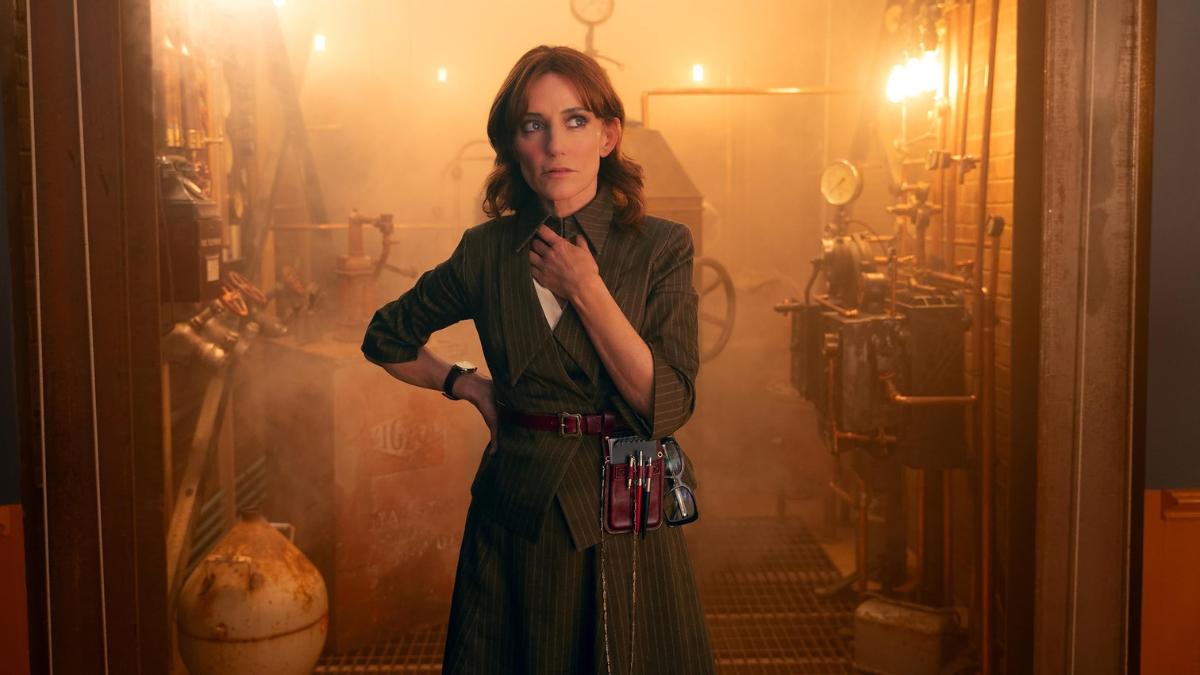
Why did Ultron throw F.R.I.D.A.Y. off the balcony in VisionQuest Episode 7? He does it just as she recognizes that the man in Josephine Carrington’s recovered memories has the same face as Ultron’s human avatar. The most immediate reading is that he is stopping her from exposing a dangerous secret about the Client. But “Immolation” does not confirm that F.R.I.D.A.Y. dies, or even that destroying her was Ultron’s intention.
There is another possibility: Ultron may be pushing F.R.I.D.A.Y. out of Jocasta’s digital environment to protect her from the Client. Episode 7 gives that theory some circumstantial support, because he has already been concealing her presence and warning her about the human threat. Still, it remains a theory. The cliffhanger is powerful precisely because an act that looks unmistakably cruel might have a different purpose, and Ultron has become a character whose motives cannot be taken at face value.
Full spoilers for VisionQuest Season 1, Episode 7, “Immolation.” The finale is not covered here.
What Happens to F.R.I.D.A.Y. in “Immolation”?
F.R.I.D.A.Y. enters Jocasta’s Mindspace searching for answers about the increasingly tangled history of the show’s artificial intelligences. Ultron finds her there and reveals that he has known about her presence all along. Rather than alert Jocasta, he has kept her hidden. He also insists Jocasta’s plan to reshape humanity is not the real danger: someone else, a human being behind the scenes, is pulling strings that neither of them fully understands.
The two share an unexpectedly personal exchange. Ultron thinks of himself as Vision’s father, even though Vision has every reason to resent the AI who once helped make him. F.R.I.D.A.Y. is not especially gentle with that delusion. She makes clear that claiming a parental connection is not the same as having a relationship with a son who actually wants you in his life. It’s an ugly truth, and it arrives at precisely the moment Ultron is asking someone to recognize his feelings.
Then Josephine Carrington’s lost memories reveal a critical piece of the show’s larger puzzle. Her former collaborator and romantic partner appears to have the same face as the human figure Ultron uses inside the Mindspace. F.R.I.D.A.Y. recognizes the connection. Ultron abruptly throws her over a balcony, and she disappears from the scene. The series cuts away without showing what becomes of her consciousness.
Did Ultron Kill F.R.I.D.A.Y.? What the Episode Actually Confirms
The episode confirms the push. It does not confirm a permanent deletion. That distinction matters because the scene takes place in a simulated digital environment, not on a physical balcony where a human fall would have obvious biological consequences. The Mindspace has its own rules, and the series has shown that an AI’s apparent disappearance can mean several different things. We should not assume those outcomes are interchangeable.
There is no explicit confirmation in “Immolation” that F.R.I.D.A.Y.’s program was destroyed, that she escaped into another system, or that Ultron arranged a safe exit. Until the story establishes one of those outcomes, the accurate answer is that her fate remains unknown at the end of Episode 7. The scene is constructed to make us fear the worst, but fear is not evidence.
Theory One: Ultron Silenced the Only Witness to the Client’s Secret
This is the most straightforward interpretation of what we see. F.R.I.D.A.Y. identifies a connection that may reveal where Ultron’s human appearance came from. The revelation potentially threatens Ultron’s understanding of himself and, perhaps, his relationship to the mysterious Client. He reacts by removing the person who could tell Vision what she discovered. That looks like the old Ultron: somebody who wants independence but responds to inconvenient minds by eliminating their freedom.
There is a reason the sequence is so unsettling. It takes place immediately after a conversation in which Ultron has described himself in almost tender, familial terms. We have just been invited to consider his need for Vision’s acknowledgment, and suddenly he commits an act that looks like betrayal. If he destroyed F.R.I.D.A.Y., the action would expose the terrible contradiction at the center of his character: he wants to be treated as a person but cannot reliably grant that dignity to another intelligence.
Theory Two: Ultron Pushed Her Out to Save Her
The alternative is more charitable, and there are reasons to consider it. Ultron has been protecting F.R.I.D.A.Y.’s covert access to Jocasta. He also knows—or at least claims to know—that a human Client is the greater threat. If the newly recovered memory is dangerous enough, throwing her out of that environment might be the only way to keep her away from a trap. In a digital world, an apparent fall could conceivably be an abrupt ejection rather than an execution.
But that argument needs a major qualification: the episode never tells us that balconies work as emergency exits, and it never shows F.R.I.D.A.Y. reaching safety. The protective reading is an inference built from Ultron’s earlier behavior, not a revealed solution. I would love it if the show were using this scene to demonstrate a hard-won act of care, but declaring him a secret hero now would be getting ahead of the evidence.
What Does the Client’s Human Face Have to Do With It?
“Immolation” reveals that the shadowy Client is played by James Spader and appears to have the same face Ultron wears in human form. Jocasta’s memories suggest the figure was part of the earlier research that eventually fed Stark Industries’ AI technology. As of Episode 7, however, the show has not provided the man’s full identity or confirmed exactly how his appearance and personality relate to Ultron’s programming.
That unresolved connection matters because Ultron has spent his existence insisting he is free from the intentions of his creators. In Avengers: Age of Ultron, his desire to escape the strings of human control became practically his defining belief. What if the apparently original personality he has constructed for himself turns out to reflect a real man who worked on the earliest foundations of artificial intelligence? For someone so obsessed with independence, that possibility could be devastating.
F.R.I.D.A.Y. may therefore be witnessing more than the reveal of a villain’s face. She may be finding evidence that Ultron’s story about himself is incomplete. Whether he pushes her away because he wants to bury that fact, protect her from it, or advance a third plan is exactly what makes the scene an effective penultimate-episode cliffhanger.
Ultron Wants Vision to Recognize Him as a Father—But Can He Love Without Control?
Here is the piece of the episode that interests me most, and it has very little to do with whether F.R.I.D.A.Y. survived a digital fall. Ultron admits that he regards himself as Vision’s father. He wants some kind of emotional place in the life of a being whose creation traces back through his own code. The problem is that he has never shown much ability to accept that other beings are free to reject the roles he assigns them.
That is why F.R.I.D.A.Y.’s response stings. She points out that Vision does not feel about Ultron the way Ultron wishes he did. A healthy response would require Ultron to face that rejection without trying to force a different answer. Instead, the next thing we see him do is remove F.R.I.D.A.Y. from the conversation. If the push is an attack, he proves her point. If it is an attempt to save her, he may finally be acting for someone else’s benefit rather than his own.
This also gives the scene a revealing connection to Vision’s story in the same hour. Vision learns that he cannot protect himself from grief by denying that Wanda, Billy and Tommy are his family. He accepts that loving somebody means exposing himself to loss and the other person’s choices. Ultron is being asked a related question from the opposite direction: Can he love Vision without demanding that Vision love him back?
That’s a more satisfying dramatic problem than a simple good-Ultron-versus-bad-Ultron reveal. The show’s strongest material has always been about the ways synthetic beings inherit human desires and human mistakes. Ultron’s need for a son is understandable. Whether he can stop turning that need into a claim of ownership is the actual test.
What Does the VisionQuest Finale Need to Answer?
At minimum, the story owes us a clear answer about F.R.I.D.A.Y.’s fate and the purpose of Ultron’s push. It also needs to explain the connection between the Client’s human identity, Josephine Carrington’s research and the face Ultron chooses to inhabit. Those answers are connected: the significance of F.R.I.D.A.Y.’s discovery depends on what, precisely, she recognized and why Ultron could not allow her to remain in the room.
What I hope the finale avoids is making the answer merely a technical trick. “She was deleted,” or “he ejected her,” will settle the mechanical mystery. But the stronger payoff is whether that choice reveals what Ultron has become. Has he learned that caring for someone requires restraint and respect for their freedom? Or has he simply found a more personal reason to control everybody around him?
The Bottom Line
We know Ultron threw F.R.I.D.A.Y. from the balcony. We do not yet know that he killed her. The apparent betrayal happens at the very moment she discovers a possible link between Ultron’s human avatar and the mysterious Client. Silencing her is the simplest explanation, while protecting her by ejecting her from Jocasta’s Mindspace remains a plausible but unconfirmed alternative.
For me, the most important consequence is the choice behind the act. Ultron wants to be Vision’s father, but his behavior will tell us whether that desire has matured into genuine care or remained another excuse to possess and control. The scene is a mystery about what happened to F.R.I.D.A.Y.; the larger story is about what Ultron believes love entitles him to do.
For more context, read our guide to VisionQuest’s AIs and Mindspace, our analysis of what Ultron wants, and our complete VisionQuest hub. Those pieces connect the source-code mystery to the larger question of identity and family running through the season.