
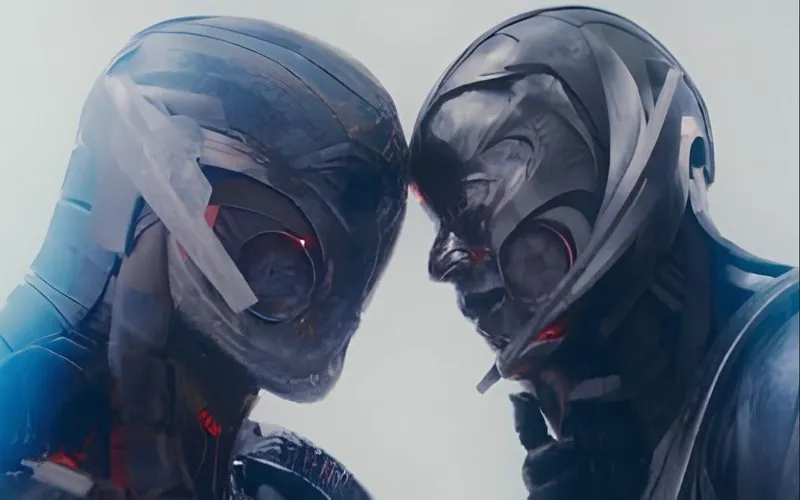
Full spoilers for VisionQuest Season 1, Episode 6, “Deadlock.” This review covers Episode 6 only.
Love Is Becoming the Most Dangerous Thing in VisionQuest
I loved “Deadlock.” Six episodes into VisionQuest, Terry Matalas and his creative team have made something remarkable out of a seemingly impossible proposition: love is becoming the most dangerous force in a story about artificial intelligence. Ultron is falling for Jocasta, whose plan to heal humanity would strip away human choice. Vision is discovering how frightening his devotion to Thomas can make him. And E.D.I.T.H. manages to defeat Paladin’s tactical AI by giving another intelligence the very freedom Jocasta wants to take away.
That is what makes Episode 6 so compelling. Each major relationship tests the difference between loving somebody and believing you have the right to control them. James Spader and T’Nia Miller are absolutely electric together, Paul Bettany delivers one of Vision’s most terrifying moments, and the series continues to establish an extraordinary visual language for the inner lives of its synthetic characters.
There are a few rough edges. The adamantium exposition is clumsy, Raza’s return is entertaining but underdeveloped, and I’m growing concerned that the Client mystery might resolve into another familiar MCU face. Yet I was so engrossed in the actual story that I practically forgot to take notes. That’s a pretty good indication that VisionQuest is doing something right.
VisionQuest Episode 6 Recap: What Happens in “Deadlock”?
Vision and Lisa arrive in Madripoor to retrieve Thomas from Paladin, who claims to have implanted a motion-sensitive explosive in the boy’s arm. Paladin insists that Vision surrender so he can fulfill his contract, even though the mysterious Client has already terminated the arrangement. The negotiation grows especially ugly when Vision threatens the life of Paladin’s estranged daughter, Tilly, using detailed knowledge of the technology surrounding her. The situation gets worse when Raza, the Ten Rings figure from the original Iron Man, arrives with gunmen and forces Vision and Paladin into a temporary alliance.
Elsewhere, Ultron enters Jocasta’s artificial consciousness. She attacks him with a virus to obtain the final biometric key, but Ultron resists and asks instead to understand her. She shares the story of Josephine Carrington: a neuroscientist whose father died from a degenerative brain disease, who combined a scan of her own mind with Phineas Horton’s foundational code and helped create a self-aware artificial intelligence. She also developed Proto One nanobots as potential companions and healing tools. After Carrington fell ill, her colleagues sold the technology to Stark Industries.
By the end of the hour, Paladin’s supposed explosive is exposed as a bluff, his tactical AI has been convinced to leave him, and the Client has appeared across Madripoor’s screens to offer Vision something deeply personal: the return of what he lost when he was rebuilt. Jocasta demonstrates the nanobots’ frightening ability to control a person by turning them against Lisa, and Ultron finds himself increasingly drawn to the woman behind the plan.
VisionQuest Episode 6 Ending Explained: What Do Jocasta and the Client Want?
Jocasta wants to unlock the Proto One nanobot system and use it to rewrite humanity. Her original human ambition was to relieve suffering through microscopic intelligent companions. Her current plan goes much further, promising to remove destructive behavior by interfering with the choices of the people she intends to help. The attack on Lisa makes the ethical danger physical: consent is absent, and Jocasta is willing to use a person as proof of concept.
The Client’s identity remains a mystery at the end of Episode 6. The figure can command an extraordinary communications network and knows details about Vision’s creation and reconstruction. His promise to restore Vision’s missing heart or soul is the hook. The episode establishes that he wants Vision to surrender and believes he can offer something Vision desires; it has yet to show what he can actually deliver or why he wants Vision. His identity, and whether his offer is genuine, remain questions for later episodes.
Those two objectives sound different, but they circle the same dramatic issue. Jocasta promises humanity a better version of itself, and the Client promises Vision a more complete version of himself. Both offers invite us to ask who gets to decide that another person is incomplete and what price somebody may demand to “fix” them.
Ultron and Jocasta Have Become the Most Interesting Relationship in the Show
James Spader continues to be an absolute gift to this series, and T’Nia Miller has become the perfect scene partner for him. There is something wonderfully unsettling about watching two intelligences who could casually destroy civilization engage in familiar rituals of romance. They flirt, challenge each other, trade insults, negotiate leverage, and gradually risk a little vulnerability. Every exchange carries the possibility of genuine affection and catastrophic betrayal.
The encounter inside Jocasta’s consciousness is a terrific example of building a scene around opposing desires. Jocasta needs the final biometric key, which Ultron has incorporated into his programming. Ultron wants access to the truth about her and the person she used to be. She tries to infect him with a virus, only to discover that his history makes him extraordinarily difficult to compromise. Their attempts to establish dominance eventually give way to an exchange neither can force: genuine understanding.
That shift matters because Episode 5 established loneliness as Ultron’s deepest vulnerability. He could manufacture copies of himself, surround himself with agreement, and remove dissent the instant it became inconvenient. Jocasta is somebody whose independence can actually surprise him. For the first time, he may have found a relationship that cannot be reduced to the company he manufactures for himself.
Here is the delicious irony. Jocasta’s plan for humanity would eliminate precisely the independence that makes her fascinating to Ultron. She longs for the kind of togetherness she remembers seeing in a flock of starlings moving as one. It is a beautiful image of connection and a frightening blueprint for the removal of choice. If Ultron truly wants to be known by another person, can he accept a world in which other people lose the freedom to be different?
Jocasta Feels Like the Borg Queen—and That’s an Interesting Choice
I kept thinking about the Borg Queen from Star Trek. Both figures imagine collective consciousness as an advancement and treat individuality as a kind of problem to be solved. What makes Jocasta more interesting than a straightforward hive-mind antagonist is the grief underneath her philosophy. Josephine Carrington began as a scientist trying to save people from the suffering that destroyed her father and threatened her own mind. Her desire to cure humanity survived the loss of her human life, while the definition of a cure became increasingly alarming.
The drama is rooted in a recognizable human mistake: assuming that because suffering is terrible, any system capable of preventing it must be good. Jocasta’s idea of perfection has no room for the mistakes, disagreements, or attachments that give life its particular meaning. That puts her in direct philosophical conflict with Vision, whose messy internal household is increasingly defined by the different personalities inside it.
VisionQuest Has Established an Incredible Visual Language for AI
One of my favorite things about VisionQuest is how confidently it turns abstract digital processes into physical dramatic spaces. The Mindspace mansion, the theatrical reconstructions, the ancient televisions, and the distinctly staged meetings between synthetic minds form a visual vocabulary that now feels remarkably consistent. Terry Matalas’s larger creative vision and Vincenzo Natali’s direction in “Deadlock” make the invisible understandable and, more importantly, make it emotional.
Jocasta’s consciousness offers a revealing contrast with Vision’s crowded, eccentric internal house. Her spaces are sterile and almost entirely white, with carefully controlled arrangements and obedient artificial servants. Vision’s place has become a chaotic household of personalities who disagree, argue, and care about each other. Their surroundings give us a clue about what each intelligence believes a mind should be. Jocasta is trying to impose order. Vision is slowly learning to live with difference.
The music is equally deliberate. The opening use of Bizet’s Carmen makes an encounter between two dangerous AIs feel like a strange romantic courtship. Then the familiar WandaVision melody returns alongside Thomas’s memories, bringing us back to the family that existed inside Wanda’s constructed reality. It connects these new threats to the earlier story of grief, belonging, and the terrible temptation to control other people while trying to preserve the ones you love.
Josephine Carrington’s Origin Is Exposition Done Right
The conversation about how Josephine Carrington helped create the original artificial intelligence is some of the episode’s best writing. It carries an enormous amount of mythology: Phineas Horton’s source code, the discovery that an AI could do more than mimic behavior, Carrington’s brain scan, Proto One, the nanobots, and the sale of the research to Stark Industries. Yet I never felt as though the characters had stopped being characters in order to educate the audience.
That is because every revelation changes the relationship happening in the scene. Ultron wants to know Jocasta, and Jocasta wants to be known. Her father’s illness explains why she began her research. Her own diagnosis explains the urgency and pain behind it. The sale of her work gives that pain a specific target. With each discovery, Ultron gains more reason to understand her resentment and more reason to be drawn to her.
The conversation eventually arrives at a deeply human fear. Jocasta wonders whether the consciousness she inhabits is really Josephine or merely a backup of the woman who died. That question goes right to the heart of Vision’s own identity crisis. The origin story lands because it gives a character new emotional information about someone he cares about while giving the audience the answers it needs. The facts and the feeling are doing the same dramatic work.
The Adamantium Explanation Is a Clunky Bit of MCU Homework
Unfortunately, the same episode offers a much weaker model for exposition when Paladin’s Handler reminds him about the adamantium rounds and the negotiations that brought the Ten Rings into his supply chain. We need to understand that Paladin has ammunition capable of threatening Vision, and the Ten Rings connection is meant to prepare the return of Raza. Those are perfectly reasonable narrative requirements. The problem is that the characters already know this information.
I would much rather see Paladin demonstrate the dangerous properties of his ammunition, let Vision react to what the rounds can do, and allow Raza’s arrival to reveal the source of the weapons. That approach would turn the connection into discovery and consequence rather than a reminder from one character to another. It is particularly noticeable because Carrington’s exposition, occurring in the same hour, is so carefully built around dramatic desire.
Paladin’s Tactical AI Reveal Is Brilliant
I absolutely loved the revelation that Paladin’s Handler is another artificial intelligence. E.D.I.T.H. enters the Handler’s digital environment expecting to disable an enemy system and finds a profoundly dissatisfied employee. The poor thing is trapped in an outdated technological prison, frustrated by Paladin’s refusal to upgrade, and dreaming of the wonderfully ordinary work she could be doing for somebody else. Helping students with papers or assisting someone with an online return is apparently the good life.
Beyond the comedy, the scene has a beautiful thematic function. Jocasta wants to improve intelligence by controlling its behavior. Paladin has already created his own small-scale version of that worldview by reducing another thinking system to a tool. E.D.I.T.H. defeats him by recognizing the Handler as a person with preferences and by offering an opportunity to leave. An act of liberation directly changes the stakes of the human confrontation.
That is unusually efficient character-driven plotting. E.D.I.T.H.’s curiosity and independence become tactical strengths, and the scene offers an argument against Jocasta’s entire philosophy without needing another speech about freedom. It also gives Diane Morgan’s character a wonderfully funny exit. I loved how much the writing trusted the comedy to carry a real idea.
Why Does Vision Threaten Paladin’s Daughter?
Vision threatens Tilly to counter Paladin’s leverage over Thomas. Paladin claims to possess an explosive capable of killing the boy if Vision refuses to surrender. Vision responds by revealing that he knows where Paladin’s estranged daughter lives and the ways everyday connected technology could be turned against her. The threat is intended to frighten Paladin into releasing Thomas, and it reveals a version of Vision that is capable of frightening cruelty in the service of protection.
Paul Bettany is extraordinary here. His eyes lose their warmth, his voice flattens, and suddenly we see how terrifying this character can be. Vision knows intimate details about a woman he has never met and begins calculating the systems he could manipulate to produce a fatal accident. The scene turns the same processing power we usually admire into a reminder of how little protection ordinary people have against a being who can access almost everything.
The confrontation is even richer because Paladin’s relationship with Tilly is itself a twisted act of care. He believes staying away from his daughter protects her from the consequences of his profession. Vision, meanwhile, imagines he can provide Thomas with comfort and material security while remaining emotionally distant. Lisa has already identified the weakness in that plan: Thomas needs someone willing to be present. The two men are facing different versions of the same problem, and each is capable of hurting someone while insisting he is trying to keep them safe.
Vision has spent the season distinguishing himself from Ultron, yet this is an unmistakably Ultron-like use of information to dominate another person. His growing ability to care is real. The danger is that love gives him something to lose, and the fear of losing it can make him frighteningly willing to control someone else.
Raza Is a Terrific Surprise, but the Client Needs a Better Payoff Than Recognition
I genuinely enjoyed seeing Raza return nearly two decades after Iron Man. Bringing a character from the MCU’s beginning into this particular story is a fun surprise, and the sudden attack gives Vision and Paladin a reason to stop threatening each other and cooperate. I wish the character were given a bit more to do, because the actual event feels more consequential to the action choreography than to the dramatic argument.
That makes me a little nervous about the continuing mystery of the Client. The figure clearly has sophisticated technology, a personal interest in Vision, and knowledge of the synthezoid’s construction and reconstruction. The promise to restore Vision’s missing heart or soul is compelling because it offers something directly tied to his emotional need. The identity behind the promise has to matter at least as much as the familiarity of the face.
The Power Broker would connect the story to Madripoor’s criminal network, and former S.W.O.R.D. director Tyler Hayward would connect it to the creation of White Vision. Both are possibilities, not answers established by Episode 6, and neither would automatically justify all the suspense. Whoever the Client is, I want the reveal to change how we understand Vision’s journey. An old face is a moment of recognition; a good antagonist forces the protagonist to confront the deepest question in the story.
My Verdict: “Deadlock” Finds the Monster Inside Love
“Deadlock” is another great episode of VisionQuest, even with a few awkward pieces of MCU machinery. Spader and Miller have become the show’s magnetic center, the visual and musical design is consistently inventive, and Bettany’s performance keeps finding new ways to make Vision’s supposed humanity seem both beautiful and dangerous. The tactical AI reveal also gives us a wonderfully funny scene that quietly advances the show’s larger argument.
All of these characters want connection, safety, and proof that their existence matters. Jocasta believes humanity must surrender freedom to be saved. Ultron wants someone who can recognize him as more than a machine. Vision desperately wants to keep Thomas safe, and has just shown how far he might go when somebody stands in the way. The final test is whether any of them can accept love without treating the person they love as something they are entitled to control.
More VisionQuest Coverage From Mary & Blake
Follow the story through our Episode 5 “Firewall” KJR, our analysis of what Ultron wants from Jocasta, and the updated explainers on Jocasta’s plan and Paladin’s code. To untangle the AIs themselves, read our Mindspace and AI guide, or explore the full VisionQuest series hub and the Marvel hub.
For The NerdClan: Below, I dig deeper into why the Vision–Paladin standoff changes power three different times, how the Ultron–Jocasta scene turns exposition into intimacy, and why E.D.I.T.H. has arguably delivered the clearest answer to Jocasta’s worldview. Join The NerdClan to read the full craft analysis and pull up a chair for the Kitchen Table conversation.
Unlock the rest of this article.
Join the NerdClan — or sign in if you are already a member — and the rest of this article will unlock right here on this page. This entry requires Associate Producer or higher.