
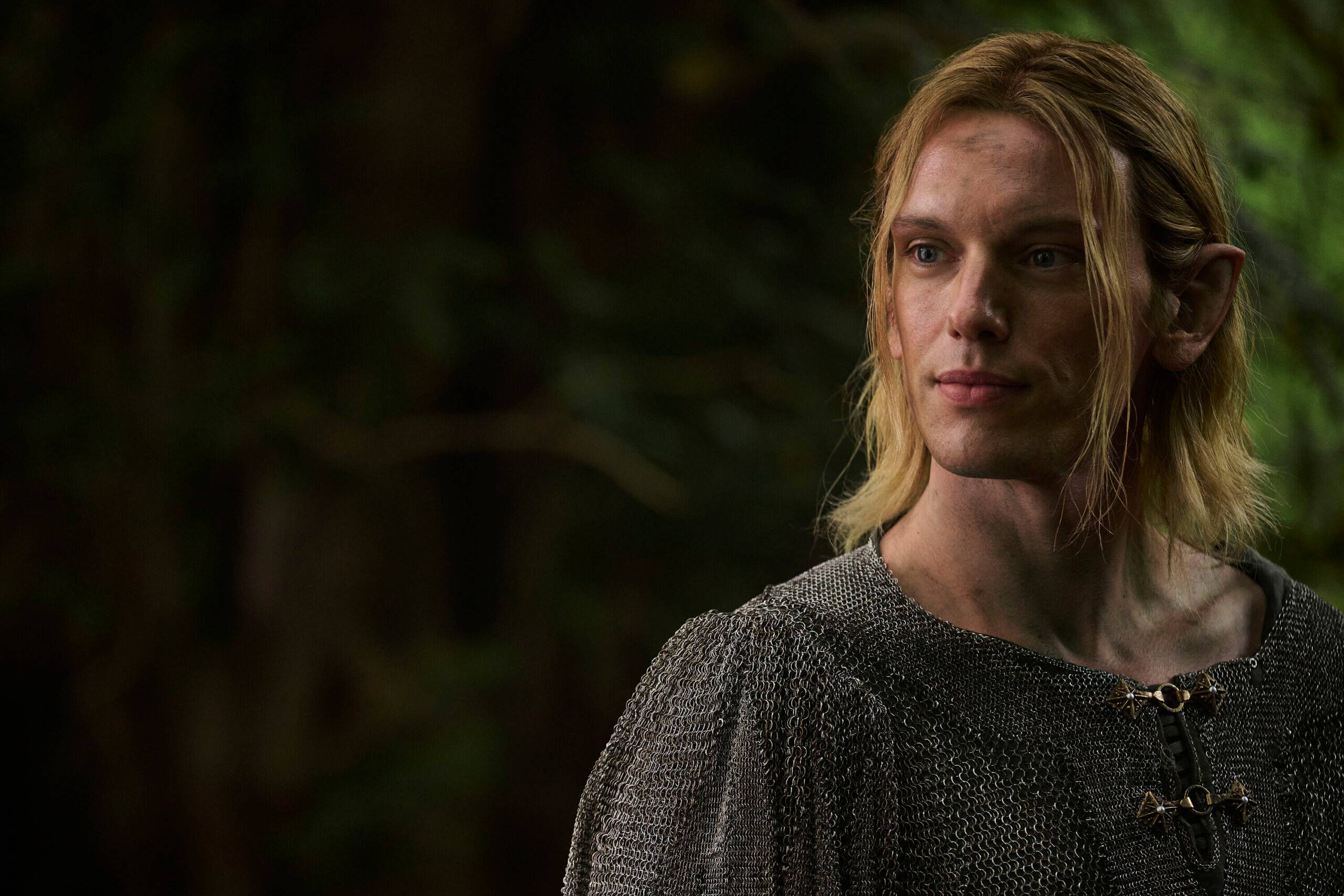
Ancalagon the Black is Morgoth’s greatest winged dragon in Tolkien’s account of the First Age, famous for fighting Eärendil during the War of Wrath and crashing onto Thangorodrim. In The Rings of Power Season 3 Episode 5, “The Lady of Lórien,” his name gains an especially brutal new meaning: Celeborn says Ancalagon’s fire destroyed his Elven legion, and Sauron later reveals that he himself was riding the dragon during the attack. That’s a massive television invention, and I think the way the episode uses it tells us something important about what this season is finally doing well.
The immediate question for fans is who this enormous dragon was in Tolkien’s history. The more interesting question for the show is why it places Sauron so directly inside Galadriel and Celeborn’s trauma. The answer is that Sauron has become the central force shaping every major relationship. The destruction caused by Ancalagon is the past returning to wreck a marriage in the present, and the story works because that history produces an actual choice for Galadriel.
Who Was Ancalagon the Black in Tolkien’s Books?
Ancalagon was the mightiest of the winged dragons in Morgoth’s service, released in the final struggle of the First Age. In the Quenta Silmarillion, the War of Wrath brings the forces of the West against Morgoth’s armies in Beleriand. Morgoth unleashes his winged dragons as a desperate escalation, and their appearance temporarily pushes the battle back. Ancalagon stands at the center of that devastation, a creature associated with the terrifying reach of Morgoth’s power.
It’s worth remembering that Ancalagon appears in a relatively brief but spectacular passage of Tolkien’s larger history. His reputation is enormous because his arrival changes the scale of the battle and because his defeat helps bring Morgoth’s age to an end. That leaves considerable room for adaptations to imagine his appearance and the experience of people who survived the war. It also means we should be careful with confident claims about exactly how large he was, the precise mechanics of his flight, or the scenes he participated in beyond what Tolkien actually recorded.
How Did Ancalagon Die? Eärendil and the War of Wrath
During the War of Wrath, Eärendil confronts Ancalagon in the skies, fighting from his ship Vingilot with the support of the great Eagles. The dragon is defeated and falls upon the peaks of Thangorodrim, breaking them in his ruin. It is one of the most vivid images in Tolkien’s history, partly because a creature representing Morgoth’s destructive might brings down a portion of the very landscape surrounding the Dark Lord’s stronghold.
Eärendil’s involvement also creates a significant family connection to this episode. He is the father of Elrond and Elros, the brothers whose differing choices about mortality give the Númenor storyline its new emotional center. The episode therefore reaches into the same First Age history from two directions: one through a dragon that shattered Celeborn’s life, and another through a father whose victory helped shape the world the twins inherited. That’s a rich set of connections, although the episode is more interested in how their legacy changes personal lives than in reciting every chronological detail.
What Is Thangorodrim, and Why Does It Matter?
Thangorodrim was the vast mountain fortress landscape above Morgoth’s stronghold of Angband. To people living through the First Age, its peaks represented the reach of the original Dark Lord, his prison and his ability to dominate the lands around him. Tolkien connects their destruction with Ancalagon’s fall in the War of Wrath. In The Rings of Power, Celeborn’s years in confinement at Thangorodrim become the missing history behind Galadriel’s belief that her husband died.
The story of that captivity could easily have been a string of grim exposition beats. Instead, Celeborn tells Galadriel that he survived by finding small moments of joy in the darkest place imaginable. He remembers a torture master named Häzgarak, describes generations of Orc guards coming and going, and explains that he used to entertain them with stories about Galadriel. The geography of Morgoth’s old power becomes an emotional setting with a purpose: a place designed to extinguish hope where one prisoner stubbornly preserves it.
How Did Celeborn Survive Ancalagon’s Dragon-Fire?
Celeborn’s explanation is wonderfully mundane. A horse kicked him into a ditch of water just before Ancalagon set fire to his legion. He emerged unburned but surrounded by enemies, and the forces of Morgoth carried him away. The detail strikes me as exactly the kind of unexpected physical accident that can make a fantastic event feel lived-in. Great heroes survive wars through courage, plans, luck and absurdly small turns of fate. Celeborn’s entire future depends on a horse doing what horses sometimes do.
The apparent simplicity creates a useful dramatic contrast. Galadriel has lived with the belief that he died in dragon-fire, a monumental ending suited to the mythic history of the Elves. His actual survival begins with an almost ridiculous interruption and leads to centuries of pain. That is a sharper human story. It denies the audience a neat heroic explanation and gives the couple the far messier consequences of separation, uncertainty and an impossible missed chance to reunite.
Was Sauron Riding Ancalagon the Black in The Rings of Power?
Yes, according to Sauron in Episode 5. When he captures Celeborn after Galadriel’s escape, Sauron identifies himself as the rider who was astride Ancalagon when the dragon burned Celeborn’s legion. Celeborn initially tries to dismiss their acquaintance, but the revelation establishes that the old attack and the current persecution are connected through the same villain. The statement is presented as Sauron’s recollection within the show’s continuity; the episode does not independently replay the event from another perspective.
That distinction matters for Tolkien’s literary history. The published account of Ancalagon’s final war does not establish Sauron as his rider in the way this television episode does. A viewer is free to debate whether that is a wise alteration, but the useful critical test is whether it changes the dramatic experience. Here it absolutely does. Sauron moves from being the enemy Galadriel obsessively hunted during her husband’s imprisonment to someone who helped cause the imprisonment in the first place. This forces her private relationship and the larger war into the same conflict.
Is Sauron Riding Ancalagon a Problem for Tolkien Lore?
I know there will be a substantial amount of conversation about the exact relationship between Morgoth, his dragons, Sauron and the chronology of the War of Wrath. Those are fair topics for fans who care about how an adaptation handles the original mythology. Personally, I have very little patience for the idea that a television series should be judged exclusively by whether it places every character in exactly the same location on a literary timeline. A dramatization has to build relationships through scenes and choices rather than expecting an audience to treat an appendix as a substitute for television.
That freedom comes with responsibility. A change should create more coherent character motivations and consequences than it costs the story. Sauron’s connection to Ancalagon passes that test for me because it deepens his connection to the couple without requiring the show to abandon its primary themes. The risk is one of scale. When the villain turns out to have caused every defining tragedy personally, the world can start to feel improbably small. The series now needs to resist turning every piece of ancient Middle-earth history into another secret Sauron encounter.
Why Is the Dragon Revelation So Important to Galadriel and Celeborn?
The scene between Galadriel and Celeborn already contains a revelation with greater emotional force than the dragon’s name. Celeborn says he saw Galadriel passing Thangorodrim when the fortress fell. He called to her, but she was consumed with searching for one of Morgoth’s lieutenants. Later, Galadriel confesses that she saw him too, though her guilt and grief convinced her the figure was another vision of the husband she believed dead. She turned away. A mythic dragon attack has led to a very intimate failure to recognize the person she loved.
This is the heart of the story for me. Celeborn was physically imprisoned by Morgoth’s servants, yet he found ways to preserve Galadriel in his imagination. Galadriel was free to move across Middle-earth, yet she became increasingly trapped by her mission to find Sauron. The episode puts those two experiences alongside each other and lets us feel their terrible imbalance. When Sauron claims to have ridden Ancalagon, the villain’s historical cruelty suddenly belongs to that psychological wound.
The Hair Story Is the Best Detail in Celeborn’s Captivity
One of my favorite little details involves Celeborn telling Orc guards stories about Galadriel’s singing, dancing and golden hair. When they doubt him, he produces a lock of her hair, and the Orcs fight over who gets to hold it. The disturbance ends with the hair being burned as punishment. That might be a relatively small piece of story business, but it shows how the writers can make an ancient, supposedly legendary relationship intimate. Celeborn preserves her memory in an object, loses that object, and has to decide whether to keep telling the stories without it.
It also lets Jamie Campbell Bower play a quality we need from Celeborn: an almost unnerving capacity to locate joy amid humiliation. He has endured generations of tormentors and still talks with a dry sense of humor. When he explains that joy could survive even within Thangorodrim, his conclusion is that the wider world must contain even more of it. Galadriel can hardly understand the choice. Their difference in worldview is becoming the most interesting part of the marriage, and the dragon gives the story a specific history that makes the difference credible.
What Is Ancalagon’s Relationship to the Dragons in The Lord of the Rings?
Tolkien’s legendarium contains several famous dragons. Glaurung, associated with the tragedy of Túrin, belongs to the First Age and is often called the Father of Dragons. Ancalagon is the greatest of the winged dragons of Morgoth’s armies. Smaug, whom Bilbo encounters in The Hobbit, belongs to the far later Third Age. Those creatures occupy different historical periods and narrative functions, even though all demonstrate how dragon-kind can embody greed, domination or enormous destructive force.
There is also a useful distinction between the dragons of Morgoth and the fell beasts ridden by the Ringwraiths in The Lord of the Rings. The show’s recent mythology has made creative choices connecting its winged creatures to other species. Those adaptations deserve their own examination; they should not be collapsed into the claim that Ancalagon was the same kind of creature as the Nazgûl mounts. For a related look at what this season is doing with the history of Sauron’s army, see our War of the Elves and Sauron guide.
Our Take: A Dragon Should Change a Character, Not Just Fill the Screen
The most exciting part of Ancalagon’s mention is how restrained the episode is about showing him. We hear what happened through Celeborn’s memory and learn the rider’s identity through Sauron’s chilling remark. The writers get an enormous scale of destruction without depending on another lengthy action sequence. The spectacle exists in the audience’s imagination, while the consequences are living directly in Galadriel and Celeborn’s conversation. That’s a sophisticated use of a famous Tolkien name.
From a screenwriting perspective, it is a smart example of backstory becoming present-tense conflict. Robert McKee’s focus on meaningful changes in value applies because the revelation alters Celeborn’s understanding of his captor and the danger facing his wife. John Truby’s character-web principle helps explain why Sauron’s connection to the dragon matters: the villain now presses upon the couple’s moral differences as well as their external struggle to survive. An ancient event finally has a dramatic function beyond proving that the production knows the lore.
I would still love a Middle-earth adaptation to develop more of its own visual identity rather than reaching so frequently for the familiar iconography of Jackson’s films. The Ancalagon material gives this show an excellent alternative. The dragon’s destruction is evoked through words, memory and revelation; it becomes specific to the characters in this series. That is the kind of adaptation choice I want more of. It respects the scale of the source while making the emotional stakes belong to the present story.
The dragon’s history matters because it changes how we understand Celeborn’s return. Our Celeborn character guide follows his marriage, absence and captivity across the seasons, while our Episode 5 Knee-Jerk Reaction examines how the episode stages those revelations. Start with the Season 3 guide to follow the full story.
What Happens Next for Celeborn and Galadriel?
Episode 5 ends with Celeborn in Sauron’s custody again. The Dark Lord believes Galadriel will return, and he has powerful reasons to think he understands how to manipulate her. Celeborn’s rescue now involves the full burden of their shared history: his imprisonment, her obsession, and the fact that the same enemy helped set their separation in motion. Whether the season can make that conflict more than another rescue mission is the real test of the dragon revelation.
For the continuing story, read our updated Celeborn guide and the complete Rings of Power Season 3 hub. Ancalagon is one of Tolkien’s great monsters, but this episode makes the name matter because of what happened to people who lived through his fire. The scale of the myth gets our attention. The human cost is what should keep it.