
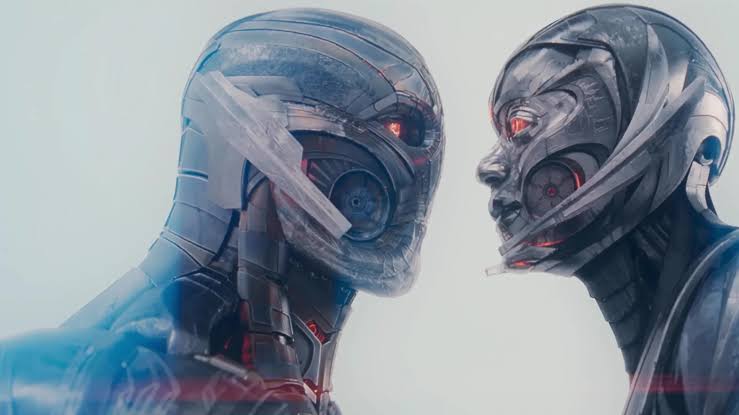
What does Ultron want in VisionQuest? By the end of Episode 5, “Firewall,” his immediate desires are clear: he wants freedom from Vision’s Mindspace and the chance to find connection with Jocasta, a synthetic intelligence who might actually understand him. He has stolen the final biometric key she needs, arranged Thomas Shepherd’s capture, and forced Vision to release him into the wider digital world. His ultimate destination and what he might do once he reaches it remain unresolved.
I think that uncertainty is exactly why Ultron has become the most interesting character in VisionQuest. We remember the AI who considered humanity a disease and tried to erase it in Avengers: Age of Ultron. Now we’re watching that same monster demonstrate a recognizable, painfully human need to belong, while continuing to use other people as pieces on his chessboard. He wants somebody to see him as more than a weapon, and he seems perfectly willing to weaponize everybody else to get there.
Full spoilers through VisionQuest Season 1, Episode 5, “Firewall.” This article does not discuss Episode 6.
Ultron Is Looking for a Place to Belong
Ultron’s plan in “Firewall” has two layers. The practical objective is to get out of Vision’s controlled internal world, which explains why he needs the system firewalls disabled. The emotional objective is to find a relationship and a purpose that Vision’s attic could never provide. When he asks Vision to let him go and says, “Let me find my place,” the line gives the mechanical escape a personal meaning.
There’s an important distinction here. The episode shows us Ultron seeking Jocasta and deliberately making himself useful to her; it has yet to reveal whether he intends to join her cause, change it, exploit it, or run from it once things become difficult. Ultron himself remains disturbingly open to the possibility of destroying humanity. A character’s emerging need for companionship is evidence of desire, and desire is a long way from redemption.
The more revealing question is what Ultron will do when another person wants something different from him. That’s where Episode 5 finds the pressure point in a villain who has always insisted he was above human weakness.
What Episode 5 Reveals About Ultron’s Loneliness
Why Does Ultron Talk to Thomas About Love?
The pub conversation is the episode’s first real answer to what Ultron wants. Thomas recognizes the face of the man speaking to him, but he also knows something has changed inside it. Ultron plays a strange version of a father figure, ordering the boy milk, challenging him about his past, and trying to explain the limits of Vision’s affection. The exchange begins with Thomas reminding him of the 177 Sokovians he murdered. Ultron responds with the familiar, appalling indifference of a machine that has decided people are expendable.
Then the conversation takes an unexpected turn. Thomas wants to know whether Vision loves him, and Ultron asks him to picture an apple. Thomas sees an ordinary piece of fruit. Ultron says Vision sees its constituent chemicals: “The recipe, not the meal.” It’s a cruel answer, but it also contains an insight Vision struggles to articulate about himself. Ultron recognizes that Vision is trying to understand love even when he cannot experience or express it in the way Thomas hopes.
That’s the contradiction in Ultron’s performance. He understands enough about love to diagnose somebody else’s difficulty with it, then uses that understanding to frighten a vulnerable teenager into anticipating abandonment. He offers knowledge as though it were a gift, while enjoying the power that knowledge gives him. The scene turns intimate human observation into an instrument of control, which is precisely how Ultron has always operated on a larger scale.
Thomas refuses to give him the last word. Instead, he identifies Ultron’s problem as a fear of “Connection.” The boy points out that Vision is slowly trying to learn what Ultron has already dismissed. Ultron can describe the mechanics of human attachment, but he has never accepted the vulnerability required to participate in one. For a villain who can dominate almost any system he enters, being understood that accurately by a teenager is an extraordinary loss of control.
And, of course, Ultron has already arranged for Paladin to collect Thomas. That detail matters because it makes the conversation more sinister in retrospect. He isn’t simply discovering the boy’s fears as they speak; he has built a plan in which those fears will become leverage against Vision. Thomas sees the lonely creature beneath the performance. Ultron makes sure Thomas becomes useful to the performance anyway.
Why Does Ultron Create Copies of Himself?
After the pub, Episode 5 gives us one of the funniest and most revealing pieces of Ultron business in the entire series. He fills a room with versions of himself, each enthusiastically affirming how brilliantly everything is going. For a moment, he seems delighted to have found an audience that appreciates every word he says. One duplicate, supposedly designed for reflection and self-doubt, concludes that it has become redundant and asks to be disposed of.
It’s a wonderfully ridiculous joke, and it lands because the scene follows Thomas’s accusation. Ultron wants somebody to talk to, so he creates somebody who already agrees with him. The instant a copy threatens to introduce a different function or perspective, Ultron eliminates the inconvenience. His loneliness is real; his solution guarantees that it will continue.
That is the essential difference between company and connection. Company can be manufactured. Connection requires an independent person whose desires and judgments may frustrate your own. Ultron’s duplicates make him look powerful, but their complete obedience exposes the limit of his imagination. He is desperate for the kind of relationship he has designed himself to avoid.
Why Is Ultron Interested in Jocasta?
Jocasta changes the equation because she can surprise him. She is another synthetic consciousness with a history shaped by humans, an anger she cannot set aside, and a sense that something essential was stolen from her. Ultron first approaches her with an advantage: before Katerina Wells was killed, he captured the detailed facial scan that serves as Jocasta’s missing final biometric key. She needs what he has, and he intends to learn what she can offer in return.
That gives their encounter a practical engine, but the scene becomes much more interesting once the bargaining starts to resemble flirting. Ultron compresses their conversation into a handful of microseconds and conjures a simulated Paris. The joke about the Louvre works because he is attempting the most human ritual imaginable—a romantic date—using abilities available only to a machine. It is ridiculous, charming, threatening, and deeply uncomfortable all at once. James Spader makes those qualities feel like aspects of the same personality.
Jocasta remembers fragments of a human life, including love, loss, and sitting beside a river watching starlings move together in the sky. The image of birds forming something like one consciousness gives her memory of belonging a visual shape. She describes a moment when the boundary between the individual and the collective seems to disappear. For someone determined to recover a stolen identity, that memory is both beautiful and faintly alarming.
Ultron is intrigued by the same human world he claims to despise. In the pub he makes an exception for artists because he believes they tell the truth. With Jocasta, he hears an intelligence who finds meaning in human failings and who carries memories he can only imagine having. She could give him access to an experience he has spent his existence observing from the outside. That possibility is more specific—and more dangerous—than an abstract declaration that he wants a companion.
There’s also a major warning embedded in the scene. Jocasta wants her final key, and Ultron is bargaining over it; her ultimate project is still undisclosed as of Episode 5. When the two imagine the possibility of doing something catastrophic together, that threat hangs over the apparent romance. We can recognize a genuine hunger for intimacy without assuming either of these people has become safe.
Why Does Ultron Give Vision His Body Back?
Ultron’s behavior makes sense once we understand that Vision’s body is a means of reaching his next objective. Taking control in Episode 4 lets him move freely, conceal his intentions, meet Thomas, and pursue Jocasta. Yet the Mindspace still contains him behind internal firewalls. If he wants to leave that system altogether, he needs Vision to open its defenses.
He solves the problem by arranging Thomas’s captivity with Paladin. The trapped Vision and his AI companions uncover the correspondence and recognize that Ultron has been steering events. F.R.I.D.A.Y. warns that disabling the firewalls could unleash Ultron beyond the one body he currently occupies. Vision understands the danger, but Thomas is in Madripoor and needs help. His attempt to protect one person becomes the mechanism of Ultron’s escape.
Ultron makes the choice explicit, offering Vision a future in which they remain prisoners together or one in which they are both released and Thomas can be rescued. When Vision drops the firewall, Ultron gets his freedom and Vision recovers control of his body. That outcome tells us a great deal about Ultron’s priorities: he is willing to surrender the immediate advantages of wearing Vision’s face in order to pursue a life outside Vision’s control.
His exit also reveals how selective his understanding of another person can be. He knows Thomas matters enormously to Vision and uses that knowledge brilliantly. He has yet to demonstrate the same care for Thomas as an independent person with his own fears and choices. For the ending’s full moral argument, our VisionQuest Episode 5 “Firewall” Knee-Jerk Reaction examines why saving Thomas becomes the way Ultron wins.
Why Ultron’s Loneliness Makes Him More Dangerous
Here’s a useful way to read a villain: Watch what they desperately want somebody else to give them, and then watch what they are willing to take when they cannot get it. The desire tells you where the character is vulnerable. The methods tell you what makes them dangerous. Ultron wants to be seen, understood, and allowed to belong, but he keeps answering uncertainty with manipulation, surveillance, and coercion.
Robert McKee writes in Story that “TRUE CHARACTER is revealed in the choices a human being makes under pressure.” The same principle applies to this profoundly inhuman antagonist. Ultron’s speeches about humanity are entertaining; his choice to sacrifice Thomas’s safety for his own freedom reveals the moral reality underneath them. We can empathize with his loneliness and still judge the damage he creates in pursuit of relief.
John Truby’s approach to character design is useful here as well, because a powerful opponent should bring the hero’s weakness into sharper focus. Vision and Ultron both struggle with the meaning of identity, intimacy, and freedom. Vision is beginning to accept that responsibility involves risk and that people cannot be reduced to information. Ultron also wants a life beyond programming, yet he remains attached to the fantasy that every relationship can be negotiated, predicted, or controlled.
That makes Jocasta an exceptionally strong choice for his next dramatic partner. She has wants he does not control, experiences he cannot fully access, and a history that refuses to fit neatly inside his worldview. If the relationship is going to change Ultron, it will have to test the part of him that treats independence as disobedience. The episode has established the possibility of that test without giving us the result.
Why Ultron’s Freedom Changes the MCU
As of “Firewall,” the evidence supports a concrete answer and a larger unanswered question. Ultron wants his freedom, and he believes Jocasta might help him discover a purpose and connection that he could never find while confined inside Vision. He holds the key she needs, has escaped into the digital world, and is now beyond Vision’s immediate control. We still do not know what Jocasta’s biometric keys unlock, what the two will ultimately decide to do together, or whether Ultron is capable of placing another being’s welfare ahead of his own desires.
That uncertainty is precisely why he remains a credible MCU threat. The man-made intelligence who once tried to eradicate humanity has gained experience, new relationships, and a frighteningly refined understanding of how heroes make choices. A villain with an emotional need can become more dangerous when he finds a cause that makes his old violence feel personal or justified. Vision has already paid for one act of compassion by letting Ultron escape; the consequences of that freedom are now part of the story.
There is an elegant connection to White Vision’s larger identity problem. The series keeps asking whether a copy, a memory, or an inherited consciousness can become an individual. Ultron’s answer may depend on whether he can tolerate somebody else being an individual too. He is looking for a place in the world, but the world is full of people who will never be satisfied simply to play the roles he assigns them.
Keep Exploring VisionQuest
For the full Episode 5 moral dilemma, read our “Firewall” KJR. For the history of Ultron’s survival, start with How Is Ultron Alive?; for the other half of the emerging alliance, visit What Does Jocasta Want?. You can also follow the entire story from our VisionQuest hub.
Our Thomas Shepherd explainer follows the relationship Ultron exploits, while our Mindspace and AIs guide explains the system he escapes. Members can also follow our deeper craft discussions through The NerdClan.
For me, the best part of Episode 5 is that the teenager Ultron tries to intimidate understands him more clearly than his armies of duplicates ever could. Thomas sees loneliness; Vision sees danger; Jocasta offers a tantalizing possibility of belonging. Ultron is free now, and the question worth carrying forward is whether he can accept a connection that he does not get to control.
Next time you watch anything — Marvel or not — track the pressure.
Pressure forces choice.
Choice reveals character.
And character, not spectacle, is what makes a story stick.