
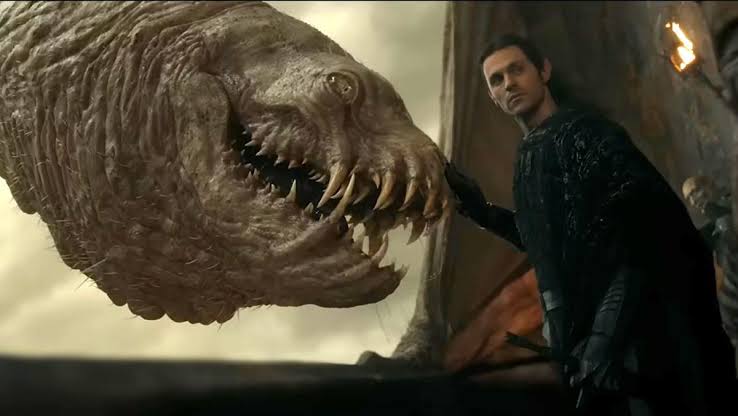
*In The Rings of Power Season 3 Episode 4, Sauron explicitly says fell beasts were once Eagles corrupted by Morgoth. That is the television show’s explanation for the monstrous flying creature Sauron saddles before traveling to Gundabad. In Tolkien’s The Lord of the Rings*, the terrifying flying mounts of the Nazgûl are real, but their exact biological origin is left uncertain. Tolkien did not explicitly establish that the creatures began life as Great Eagles.
The difference is a perfect example of how an adaptation can fill a space left open in the mythology. The show turns a familiar monster into evidence of Morgoth’s corruption of the natural world, then pairs Sauron’s beast with the arrival of a genuine Great Eagle later in the same episode. The result is a surprisingly elegant visual idea.
What Does Sauron Say About Fell Beasts in “Gundabad”?
Early in Episode 4, Orcs struggle to saddle a pale, frightening flying creature. They offer Sauron horses as an alternative, but he knows what the beast is and how to control it. He explains that these creatures were once Eagles until Morgoth altered them. He also reveals the reason the animal refuses the dead meat the Orcs have been providing: it craves living flesh.
Sauron demonstrates that knowledge by throwing an Orc to the creature, using the man’s death as both a feeding and a lesson. It is a brutal piece of exposition, and I rather love how efficiently it works. We learn the monster’s origin, understand its appetite, and see Sauron’s absolute indifference to the soldiers serving him. He establishes mastery over the creature in the same moment he makes an example of a subordinate.
The show is therefore unambiguous about its own lore. For The Rings of Power, the fell beast is part of Morgoth’s legacy and can be harnessed by Sauron in the Second Age.
Does Tolkien Say the Nazgûl’s Fell Beasts Were Eagles?
Tolkien describes the great winged creatures ridden by the Ringwraiths, but he never definitively identifies them as transformed Eagles. Readers sometimes infer that they are a kind of ancient, hideous flying creature bred or twisted by evil, a reading compatible with the broader motifs of corruption in Middle-earth. The books give more attention to the beings riding those mounts and to the fear they inspire than to a neat taxonomy of the creatures themselves.
That leaves meaningful space for interpretation. The adaptation chooses a direct explanation by giving Morgoth a role in their transformation, and that explanation has to be judged as part of the show’s invented history. It is fair to prefer Tolkien’s mystery, and it is also fair to ask what the new origin adds to the television storytelling.
A detailed Episode 4 breakdown by Fellowship of Fans makes the same factual distinction: the series names the Eagles as their ancestors, while Tolkien’s writing leaves that specific relationship unconfirmed.
Were Fell Beasts Already Around in the Second Age?
The show clearly places a fell beast in the Second Age and has Sauron use it to travel to Gundabad. The question of when Tolkien’s flying mounts first existed is less firmly documented than their appearances during the War of the Ring. Their association with the Nazgûl in the Third Age establishes how they were used later; it does not, on its own, supply a definitive date for the species’ creation.
The practical storytelling function is obvious. The war has become geographically enormous, with characters scattered between Mordor, Gundabad, Lindon and Númenor. Giving Sauron a flying mount allows the villain to cross that distance and enter the Gundabad story at the most dangerous possible moment. The creature also gives Sauron the visual presence of the terrifying Dark Lord audiences recognize from Peter Jackson’s films.
The change belongs to a broader set of Rings of Power timeline decisions that compress and rearrange the legendary history. Those choices deserve scrutiny, particularly when they affect cause and effect, but the mere appearance of a familiar creature in an earlier age is only the beginning of the argument.
Why Does the Show Use a Corrupted Eagle Origin?
It gives the episode a way to contrast the purposes of power through creatures associated with the sky. Sauron’s fell beast has been made monstrous through domination; he controls it by understanding and exploiting its appetite. Later, the Great Eagle Landroval comes to the aid of Galadriel and Celeborn during their escape from Gundabad. The imagery puts two versions of airborne power in the same hour.
The contrast is thematically rich. Sauron turns living things into instruments of fear. Celeborn seeks help from an Eagle capable of acting as an ally. Their respective arrivals turn the sky into a place of danger and salvation. That makes the new explanation for the fell beast do something useful for the story even if Tolkien never made the same identification.
It also tells us something about Sauron’s character. He was a servant of Morgoth, and he now repurposes his old master’s cruelty as a technology of control. Watching him make the beast obey is a miniature version of the larger conflict unfolding through the Rings: the promise of mastery is purchased with someone else’s suffering.
Are the Fell Beast and Landroval the Same Kind of Creature?
Within the show’s stated mythology, the fell beast descends from a corrupted Eagle, while Landroval is a Great Eagle who remains on the side of the heroes. The episode presents them as a meaningful visual contrast, although it does not document an individual family tree or tell us precisely how Morgoth changed the creatures.
Landroval is also a character with an established place in Tolkien’s writing. He is the brother of Gwaihir the Windlord and participates in the rescue of Frodo and Sam after the destruction of the One Ring in The Return of the King. We’ve broken down that history in our companion article, Who Is Landroval in The Rings of Power?.
Does the Change Actually Improve the Story?
For me, the strongest argument in its favor comes from the scene itself. The lore is delivered through a villain performing a consequential action, and the information enriches what we see later at Gundabad. The audience understands the creature’s hunger, Sauron’s cruelty, and the symbolic contrast with Landroval without requiring a second explanatory scene.
A viewer can enjoy that construction and still prefer Tolkien’s open-ended account of the creatures’ origins. Adaptation criticism becomes more useful when it examines what a change does to the story rather than treating every difference as an automatic verdict. In this case, the fell beast contributes atmosphere, character and an unusually sharp visual metaphor. That’s a strong use of a monster.
For more on the rescue, Arondir’s tragic final stand, and the episode’s larger strengths and weaknesses, read our full “Gundabad” Knee-Jerk Reaction or return to the Rings of Power Season 3 guide.
Related Coverage
- Explainer: Where Is Mount Gundabad in Middle-earth? Rings of Power Location Explained
- Explainer: Who Is Landroval in The Rings of Power? The Great Eagle Explained
- Explainer: Why Did Theo Kill (SPOILER) in The Rings of Power? Episode 4 Explained
- Knee Jerk Reaction: KNEE-JERK REACTION | The Rings of Power Season 3 Episode 4: “Gundabad” — What Happens With Arondir Is A Way Bigger Deal Than You Think