
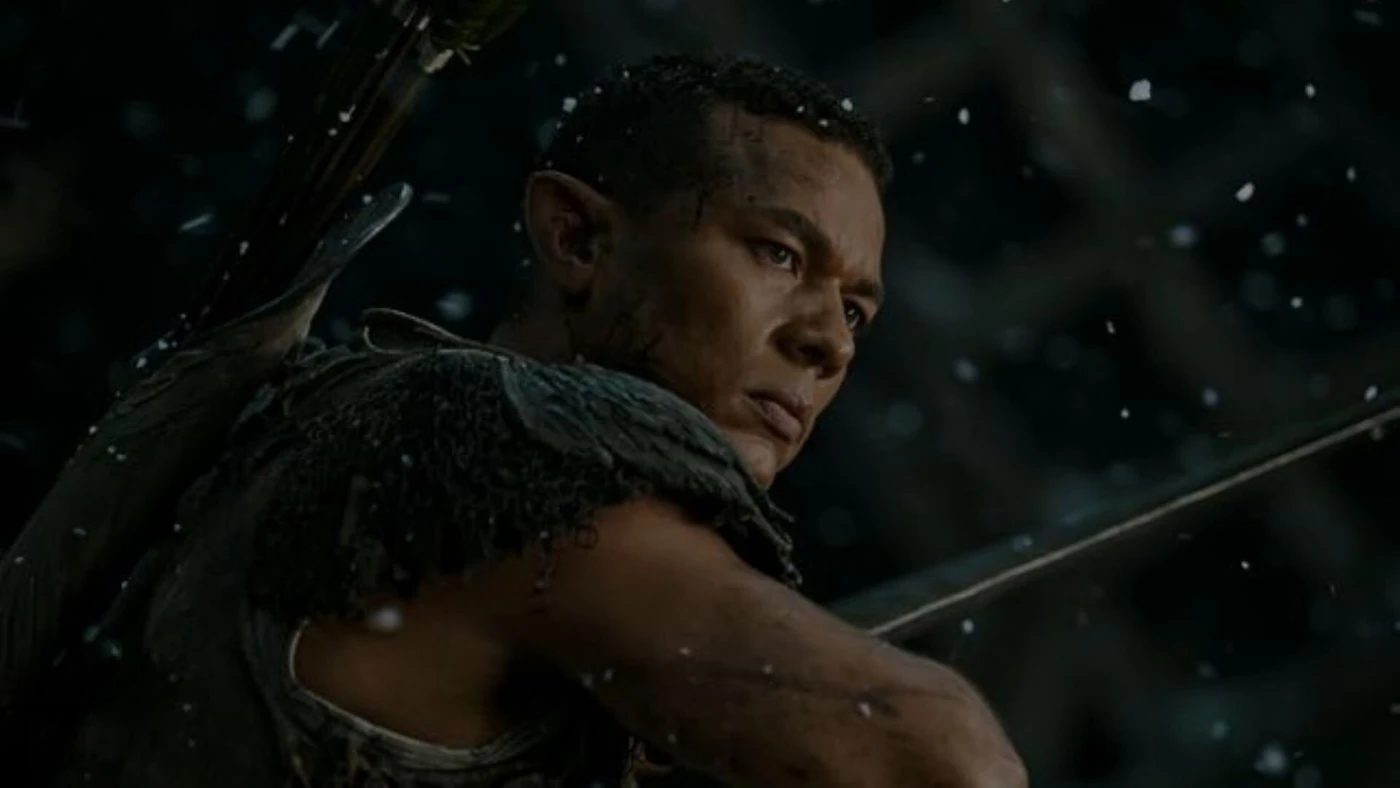
After a slight stumble with “The Secret Fire,” The Rings of Power comes roaring back with “Gundabad,” and I think this might be the episode that finally tells us exactly what Season 3 wants to be. The hour is meaner, leaner, and increasingly interested in consequences. Galadriel finds a husband she thought she had lost. Durin loses a throne he thought he had secured. Theo, a character who spent two seasons searching for a meaningful place in this story, makes a choice that destroys one of his last connections to the person he used to be. And Arondir, whom I have long considered one of the series’ least interesting characters, gets a farewell that genuinely made me sad.
“Gundabad” finally gives Arondir a dramatic purpose with some value, and the result is an emotional payoff the story has chased for a long time. My main complaint concerns the Dwarves, whose storyline repeatedly interrupts the central conflict. Even with that reservation, this is fantastic television, and the season deserves a fresh look from viewers who checked out earlier.
What Happens in The Rings of Power 3.04, “Gundabad”?
Sauron prepares a fell beast to pursue Galadriel, Arondir, and their Orc guide Marnûkh, who infiltrate Gundabad in search of Maitalle, an Elven smith with knowledge Sauron needs. Marnûkh appears to betray the Elves as part of their plan, but Maitalle is already dead. Another prisoner turns out to be Celeborn, Galadriel’s long-lost husband.
In Khazad-dûm, Thráin challenges Durin’s succession because their father wore a Ring when he restored Durin as heir. Thráin uses his history with Disa to unbalance his brother during trial by combat and wins the crown. Elrond persuades Gil-galad to seek Númenor’s help, while Anárion rescues Elendil and captures Kemen.
Galadriel and Celeborn reunite during the escape, and the Great Eagle Landroval arrives. Marnûkh appears to be cut down by a Ring-servant, who removes his mask to reveal Theo. Arondir tries to reach him, but Sauron orders Theo to kill his former protector. Theo complies. Galadriel escapes with Celeborn, leaving Arondir dead on the fortress roof.
Related Coverage
- Explainer: Are Fell Beasts Corrupted Eagles in The Rings of Power? Tolkien Lore Explained
- Explainer: Where Is Mount Gundabad in Middle-earth? Rings of Power Location Explained
- Explainer: Who Is Landroval in The Rings of Power? The Great Eagle Explained
- Explainer: Why Did Theo Kill (SPOILER) in The Rings of Power? Episode 4 Explained
Arondir’s Death Is the Best Argument for a Leaner Season 3
Here is something I never expected to write: I was honestly moved by Arondir’s death. I have struggled with this character for most of the series. Ismael Cruz Córdova brings physical grace and sincerity to the role, yet Arondir frequently seemed to exist alongside the story. His relationship with Bronwyn initially gave him a personal stake, and her absence left him searching for a stronger dramatic engine. He needed a sharper purpose.
“Gundabad” finally finds one. When Arondir recognizes Theo, his objective becomes painfully clear: bring this young man home. Bronwyn’s death, Theo’s resentment, and their growing distance all converge. Arondir could escape, yet he commits himself to the boy he once promised to protect. His defining virtue now carries a cost.
This is the kind of story construction Robert McKee writes about when he examines how meaningful action changes the value of a scene. Arondir enters the confrontation with the possibility of recovering his family. He leaves it dead, and Theo loses the person who might have reminded him of another way to live. Their relationship changes permanently. The plot changes with it. We can feel the consequences in both characters, even though only one survives.
The wider lesson matters. Television stories change as performers inhabit characters and finished episodes reveal what works. A series with this much ambition should have the freedom to adjust. Eärien’s departure and now Arondir’s death suggest a show willing to make difficult decisions about where its attention belongs. Whatever the history of those creative choices, their dramatic effects are what we can evaluate.
The idea of cutting excess concerns storytelling functions, with real performers whose work deserves respect. Arondir’s ending honors his defining quality, gives Theo a devastating burden, and clears space for a season that increasingly knows where it wants to go.
Theo Finally Has a Purpose — and That Makes Him Frightening
Theo has spent a remarkable amount of time annoying me. His grief and anger were understandable, yet the show often let those feelings substitute for an evolving character arc. Now his pain becomes action and consequence. Sauron exploits his desire for control and makes his old relationships the price of a new allegiance.
I love the choice to put Theo behind the mask. The reveal reinterprets the boy we have watched since Season 1 and lends a distinctly human face to the process of creating one of Sauron’s servants. There is a legitimate question about whether Theo becomes the Witch-king, and the series has left that particular identity unconfirmed. The dramatic question in this episode is more immediate: how much of Theo is still capable of choosing, and what does he believe he gains by obeying Sauron?
The hesitation matters. Arondir sees a chance to remove the Ring, and Theo seems to waver. When Sauron orders the killing, the violence comes so quickly that I ALMOST wanted another beat to understand its mechanism. Magical influence, fear, and the need to bury his old identity would each make this an importantly different kind of choice.
Interestingly, Tyroe Muhafidin has explained in an interview with People that these early Ring-servants retain some autonomy because the One Ring has yet to be forged. That makes this moment even more disturbing. We are watching the beginnings of enslavement alongside the choices that help build it. The performance sells the shock, and the writers have given Theo a future I am suddenly invested in following. I only wish the precise instant where his resistance becomes obedience were a little easier to read.
The Dwarves Still Feel Like a Different Television Show
Now for my biggest complaint. Somewhere inside this season is a second show called Dwarves, and it keeps interrupting the show I am enjoying. I understand the broad design: the Seven Rings have to move through the Dwarven world, Durin opposes their use, and Sauron needs that resistance broken. Thráin’s legal challenge is even a rather clever way to turn the corruption of the old king into an argument against the new one. The trouble is the amount of dramatic energy devoted to material that feels detached from the urgent war swallowing Middle-earth.
We move from Sauron’s pursuit and the desperate mission at Gundabad into scenes about Thráin’s history with Disa and whether Durin can control his temper. I have enjoyed Durin and Disa in previous seasons, but these scenes have their own tempo. The central story repeatedly loses pressure when we return to Khazad-dûm.
John Truby’s character-web principle helps explain the issue: supporting stories should exert pressure on the central dramatic struggle. The Dwarven conflict could illustrate Sauron’s method, whereby fear makes destructive power look like protection. The council debate does this beautifully. Disa’s past and Durin’s pride move us toward family soap opera, and the eventual trap becomes frustratingly predictable.
I would have loved a version in which Sauron’s armies create the choice that costs Durin his throne: protect the mountain without the Seven, or risk using the same corrupting power that damaged his father. Let Thráin exploit the crisis and let Durin’s resistance cost his people something tangible. The actors are giving this material everything they have. I want them directly in the main engine of the season.
The Lore Argument Is Missing the Most Interesting Question
Sauron riding a fell beast? Wonderful. The show suggests these creatures were once Eagles corrupted by Morgoth, a choice that departs from the limited description of their origins in Tolkien’s writing. The Nazgnagôl developing toward the Ringwraiths before the One Ring exists? Fine by me, provided the series makes the stages of that corruption dramatically coherent. Timelines have been compressed, events have been rearranged, and the show is creating connective material because it is telling an enormous history through the grammar of serialized television.
Tolkien’s history deserves serious discussion. For an adaptation, I keep returning to whether a change makes for better television. Does it sharpen motivation, intensify conflict, and make consequences felt? The fell beast sequence reveals Sauron’s cruelty through economical action. Theo’s Ring turns mythology into a recognizable tragedy about wounded pride and seduction by power.
This same standard exposes the show’s weaker moments. Gandalf’s recent Secret Fire sequence felt derivative and over-explained, borrowing familiar imagery without creating much discovery. The climax here recalls another blockbuster almost beat for beat. I can forgive the familiar shape when the underlying scene has enough emotional force; we will examine that resemblance in the NerdClan section.
Why Amazon Released Four Episodes at Once
I can see why “Gundabad” ends the first four-episode drop. These opening hours function almost like a long first movement, pulling characters toward common threats and finally allowing the consequences to hit. After the relative detour of Episode 3, Episode 4 delivers a major death, a new king in Khazad-dûm, the return of Celeborn, and a clearer trajectory for Theo. Watching the entire movement together makes the season’s ambition more apparent. The cumulative effect is much stronger than stopping after “The Secret Fire” and waiting a week for payoff.
Amazon’s internal business calculations remain unknown to us. Co-showrunner Patrick McKay told GamesRadar+ the team wanted the season available before the holidays in the hope that families would watch together. That supports a binge-friendly reading of the strategy; the storytelling offers another advantage because this first batch ends at a turning point. Does it make sense? Kinda. Is that the honest truth? Who knows?
For me, the release strategy and the quality of the television remain separate judgments. The first can be debated using viewing habits and business incentives. The second deserves to be judged by the work on the screen, and four episodes in, I think this is the strongest Rings of Power has been in a long time.
My Knee-Jerk Verdict on “Gundabad”
“Gundabad” convinced me that Season 3 can redefine this series. Charlie Vickers makes Sauron a compelling center of gravity, Galadriel’s reunion with Celeborn brings warmth into the violence, and Marnûkh complicates our assumptions about the Orcs. Above all, Theo and Arondir reach a consequence that transforms them both.
I still wish the Dwarves were better integrated into the machinery of Sauron’s war, and I wish the episode trusted its own distinctive imagination a little more in the final confrontation. Even with those reservations, I finished “Gundabad” excited for what comes next. Fans who loved the sweep, danger, and emotional stakes of Peter Jackson’s films may be missing a surprisingly good season by assuming this show is still exactly what it was two years ago. Middle-earth is beginning to feel dangerous again, and the series is finally willing to make that danger cost something.
For the deeper NerdClan analysis, I want to open up the Arondir/Theo scene as a piece of screenwriting, examine its striking resemblance to The Force Awakens, and show how a more integrated Dwarven storyline could reach the same outcome with greater dramatic force.
NerdClan Deep Dive: The Arondir Scene and the Han Solo Problem
All right, we need to talk about the bridge. Anyone who watched Arondir reach out to Theo and immediately thought of Han Solo confronting Kylo Ren in Star Wars: The Force Awakens has a very good memory for how popular movies stage family tragedy. The visual and emotional arrangement is striking: an older protector approaches a younger man compromised by an authoritarian villain; the older man believes their relationship can still reach him; an offered chance to come home turns into a fatal stabbing; another hero witnesses the event helplessly. Even the surrounding vertical danger helps the scene feel cut from the same cinematic cloth.
The likeness is hard to miss, and I think it is fair criticism. After the Ten Commandments echoes in Episode 3, this show is once again leaning on very recognizable screen language. My objection is partly about originality and partly about audience anticipation. When we recognize a scene’s architecture, we start anticipating the familiar turn. The writers have to do something specific enough with their characters to reclaim our attention, or the audience experiences a replay with new costumes.
The subtle differences here are dramatically important. In The Force Awakens, Kylo Ren kills his actual father as part of his struggle to prove allegiance to the dark side. His choice is central to the scene, and the terrible irony is that the act he imagines will liberate him also deepens his suffering. Arondir is Theo’s almost-father, someone who loved his mother and still believes he can save what remains of their family. Theo’s allegiance has been shaped by grief, resentment, occupation, and the promise of power. Sauron is physically present to issue the order, making the causal mechanism much more explicitly about obedience to a master.
That distinction gives The Rings of Power its own thematic possibility. If Han’s death examines a son trying to destroy the last vulnerable piece of his identity, Arondir’s death can examine an oppressor weaponizing that vulnerability until love itself becomes a target. The episode comes close to a devastating version of that idea. A stronger articulation of Theo’s inner choice at the point of attack would make the scene feel more uniquely his, especially now that we have reason to believe these early Ring-servants retain some autonomy.
How I Would Tighten the Theo Scene
Imagine preserving every major event exactly as it happens. Theo is revealed. Arondir recognizes him and refuses to leave. He reaches for the Ring, and we can see the possibility that Theo might surrender it. Sauron steps into the space and orders the killing. The episode still ends with Arondir dead, and the audience still carries that image into the next installment. The change I would make is to the beat between command and action.
A scene like this depends on the relationship among the character’s internal need, the external pressure, and the decision that changes everything. Craig Mazin’s discussion of story structure emphasizes the way character and thematic argument generate the turns of a scene. Here the argument is compelling: can a person who has surrendered himself to power still choose love? We need to know exactly how the scene is answering that question, even if the eventual answer contains ambiguity.
I would hold on Theo after Sauron’s command. Give him enough time to look from his master to Arondir, to remember the choice he was nearly ready to make, and to register the terrifying price of either path. Perhaps his fingers tighten around the hilt as he makes the decision. Perhaps the Ring seems to lead the movement, if the writers want magical coercion to be the operative force. Those are different versions of the same tragedy, and the distinction is the point. We should watch the mechanism happen rather than infer it after the blade has already struck.
Córdova’s final expression and the closing image of snow falling on Arondir are already doing considerable emotional work. His death becomes especially painful because he seems incapable of imagining a world in which Theo is beyond saving. Extending Theo’s moment of hesitation would allow the two performances to complete the moral argument before the episode seals its consequence. The extra seconds would be worth their weight in mithril.
A Better Structural Route for the Dwarves
The Durin–Thráin material has a workable skeleton. Durin’s father was damaged by a Ring; Thráin uses that history to question his brother’s legitimacy; Durin’s longstanding temper makes him vulnerable in the trial; Sauron is maneuvering for the Seven. As an outline, there is a lovely irony in the fact that the very power Durin rejects is used to delegitimize him. We can keep the legal challenge, the brotherly conflict, and the eventual defeat. The missing ingredient is more immediate pressure from the series’ central conflict.
I would start with evidence of Mordor’s armies threatening a Dwarven settlement. A messenger arrives with news that civilians are trapped and that the Seven may be able to protect them—or at least that powerful Dwarf-lords believe they can. Durin refuses, informed by what the Ring did to his father. Thráin turns that refusal into an indictment of the king: he is risking the people to protect his own moral certainty. When Thráin then challenges the validity of Durin’s succession, the political coup grows directly out of an urgent national crisis rather than a largely private quarrel.
Disa would remain central, particularly because she knows how easily fear can push her people toward Sauron’s promise of strength. She would have an active tactical problem to solve rather than functioning primarily as the keeper of a damaging romantic secret. Thráin could still bait Durin with the worst insecurities of their relationship, and Durin could still lose control. Yet the fight would now carry a sharper meaning: a king who understands the danger of corrupted power loses his position because he cannot persuade his people that restraint will keep them safe.
That version dramatizes the larger moral argument through the Dwarves. Sauron wins influence by creating an emergency, encouraging a false solution, and turning ordinary fear into political leverage. We would then return to Gundabad with the sense that both stories are pushing on the same pressure point. The episode’s sprawling geography would feel like a single war being fought through different forms of temptation.
The Value of Rewriting a Series While It Is Still Alive
There is another fascinating conversation beneath Arondir’s exit: how much freedom should a continuing series have to correct its course? Some viewers treat the plan developed for Season 1 as a sacred contract, and any later revision becomes evidence that the writers were lost. That misunderstands how much storytelling changes when actors embody characters, scenes are cut together, and audiences reveal what relationships they actually care about.
The reporting around this particular death suggests the choice was established well before the third season was finished. In an interview with Collider, Córdova recalled the showrunners telling him of Arondir’s ending in March 2025. Theo actor Tyroe Muhafidin has also said he spent years encouraging a darker direction for his character, although he did not know all the details of what the writers had planned. That gives us evidence of a deliberate trajectory without pretending we can reconstruct the complete history of the writers’ room.
The practical question remains wonderfully simple: does the eventual scene earn the preceding hours of investment? With Arondir, I think the answer is yes. His best quality finally becomes the thing that puts him at risk. Theo’s most understandable wound becomes the means by which Sauron claims him. The episode gives a relationship that had felt stalled a definite tragic outcome, and the audience now has a personal reason to fear the man Theo may become.
The same principle should guide how the show handles Celeborn and Marnûkh. Celeborn’s reunion with Galadriel has emotional power because it is grounded in the pain of separation, and his survival immediately creates new possibilities for her. Marnûkh works because each apparent betrayal forces us to reconsider the boundary between allegiance and conscience. These are characters adding pressure, possibility, and surprise to the main action. If The Rings of Power keeps giving its ensemble those kinds of jobs, the story can remain enormous without feeling directionless.
The Question Season 3 Has Finally Learned to Ask
What fascinates me about the first four episodes is how often Sauron succeeds by turning a character’s virtues and wounds into points of vulnerability. Durin’s loyalty to his father’s memory threatens his position. Galadriel’s determination to protect Middle-earth leads her into the heart of an enemy fortress where her oldest grief resurfaces. Theo’s desire for dignity makes Sauron’s offer feel like a path toward it. Arondir’s loyalty turns a chance to escape into a fatal stand.
That is a strong unifying design for a fantasy season: one villain, several kinds of temptation, and a world whose fate depends on choices made under terrible pressure. It provides the scale we associate with Tolkien while keeping the action legible at the human level. The series still has work to do, especially in Khazad-dûm and in the connective logic of its evolving Rings mythology. But “Gundabad” has demonstrated that the story knows how to turn its biggest ideas into something we can feel.
My lasting image of this episode is Arondir staring at the young man he still believes he can save. He has every reason to be afraid, and he stays. That decision gives his ending the dignity that his wandering storyline had been missing, and it leaves Theo with a wound that no amount of borrowed power can easily heal. The series has finally found a way to make Middle-earth’s growing darkness personal. That is the version of The Rings of Power I want to keep watching.