Full spoilers for Outlander: Blood of My Blood Season 1 follow. This article discusses the real history and filming locations behind Castle Leathers but contains no future book spoilers.
Castle Leathers feels like exactly the kind of place Blood of My Blood would invent for Simon Fraser, Lord Lovat. It is remote, weathered, difficult to escape, and imposing enough to make Julia Beauchamp’s arrival there feel less like finding shelter in the eighteenth century and more like being dropped into somebody else’s prison. Brian Fraser may technically call it home, but almost everything about the place tells us that the real owner of the world inside those walls is his father.
The history underneath Castle Leathers is more complicated — and more interesting — than simply asking whether the castle is “real.” There was a genuine Castleleathers or Castle Leathers place near Inverness with a supposed medieval castle site, and the name became strongly associated with Major James Fraser of Castle Leathers, an important member of Clan Fraser who was directly involved in bringing Simon Fraser back to Scotland before the 1715 Jacobite Rising. The building we see on television, however, is Balvaird Castle in Perthshire, while the interiors were created specifically for the series.
That means Blood of My Blood has effectively combined several pieces of Scottish history into one story world. A genuine Fraser place-name supplies the identity, a completely different historic Scottish castle supplies the exterior, and the writers place Lord Lovat at the center so Castle Leathers can become a physical expression of the power struggle shaping Brian, Julia, Davina, and eventually the 1715 Rising.
Quick Answer: Is Castle Leathers In Blood Of My Blood Real?
Castle Leathers is based on a real Fraser-associated place-name, but the castle shown in Blood of My Blood is fictionalized. Historical records identify Castleleathers, Castle Leathers, and later Castle Heather near Inverness, where archaeological records preserve a supposed medieval castle site and where Major James Fraser of Castle Leathers became an important Fraser figure during the early eighteenth century.
The castle seen on television is actually Balvaird Castle in Perthshire, a real late-15th-century tower house historically associated with the Murray family rather than the Frasers. Historic Environment Scotland confirms that Balvaird doubles for Lord Lovat’s Castle Leathers in Blood of My Blood, while the rooms we see inside the house were created as studio sets for the production.
Castle Leathers Makes More Sense Once You Understand Lord Lovat
The real Simon Fraser spent decades fighting over land, inheritance, clan authority, and political survival. Our complete Lord Lovat guide explains why the Old Fox backed the government in 1715, later backed the Jacobites, and became the exact kind of father Brian spends his life trying not to become.
What Is Castle Leathers In Blood Of My Blood?
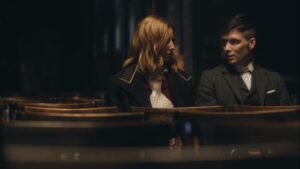
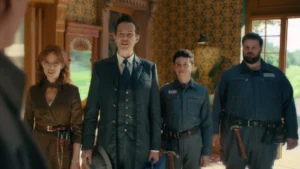
Inside the series, Castle Leathers is the Fraser household ruled by Simon Fraser, Lord Lovat, and the place where Brian lives with his mother, Davina Porter. Julia Beauchamp is brought there after accidentally traveling from the twentieth century into eighteenth-century Scotland, which immediately puts her under the authority of a man who possesses nearly every form of power she suddenly lacks.
That makes Castle Leathers more than a convenient location for the Scottish half of the prequel. It becomes one of the show’s clearest demonstrations of how power works in this period: Lovat controls the property, the servants, the money, the armed men, the social rules, and the public story other people are expected to believe. Julia may understand more about the future than anyone around her, but inside Castle Leathers knowledge does not automatically translate into authority.
Why Castle Leathers Feels Like A Prison For Julia
Julia’s predicament is much bigger than simply waking up in the wrong century. She has lost Henry, her home, her social identity, access to money, and almost every institution that would normally recognize her as an independent adult. At Castle Leathers, even physically leaving safely requires horses, supplies, knowledge of the surrounding country, and the ability to move through a society where a woman traveling alone would immediately attract attention.
The production design turns that loss of freedom into architecture. Julia’s attic space was conceived around the image of a woman trapped high inside a tower, while the isolation of the castle exterior makes the wider landscape feel almost as restrictive as the room itself. Blood of My Blood therefore takes Julia’s emotional condition — trapped in another time and desperate to get back to Henry — and gives that condition stone walls, narrow windows, and a long way down.
That is why the castle works even when nobody is actively threatening Julia. The story does not need Lovat standing in every doorway because the house already reminds us that she is living inside his world. Every conversation with Davina, Brian, or Simon happens under the larger pressure that Julia cannot simply decide she has had enough and go home.
The Castle On Screen Is Actually Balvaird Castle
The real building used for Castle Leathers exteriors is Balvaird Castle in Perth and Kinross. Historic Environment Scotland dates the tower house to around 1495 and describes it as an unusually sophisticated residence for the wealthy Murray family, with architectural features that would have represented considerable status and comfort when it was built.
By the eighteenth-century period depicted in Blood of My Blood, a building of that age would already carry generations of visible history. That is useful for the series because Brian and Simon’s conflict is fundamentally about inheritance: who belongs to a family, who controls its future, and what one generation owes the next. A newer or more polished house could have communicated wealth, but Balvaird communicates something better for Lovat — old power that no longer looks as secure as the man inside believes it should.
Why Balvaird Is Such A Good Choice For Lord Lovat
Balvaird’s weathered exterior gives Simon Fraser a home that visually contradicts his ego. Lovat behaves like a man who should sit at the center of an enormous political world, but the house around him feels isolated and diminished. That tension allows the production design to tell us something about Simon before anybody needs to explain the complicated legal and political fight that shaped the historical Lord Lovat’s life.
The real Simon Fraser spent decades trying to gain or recover the Lovat title, estates, and authority he believed properly belonged to his branch of the family. Blood of My Blood compresses that sprawling history into something an audience can feel immediately: Simon lives inside a castle, but it does not look like enough for him. His hunger for status therefore feels less like abstract exposition and more like a wound he has to look at every time he walks outside.
The Castle Leathers Interiors Were Built For The Show
The interiors of Castle Leathers were not simply photographed inside Balvaird Castle. The production created the rooms in the studio, allowing the designers to build spaces around the emotional and practical needs of the story rather than around the restrictions of a surviving medieval tower house.
Julia’s attic is the clearest example. Its height, confinement, windows, and relationship to the rest of the household can all be manipulated to reinforce her isolation, while the larger sets give the cameras and actors enough room to create the social hierarchy of the house. The result is a location assembled from two different filmmaking tools: authentic Scottish stone establishes the exterior reality, while constructed interiors allow the show to make the emotional reality much more precise.
So Was There Really A Castle Leathers In Scotland?
This is where we need to be more precise than simply answering yes. Historical records absolutely preserve a place near Inverness known in various forms as Castleleathers, Castle Leathers, Castle Leather, and eventually Castle Heather. The Highland Historic Environment Record also identifies a supposed medieval castle site there, with references to earlier forms of the place-name reaching back centuries.
What the surviving evidence does not give us is a preserved castle resembling the enormous stone building seen in Blood of My Blood. The archaeological record describes traces and a supposed site rather than a surviving structure we can confidently reconstruct room by room. So the safest historical answer is that Castle Leathers was a real place with a castle tradition and strong Fraser associations, while the television version is a dramatic reinvention rather than a recreation of one documented building.
Where Was The Real Castle Leathers?
The historical Castleleathers area was near Inverness, not in Perthshire where Balvaird Castle stands. Modern place-name research connects today’s Castle Heather area with older forms including Castle Leather, Castle Lethers, Castleleathers, Castle Lathir, and Castletown of Lather, showing that the name evolved considerably over centuries.
The Gaelic place-name has been interpreted as relating to the slope, which also helps explain how the modern “Castle Heather” form emerged from something that originally sounded quite different. That means fans searching contemporary maps should not expect to find a surviving attraction labeled “Castle Leathers” that looks like Lovat’s home; the old name survives through the history of the surrounding Inverness landscape rather than through the television castle itself.
The Real Fraser Connection Is Major James Fraser Of Castle Leathers
The historical person who makes this location particularly valuable to Blood of My Blood is Major James Fraser of Castle Leathers, born in 1670. He was an important member of the wider Clan Fraser of Lovat and is identified in surviving records and portrait collections specifically by the Castle Leathers name.
James matters because his life overlaps directly with the political crisis the prequel is moving toward. He supported the Protestant and Hanoverian political settlement, participated in the government-aligned Fraser response to the Jacobite Rising, and left behind a manuscript recounting his experiences, including his relationship with Simon Fraser. Once we follow James into that history, Castle Leathers stops being merely a clever Scottish-sounding name and starts connecting directly to the real story surrounding Lovat in 1715.
James Fraser Helped Bring Simon Fraser Back To Scotland
Before the 1715 Rising, Simon Fraser was still fighting to secure the Lovat position while spending significant time outside Scotland. In 1714, leading Fraser gentlemen chose James Fraser of Castle Leathers to travel to France and help persuade Simon to return home, a mission James later described in the manuscript associated with his name.
That creates a remarkable historical connection to the television series. Blood of My Blood turns Castle Leathers into Simon Fraser’s own household, but the real Fraser whose name was attached to Castle Leathers was one of the men who helped bring Simon back into Scotland at exactly the moment his political fortunes were about to change. The show rearranges the geography, but the place-name still leads us straight into Lovat’s historical return.
Why Bringing Lovat Home Mattered So Much
Simon’s return was tied to the unresolved fight over who truly controlled the Lovat estates and Clan Fraser. Alexander Mackenzie of Fraserdale, connected through marriage to the competing inheritance claim, possessed the estate and would soon support the Jacobite rebellion. That created a potentially enormous opening for Simon because the political future of the country and his private family dispute were suddenly becoming the same problem.
When the 1715 Rising began, Simon backed the Hanoverian government instead of the Jacobites. A government victory could weaken Fraserdale, strengthen Simon’s position among the Frasers, and give the crown a reason to reward a man it had previously had plenty of reasons to distrust. Our 1715 Jacobite Rising explainer goes much deeper into why these clan decisions cannot be reduced to Scotland versus England or Jacobite versus loyalist.
James Fraser Also Supported The Government In 1715
Major James Fraser aligned with the Hanoverian government during the 1715 crisis as well, which makes the historical Castle Leathers part of the same Fraser political network that helped Simon recover his position. Fraser gentlemen who opposed the Jacobite rising could weaken the rebel coalition in the north while simultaneously influencing which branch of their own clan emerged strongest after the rebellion ended.
This is why the real history is more interesting than a clean chart showing some clans colored Jacobite and others colored government. Clan politics operated inside national politics. The Fraser decision involved the succession to the British throne, but it also involved land, rival families, old legal claims, leadership of the clan, and the possibility that choosing the winning national government could settle a very local argument.
James Fraser And Simon Fraser Did Not Simply Become Loyal Friends
James Fraser’s surviving story also includes later disputes with Simon, which gives us another useful reminder that Clan Fraser was never one personality moving under a single command. Men could work together when their interests aligned, help restore the same clan chief, and later fight over authority or decisions once the immediate political crisis had passed.
That complexity fits Blood of My Blood extremely well because the prequel is already interested in the gap between family loyalty and personal loyalty. Sharing Fraser blood does not make Brian automatically agree with Simon, just as the historical Fraser gentlemen could disagree sharply while still understanding themselves as part of the same wider clan. Castle Leathers therefore opens a door into the exact kind of messy internal politics Season 2 needs.
Did Lord Lovat Really Live At Castle Leathers?
Not in the straightforward way Blood of My Blood portrays it. The historical Castle Leathers name is particularly associated with Major James Fraser, while Simon Fraser’s major inheritance struggle centered on the Lovat estates and the family’s Beaufort property. The series takes the Castle Leathers name and places Simon, Brian, Davina, and Julia together there because television needs a concentrated dramatic arena.
That is better understood as adaptation than as a historical mistake. A literal version of Simon Fraser’s life would require years of lawsuits, rival households, political travel, exile, shifting residences, and a family tree capable of making even experienced Outlander viewers beg for a whiteboard. One visually memorable household allows the show to turn all that dispersed pressure into relationships we can watch collide in the same rooms.
Why The Writers May Have Chosen The Castle Leathers Name
The production has not publicly given us a definitive statement saying the name was chosen specifically because of Major James Fraser’s historical connection to Lovat, so we should not turn an attractive theory into a fact. What we can say is that Castle Leathers was a genuine Fraser-associated name, and Major James Fraser of Castle Leathers belonged directly to the historical network surrounding Simon Fraser’s return and the political choices leading into 1715.
That makes the name far more appropriate than a completely invented “Fraser Castle” would have been. Whether the writers selected it because of James specifically or simply because it existed within Fraser history, the result creates a real historical echo beneath the fictional household. The show bends the geography while remaining surprisingly close to the political world attached to the name.
Castle Leathers Tells Us Who Brian Fraser Is Before He Can Explain It
Brian grows up inside a house controlled by a father who treats blood as a claim on other people. Simon can demand Brian’s loyalty because Brian is his son while simultaneously using Brian’s illegitimacy to limit his security, independence, and standing. The contradiction gives Brian a brutal education in what family authority looks like when the person at the top believes power and ownership are basically the same thing.
That makes Castle Leathers one of the places where Jamie Fraser’s character begins before Jamie is ever born. Brian learns firsthand what it feels like to live under coercive paternal authority, which gives him a model he can either reproduce or reject when he eventually builds a family with Ellen. Our Lord Lovat history and character guide digs deeper into why Brian’s refusal to become Simon may be one of the most important things Jamie ultimately inherits.
Castle Leathers And Castle Leoch Teach Brian And Ellen Different Kinds Of Power
One of the most interesting things about Brian and Ellen is that both of them grow up inside politically important clan households, but the two homes teach them very different lessons. Castle Leoch is full of competing MacKenzie interests, rival claims, marriage negotiations, siblings, alliances, and people trying to influence what happens after Red Jacob dies. Ellen learns to survive by understanding the room, anticipating what people want, and finding openings inside a crowded political system.
Brian’s education is more concentrated. Castle Leathers is dominated by Simon’s authority, so Brian learns what happens when the problem is not too many people competing for power but one man believing power entitles him to control everyone else. When Brian and Ellen eventually try to build a life together, they are not simply combining two families; they are combining two very different educations in how leadership can work.
Why Castle Leathers Matters To Julia’s Story Too
Julia enters this Fraser world without Brian’s lifetime of experience reading Simon. At first, she does not know the hierarchy, the family wounds, the political landscape, or the limits on what a woman in her position can safely challenge. What Julia does possess is the ability to observe, adapt, and understand that survival sometimes requires reading the person with power before deciding how openly to resist him.
That makes Castle Leathers a useful counterpart to Julia’s twentieth-century life. In her own time, Julia can depend on social expectations, institutions, and a marriage in which Henry recognizes her as an equal partner. In Simon’s house, those protections vanish, forcing her to discover how much of her independence came from the world around her and how much she can preserve when that world no longer exists.
The Castle Also Makes The Julia And Lovat Paternity Question More Dangerous
The uncertainty surrounding Julia’s pregnancy becomes especially brutal because Lovat controls the environment in which the truth has to be established. Julia can know what happened to her, understand her own timeline, and insist on what she believes to be true, but the eighteenth-century household around her does not possess modern paternity testing or any institution capable of overriding Simon simply because Julia says he is wrong.
Our Julia and Lord Lovat paternity explainer gets into why the story is really about power rather than genetics alone. Castle Leathers intensifies that problem because Simon does not merely participate in the dispute; he controls the social arena in which the dispute is being judged.
Can You Visit The Castle Leathers Filming Location?
Yes. Balvaird Castle is cared for by Historic Environment Scotland, and the interior reopened for guided access in 2026 after being closed to visitors for more than a decade. The tours take visitors through the castle interior and exterior, with access that can include the roof walk depending on conditions, while also explaining the actual Murray family history of the site.
As of September 6, 2026, Historic Environment Scotland currently lists additional guided-tour dates on September 23, October 3, and October 16. Those dates and access arrangements can change, so anyone planning an Outlander trip should check the official Balvaird Castle tour page before building travel plans around a visit.
Fans should also know what they are going to see. Balvaird provides the exterior Castle Leathers identity, but Julia’s attic, Lovat’s interior rooms, and the household spaces used for the series were constructed for filming. A visit lets you stand inside the genuine medieval tower house that gave the show its visual language, not walk through an intact set from the series.
The Droughtlander Dispatch
Stay At The Table For Blood Of My Blood Season 2
Want smart Outlander updates, Blood of My Blood history explainers, podcast drops, character conversations, and the stories worth remembering? The Droughtlander Dispatch is our direct path back to the Ridge.
Castle Leathers FAQ
Is Castle Leathers a real castle?
Castle Leathers was a real Fraser-associated place-name near Inverness, and archaeological records preserve the supposed site of a medieval castle there. The surviving evidence does not support treating the television building as a reconstruction of one clearly documented historical Castle Leathers structure.
Where is Castle Leathers filmed in Blood Of My Blood?
The exterior of Castle Leathers is filmed at Balvaird Castle in Perth and Kinross, Scotland. Historic Environment Scotland confirms that the late-15th-century Murray tower house serves as Lord Lovat’s ancestral home in the series.
Were the Castle Leathers interiors filmed inside Balvaird Castle?
No. The production built the major Castle Leathers interiors as sets so the rooms could be designed around Julia, Brian, Davina, Lovat, and the needs of the story. Balvaird supplies the exterior identity while the studio supplies much of the interior world.
Who was James Fraser of Castle Leathers?
Major James Fraser of Castle Leathers was a real member of Clan Fraser of Lovat born in 1670. He supported the Hanoverian government and traveled to France in 1714 as part of the Fraser effort to bring Simon Fraser back to Scotland before the 1715 Jacobite Rising.
Did Lord Lovat really live at Castle Leathers?
Not in the straightforward way shown in Blood of My Blood. Historical Castle Leathers is particularly associated with Major James Fraser, while Simon Fraser’s struggle for power centered on the Lovat estates and Beaufort; the series combines those pieces into one fictionalized Fraser household.
Why is Castle Leathers connected to the 1715 Jacobite Rising?
The connection comes primarily through Major James Fraser and Simon Fraser. James helped bring Simon home shortly before the Rising, and both became part of the government-aligned Fraser response while Simon used the political crisis to strengthen his claim to Lovat.
Is Castle Leathers the same place as Castle Heather?
The modern Castle Heather name near Inverness developed from earlier place-name forms including Castle Leather, Castle Lethers, and Castleleathers. Historical records show several variations across centuries, which is why the location can appear under different spellings in different sources.
Can you visit Castle Leathers from Blood Of My Blood?
You can visit Balvaird Castle, the real filming location used for the exterior. Historic Environment Scotland is offering selected guided tours through October 16, 2026, although visitors should verify current availability directly before traveling.
Why Castle Leathers Matters More Than A Filming Location
Castle Leathers is a good example of the kind of historical adaptation Blood of My Blood can do particularly well. The production is not recreating one preserved Fraser castle exactly as it stood in 1715; instead, it combines Balvaird’s authentic medieval architecture, a genuine Fraser-associated place-name near Inverness, and the real political world surrounding James Fraser and Simon Fraser into one dramatic location that the audience can immediately understand.
That compression works because every piece still points toward the same larger argument about power. Major James Fraser’s historical Castle Leathers leads us into Simon’s return and the politics of 1715, while the fictional Castle Leathers teaches Brian what happens when a father turns family into ownership and forces Julia to survive inside a world where almost all legitimate authority belongs to somebody else. The history gives the castle roots, but the story gives those roots a reason to matter.
Keep Going Through The Fraser & Jacobite Story
Castle Leathers sits directly inside the Lord Lovat, Fraser family, Julia, and 1715 history cluster. These are the strongest next steps if you want to understand what Season 2 is building around the house.
- Lord Lovat: The Real Simon Fraser & Why The Old Fox Changed Sides
- 1715 Jacobite Rising: Why Scotland Was Ready To Explode
- Blood Of My Blood Family Tree: How Everyone Connects To Jamie And Claire
- Julia & Lord Lovat: Is Lovat Really The Father Of Julia’s Baby?
- Blood Of My Blood Season 2: Complete Episode & Coverage Guide
- Blood Of My Blood: Complete Mary & Blake Guide
- Outlander: Complete Mary & Blake Guide