
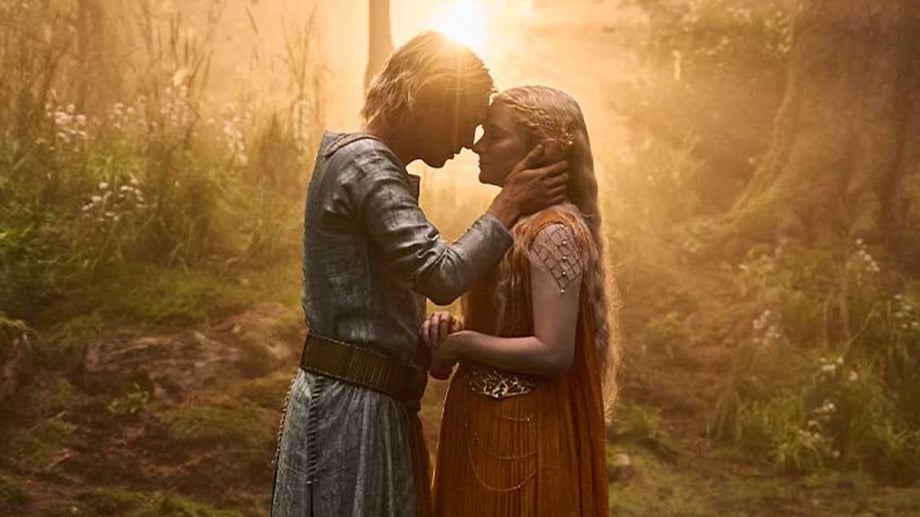
Celeborn may be the most important new character in The Rings of Power Season 3 because his return exposes the difference between loving Galadriel and trying to possess her. Jamie Campbell Bower and Charlie Vickers explored that distinction during a joint interview with Fangirlish, and it gives us a useful way to understand the conflict at the center of the season. Sauron needs control. Celeborn needs a relationship in which Galadriel can remain herself. The way the actors approach those impulses helps explain why the writing is becoming more focused.
We’ve spent several episodes saying that Charlie Vickers is the most consistently electrifying performer on this show. His Sauron has become an engine for nearly every important relationship, which is exactly where I want a villain of his size to be. Celeborn’s arrival makes that engine more interesting. Jamie Campbell Bower gives Galadriel a history and a human-scale emotional problem that can stand alongside Sauron’s enormous ambitions.
Spoiler scope: This analysis covers The Rings of Power Season 3 through Episode 5, “The Lady of Lórien.” It does not discuss Episode 6.
What Jamie Campbell Bower and Charlie Vickers Revealed About Their Characters
In a November 12 interview conducted by Lyra Hale for Fangirlish, Jamie Campbell Bower described Celeborn and Galadriel as “the river and the rock.” He explained that the partners exchange those roles as their relationship changes. The image works because it suggests a marriage where the balance of strength keeps shifting, and where the two people are capable of affecting one another without becoming identical.
Charlie Vickers offered a revealing description of Sauron’s frustration with Galadriel after their years apart. He suggested that Sauron is especially bothered because he “can’t control her anymore.” That is a striking way to understand their conflict. The danger in their relationship comes from Sauron’s certainty that other people should ultimately submit to his vision of order.
Those are the actors’ interpretations, and Fangirlish deserves credit for the interviews. The interesting question for us is whether the series has found a dramatic way to put those competing ideas on screen. I think Season 3 is beginning to do precisely that.
Why Celeborn Is a Better Counterweight to Sauron Than Another Army
Middle-earth has no shortage of soldiers who can oppose Sauron. The story has spent years collecting warriors, kings, and would-be allies. Each can resist him in a battle. Celeborn presents a different kind of challenge because he reminds Galadriel of a life that exists outside her war against the Dark Lord.
That possibility is particularly painful for the version of Galadriel we have been watching. She has organized her identity around the pursuit of an enemy. Her grief pushed her toward action, then action became a habit that determined how she interpreted the world. Celeborn’s return forces her to recognize that years spent looking for Sauron were also years in which she lost track of someone who loved her.
Episode 5 sharpens that wound when Celeborn describes seeing Galadriel during the fall of Thangorodrim. She saw a figure she believed to be another vision and moved on. The revelation connects a colossal mythological event to a devastating personal misreading. Galadriel’s determination, one of her defining strengths, also contributed to the failure to recognize a chance to reclaim her husband.
Our Celeborn character guide explains his captivity, reunion, and Tolkien history in detail. What fascinates me here is the scene’s dramatic construction: the past arrives in front of Galadriel with a face, a voice, and a memory of the moment she walked away.
The River and the Rock Is a Useful Way to Write a Marriage
Bower’s metaphor offers an elegant solution to a difficult storytelling problem. Galadriel is a formidable character. A new husband can feel like a device designed to soften her or tell her what to do. Instead, Celeborn can reveal a part of her that the audience has rarely had an opportunity to see. He can disagree with her, forgive her, challenge her, and maintain his own sense of dignity. Those interactions create room for intimacy through the ordinary mechanics of conflict and response.
Look at how the actors occupy the moments of reunion. Galadriel is accustomed to meeting other characters with urgency. The presence of Celeborn interrupts that rhythm. Her reactions have to account for uncertainty and recognition. Bower brings a quieter steadiness that lets Morfydd Clark play against a different energy than the one the series has usually placed opposite her.
That adjustment creates something we’ve been asking the show to do since the beginning: give its larger mythological argument an intimate expression. An exchange between two actors can carry questions about loyalty, devotion, regret, and responsibility without forcing them into exposition.
It also gives the romance an active purpose. The point is to make the marriage a relationship that changes under pressure. Celeborn’s long absence has changed him. Galadriel’s pursuit of Sauron has changed her. When they reconnect, they have to discover which parts of their old understanding still fit the people standing in front of them.
Sauron Understands Desire as a Route to Power
Sauron has repeatedly shown how well he can identify what another character wants. He studies shame, ambition, grief, and the longing to matter. He then offers an answer that places him at the center of the other person’s future. That is what makes his manipulation so chilling: the promise feels tailored to its recipient.
With Galadriel, that approach has collided with a woman whose resistance increasingly threatens his sense of mastery. Vickers plays that frustration beautifully. His composure tells us Sauron expects control, and the moments when Galadriel evades him expose the anger beneath the performance.
Episode 5 adds a particularly ugly detail. Sauron tells Celeborn that he was riding Ancalagon when the dragon devastated Celeborn’s company. In the show’s version of the history, the villain was present at the beginning of the trauma that separated this couple. The revelation links the couple’s oldest wound to the antagonist now threatening their reunion.
I love that from a storytelling perspective because the season is finally allowing a revelation to affect more than the lore discussion. Ancalagon’s appearance changes the meaning of Celeborn’s suffering. Sauron now has a direct relationship to both the original loss and the present danger. For the distinction between Tolkien’s accounts and the television invention, see our Ancalagon the Black explainer.
Why This Conflict Is Working Better in Season 3
The best television antagonists organize the choices around them. Sauron is increasingly doing that for The Rings of Power. His influence is visible in Theo’s collapse, the compromises surrounding the Rings, and the renewed wound between Galadriel and Celeborn. We can trace how a particular person is changed by a particular encounter with him.
That gives the season a clearer dramatic argument. The characters respond differently to the same essential temptation: the promise that power can protect someone from loss or uncertainty. Sauron wants to impose his answer on everyone. Celeborn offers Galadriel the possibility of being recognized without being remade in someone else’s image.
There’s a craft lesson in this. A scene gains force when each character’s objective is distinct and their methods are specific. Vickers can play Sauron as deliberate, almost amused, until a loss of control cracks the surface. Bower can play Celeborn with warmth while allowing the weight of his captivity to complicate that composure. Clark can react to both men as someone whose understanding of herself is changing. The relationship triangle becomes a means of character analysis.
And it returns the series to what Tolkien’s world has always done exceptionally well: turn the moral consequences of power into relationships the reader or viewer cares about.
My Take: Celeborn Exposes Sauron’s Greatest Weakness
For me, Celeborn matters because his devotion asks Galadriel to remain fully Galadriel, while Sauron’s desire for mastery demands that other people become extensions of his will. That distinction is a strong foundation for the show’s current conflict. The actors’ comments clarify what they are playing, and the episodes are increasingly finding concrete scenes that justify those interpretations.
We’ve spent two seasons waiting for The Rings of Power to concentrate its enormous mythology into a clear story about people. Celeborn’s arrival has helped make that happen. His history gives Galadriel another kind of loss to confront, and Sauron suddenly has something personal to threaten.
For more, read our Episode 5 Knee-Jerk Reaction, our Celeborn guide, and the Season 3 hub. Those pieces follow the plot, the Tolkien lore, and our larger reaction while this essay concentrates on the characters’ competing ideas of love and power.