
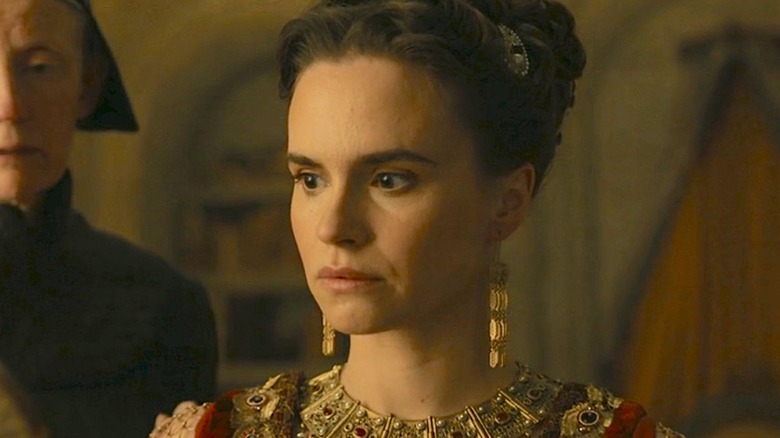
Eärien dies in The Rings of Power Season 3 Episode 2, “The Gift of Men,” after Pharazôn exposes her as a spy for the Faithful and threatens to force her to reveal where Míriel is hiding. Faced with the king’s promise that someone more brutal will extract the truth, Eärien jumps from the palace balcony. Her brother Isildur sees the aftermath. When a bystander asks whether he knew her, he denies knowing his own sister. The episode presents her death as a tragedy born of political coercion, compromised loyalties and years of trying to survive inside an increasingly cruel regime.
And oof, did this hit hard. Ema Horvath is wonderful throughout the episode, largely because she has to perform two competing versions of the same woman. There is the confident palace insider the king’s men expect to see, and there is the Faithful operative who has begun to fear that every compromise is changing who she really is. The scene builds toward the unbearable moment when that double life finally collapses. I have a few questions about the mechanics of Pharazôn’s trap, but the emotional construction is exceptionally strong.
Major spoilers for The Rings of Power Season 3 Episode 2, “The Gift of Men.”
What Happens to Eärien in Season 3 Episode 2?
After the five-year time jump, Eärien is living inside Pharazôn’s court while secretly helping the Faithful resist him. Her position gives her access to the royal household, but that access comes with a horrifying price. When Isildur tries to assassinate Pharazôn during a procession, an innocent woman is killed and Haleth, another member of the conspiracy, is captured. Eärien is ordered to interrogate him, requiring her to maintain the appearance of a loyal agent of the king.
Haleth already knows that Eärien is one of the Faithful. He also knows that any sign of recognition could destroy her cover. When she tries to offer relief from his suffering, he refuses because he fears that the medication might make him reveal the resistance’s secrets. Eärien ultimately gives the order that ends his life. She preserves the network’s secrecy while accepting a responsibility that leaves her deeply shaken. Later, in private with Isildur, she describes how frightening it feels to keep playing the person the palace expects her to be.
Why Was Eärien Secretly Working for the Faithful?
Eärien’s apparent closeness to Pharazôn gives the resistance something it badly needs: a person with access to decisions made inside the court. The time jump means we have missed much of the journey that brought her to that position. The episode asks the audience to understand her current allegiance through behavior, especially the risks she takes for Haleth, her effort to help Isildur and her growing guilt over the regime’s violence.
That is a bold piece of structural compression. The writers have moved Eärien to a dramatic position where almost every relationship carries an immediate threat. She knows people on both sides, and she has spent years learning the language and habits of those she opposes. The result is a character trapped inside a performance. Horvath makes that performance convincing enough that we can feel the effort it takes to maintain.
How Does Pharazôn Discover That Eärien Is a Spy?
Pharazôn reveals that Eärien has been under suspicion for months. Her handmaid had apparently warned the king’s circle about unusual behavior. Eärien tried to dismiss or eliminate the threat by having the handmaid sent to the rope, but that decision reinforced the suspicion against her. A move intended to protect her identity became evidence of guilt. It’s a neat example of political paranoia turning a person’s defensive instincts into a weapon against them.
Meanwhile, Eärien learns that the king’s men plan to attack the Faithful’s western havens. She and Isildur decide to use the palantír to warn Elendil about a trap. Pharazôn later tells her that their warning was precisely what his plan required. The siblings believed they were finding a way around the palace’s control; he had already made their attempted rescue part of his strategy. The information reversal is devastating because we can see how completely their choices have been anticipated.
The episode leaves room to question exactly how the trap functions. We hear the king explain his superior knowledge after the characters have already acted. A slightly earlier clue about the surveillance of Eärien or the palantír could have strengthened the payoff. The emotional logic, however, is clear: she has been relying on a false sense of safety inside an institution that has been watching her for a very long time.
Why Does Eärien Jump From the Palace Balcony?
Pharazôn wants Eärien to betray Míriel and help dismantle the Faithful. Once her cover is gone, he tells her that she belongs to the regime and threatens to pass her to someone who will use harsher methods if she refuses to reveal Míriel’s whereabouts. Eärien understands that continued imprisonment could put the entire resistance at risk. Her final action emerges from desperation, fear and an attempt to resist coercion under circumstances the episode has made terrifyingly narrow.
The series presents this as the culmination of a tragedy. The king has spent the episode converting family loyalty, religious faith and the desire to save innocent people into traps. Eärien is surrounded by consequences for choices that once seemed necessary. She makes a fatal decision during a crisis in which every alternative appears catastrophic, and the scene’s power comes from seeing the harm that leaves behind.
The moment immediately recalls Tommen’s death in Game of Thrones. I recognized the visual resemblance right away. The emotional arrangement here is distinct: Eärien has been operating undercover, she is being threatened with forced disclosure, and her surviving brother becomes the person who must absorb the most immediate shock. Visual echoes can create comparisons, and the script gives this scene its own set of pressures to examine.
Why Does Isildur Say He Never Knew Eärien?
After Eärien falls, Isildur stands among the onlookers. A stranger asks whether the woman was a friend of his, and he says he did not know her. It is a brutal response to an unbearable situation. He is looking at his sister, and speaking the truth would expose their connection at the very moment the regime has identified her as a traitor. His survival now demands the same kind of concealment that defined her last years.
That final line turns the espionage story into a family tragedy. Eärien has spent years telling lies to protect the Faithful, and Isildur must immediately begin lying about her. The irony gives the scene a much larger aftershock than the fall itself. Maxim Baldry’s restrained reaction makes the cost visible without a speech about it. He has lost his sister and, for a moment, even the right to say that she was his sister.
How “The Gift of Men” Makes Eärien’s Fate Even More Painful
In Tolkien’s mythology, the Gift of Men is mortality, a destiny that allows human beings to leave the world after death. The Faithful speak of death as something that can hold meaning, especially when Haleth sacrifices himself to protect others. Eärien recoils from that language because the death she has just ordered is painfully immediate. The title places an enormous philosophical idea beside her very human experience of responsibility and grief.
The episode draws its strongest emotional tension from this collision. Eärien has sacrificed pieces of herself to serve a righteous cause, yet the king’s apparatus keeps using those sacrifices to tighten its grip. The tragedy lies in what that system extracts from her and what it demands from the people left behind. Her story makes Númenor’s political future feel like a question about ordinary human lives.
Why Eärien’s Death Matters for the Rest of Season 3
Eärien’s death leaves Isildur and Elendil with a personal loss connected directly to Pharazôn’s rule. It also exposes the weakness of the Faithful’s methods: secret networks and urgent warnings may already be compromised. Míriel’s principles of resisting the king’s violence become harder to uphold as grief and anger accumulate. The future of Númenor now has a family wound at its center.
For the full episode review and our analysis of the writing, read the “The Gift of Men” KJR. The Season 3 master guide connects the wider conflict, and our time-jump analysis explains the structural gamble behind Eärien’s new role.
Related Coverage
- Explainer: Did Thráin Betray Durin in The Rings of Power? His Secret Deal Explained
- Explainer: What Is the Gift of Men in The Rings of Power? Tolkien’s Meaning Explained
- Explainer: Who Is Theo’s Father in The Rings of Power? Sauron’s Story Explained
- Knee Jerk Reaction: KNEE-JERK REACTION | The Rings of Power Season 3 Episode 2: “The Gift of Men” — Middle-earth Finally Feels Lived In
The image that stays with me is Isildur having to deny the woman he loves as his sister. Eärien spent years hiding the truth to keep other people alive. Her death leaves him carrying the same terrible burden.