Full spoilers for The Rings of Power Seasons 1 and 2.
If you’re following our growing Rings of Power cluster, start here first: The Rings of Power Season 3 first look shows the show may finally become what it promised.
This Week’s Rings of Power Coverage
- First Look: Why Season 3 finally looks focused
- Analysis: Why the One Ring gives Season 3 its missing spine
- The Rings of Power with Mary & Blake show page
The most important thing about The Rings of Power Season 3 is the time jump.
That may sound strange when the marketing is handing us a darker Sauron, a release date, and the promise of the One Ring. But the time jump is the thing that can actually change how the show works scene to scene.
Amazon’s setup for Season 3 is clear: the story jumps forward several years, lands at the height of the War of the Elves and Sauron, and centers Sauron’s effort to forge the One Ring. That matters because it moves the show into a phase where the story finally has enough pressure to organize itself.
For two seasons, The Rings of Power has often spent its energy on positioning.
Season 1 built toward revelation. Halbrand’s identity functioned as a mystery engine, and the season closed by revealing that Galadriel had helped restore Sauron to the board and that Celebrimbor had already been influenced by him. The Three Elven Rings were forged at the end of that season, which gave the finale a major lore milestone, but the larger story still felt like it was waiting for its central action to declare itself.
Season 2 pushed further by moving Sauron into his Annatar phase and placing him directly inside Eregion with Celebrimbor. That was real progress because it gave corruption a face, a method, and a target. The Dwarven rings were completed. The project advanced toward the Nine for Men. Gandalf was finally named. Rivendell moved closer to becoming an active refuge instead of just a future landmark hanging over the map. Durin III’s ring pushed Khazad-dûm toward a sharper contradiction: restoration on the surface, greed and danger underneath.
Those are real developments. They just did not always add up to the same thing as momentum.
That is the craft problem the time jump can solve.
A story gets stronger when conditions are already active enough to pressure every scene. Open war changes the texture of drama. A hidden enemy can create suspense. An enemy already moving to dominate the world creates consequence. Once Sauron is openly pursuing the One Ring, the season has a central action strong enough to bend the rest of the board around it.
That is the first reason the jump matters: it lets Season 3 begin with pressure already embedded in the world.
Sauron no longer needs introduction. The audience has already seen him as Halbrand and as Annatar. The show does not need another run of episodes built around proving he is dangerous or clarifying what he wants. It can move directly into execution.
The Rings are no longer abstract mythology either. The Three already exist. The Dwarven rings already exist. The project has already progressed far enough that the forging of the One Ring can function as the act that reorganizes everything else. In story terms, that gives the season something it has often lacked: a clean dramatic spine.
The One Ring is not only an iconic Tolkien object. It is a narrative engine.
It gives Sauron a concrete goal. It gives the season a center of gravity. It gives the surrounding plotlines a reason to orient themselves against one dominant move. That is stronger than diffuse intrigue. It is stronger than atmosphere doing work that the story engine itself should be doing.
That is the second reason the jump matters: it turns the Ring from distant lore into the season’s controlling objective.
The Elven side of the story benefits from that shift too. Rivendell is now closer to its real dramatic function. In Tolkien’s larger history, it becomes one of the great surviving Elven refuges under Sauron’s growing power. A later starting point gives Season 3 a better chance to dramatize Elven adaptation under pressure rather than keeping the Elves in a perpetual state of warning and preparation.
Khazad-dûm also gets stronger material from a later entry point. Durin III’s use of the ring already pushed the Dwarven story toward a harsher contradiction in Season 2. Wealth, hunger for more, and the long-term consequences of delving too deep are already part of the trajectory. A jump forward gives those tendencies time to become active burdens instead of early warning signs.
Númenor may benefit the most from the same logic. The show has already placed Pharazôn in a stronger political position. Tolkien’s lore makes clear where that road leads: Sauron corrupts Númenor from within, exploits its fear of death, and turns imperial pride into catastrophe. Season 3 does not need to sprint all the way there. A few years of elapsed time, though, make it far easier to portray political corruption as a system rather than a mood.
That is the third reason the jump matters: elapsed time can turn tendencies into institutions.
Season 1 and Season 2 introduced tendencies. Season 3 now has a chance to show what those tendencies become once they harden.
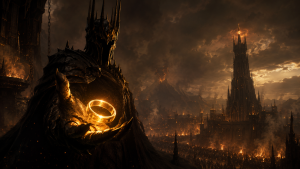
The first-look image of Sauron in Morgoth’s crown points in the same direction. It suggests a show less interested in disguise and more interested in assertion. That is healthy for long-form television. An antagonist can function as a riddle for only so long before the riddle starts draining energy from the story around him. Eventually, power has to stop hinting and start shaping the frame.
Once that happens, everybody else’s story becomes clearer. Resistance sharpens. Fear sharpens. Strategy sharpens. The central dramatic question stops being whether Sauron is becoming the dominant force in Middle-earth and becomes what everybody does now that he already is.
That question creates stronger scenes.
Scenes improve when characters are trapped between competing goods instead of processing exposition. Scenes improve when urgency sharpens the subtext. Scenes improve when alignment carries immediate cost.
A jump forward several years creates exactly that terrain.
None of this guarantees Season 3 will work. Execution still rules everything. The show still has to write sharp scenes. Character logic still has to hold. Spectacle still has to serve narrative rather than replace it.
But this is the first Season 3 detail that feels promising because it is not just bigger. It is more useful.
It moves the story to the point where existing plotlines can stop orbiting potential and start paying cost.
That is what this show has needed.
Read Next In Our Rings Of Power Cluster
- The Rings of Power Season 3 first look shows the show may finally become what it promised
- Why the One Ring gives Season 3 its missing spine
- Browse our full Rings of Power podcast hub
Listen To Our Rings Of Power Podcast
If you want the full Mary & Blake treatment on The Rings of Power — reaction, craft, theory, and the larger Tolkien stakes — head to The Rings of Power with Mary & Blake show page and start listening there.
Slàinte Mhath.