
The Rings of Power Season 3 Episode 2, “The Gift of Men,” is another very good episode, and I think I finally understand why this season is working so much better for me. The five-year jump has put the characters inside a world with consequences. Númenor is becoming an empire, the Dwarves are learning how expensive Sauron’s gifts can be, and Theo is being offered an identity that might destroy him. Middle-earth finally looks like a place where people live, fight and carry scars from the choices they’ve made.
Charlotte Brändström directs an episode written by Justin Doble that moves between political intrigue, dark fantasy and a devastating family tragedy. Charlie Vickers remains the best thing this show has produced, and his scene with Theo is a terrific example of manipulation built out of character history. I have a couple of questions about the storytelling, especially a suspicious explanation for Theo’s old sword. Still, the series has found a confident dramatic engine. LET’S GET WEIRD, BABY.
Full spoilers for Season 3, Episode 2, “The Gift of Men.” This review treats possible future Ringwraith identities as theories.
The Rings of Power Season 3 Episode 2 Recap: What Happens in “The Gift of Men”?
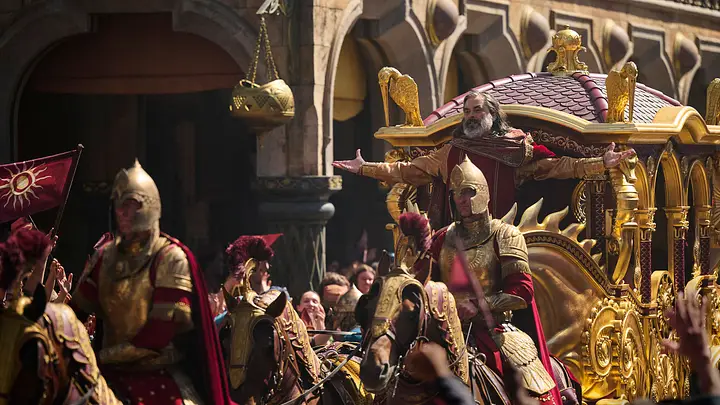
Five years after Eregion’s fall, Ar-Pharazôn has turned Númenor into a wealthy naval empire. Isildur tries to assassinate him during a royal procession, killing an innocent woman instead, and his fellow conspirator Haleth is captured. Eärien, secretly working for the Faithful inside the palace, is forced to oversee Haleth’s interrogation and death while investigating an attack on the western havens. She and Isildur use the palantír to warn Elendil, only to learn that Pharazôn anticipated their move. Exposed and threatened with torture for Míriel’s whereabouts, Eärien jumps to her death.
Meanwhile, Sauron subjects Theo to a grotesque ritual and claims to reveal the identity of his father. Two Nazgnagôl confront Durin over Marnûkh, the Orc carrying knowledge of Sauron’s plan for a Master Ring. Marnûkh points Galadriel and Arondir toward the surviving Elven-smith Maitalle in Gundabad, while Elrond seeks Númenórean aid. Durin’s brother Thráin appears to defend him from the Ring-servants, then secretly reveals he has been preparing a trap.
The Five-Year Time Jump Was Exactly the Creative Reset This Show Needed
I’m becoming convinced the smartest decision the writers made was to let five years pass. The interval gives the series permission to arrive at the interesting version of its conflicts. Pharazôn has built an armada and cultivated a public that adores him. The Faithful are an underground resistance. Theo has endured years of occupation, Sauron has expanded his war, and the Dwarves are living with the consequences of their alliances. The audience meets those results and reconstructs the missing years through behavior. That’s efficient television storytelling.
It reminds me of what The Leftovers accomplished when its second season boldly reoriented the series. The comparison is about creative confidence: a show recognizes which aspects of its original engine are holding it in place, then reorganizes around characters and conflicts with greater potential. Here, the jump lets The Rings of Power shed narrative weight and focus on conquest, resistance and the corrupting promise of power. The writing has more urgency because every character has something concrete to gain or lose.
There is a cost. Eärien’s transformation into a Faithful spy and Theo’s growth into a potential conqueror contain years of development we have to infer. I can understand wanting to witness more of that progression. The gamble works for me because the conflicts are immediately playable and the performances suggest the missing history.
Finally, Middle-earth Looks Like People Actually Live There
The series still has those sweeping landscapes and unmistakable Lord of the Rings images, while the people occupying them seem increasingly subject to weather, fatigue, ambition and time. Brändström uses Númenor’s magnificent harbor to make Pharazôn’s empire feel enormous, then takes us into cramped interrogation rooms where that power becomes cruelly intimate. The visual scale serves the drama. This is the lived-in aesthetic I’ve wanted for a while.
And can we discuss Pharazôn’s hair? Bless him, it finally looks like hair. His earlier styling occasionally suggested that a Drybar had opened inside the palace. Now his longer, more natural look suits a man alarmingly comfortable in his own power. Theo has apparently spent the intervening years embracing the Jacob Black New Moon glow-up program. He looks like somebody who grew into his anger, and Tyroe Muhafidin plays that hardness with vulnerability underneath it. Styling can carry character history just as effectively as a speech.
Sauron Knows Exactly How to Break Theo
Charlie Vickers is operating on another level. Sauron notices the mark left by the old blood-powered hilt on Theo’s arm and asks about his father. He’s found the unanswered question that can destabilize Theo’s entire sense of self. Then he stages a horrible act of necromancy, using an Orc in a ritual that supposedly allows the dead to speak. The spectacle gives Sauron’s story supernatural authority. Theo wants an answer badly enough to keep listening even while the procedure appalls him.
Sauron names Theo’s father as Fäldred, son of Hammethreg. He claims the family comes from ancient Mordor nobility and alleges that Bronwyn murdered the man after discovering his true nature. Importantly, Sauron is the source of every revelation. He is translating the ritual, interpreting the voice and controlling what Theo hears. Once Theo is shaken, Sauron attacks his memory of Bronwyn’s love and repackages years of oppression by Elves, Orcs and Númenóreans as evidence that he was destined to rule. He offers Theo a future as conqueror, sorcerer and king. That’s manipulation constructed around a real emotional wound.
I do have a continuity question. Theo says the hilt was left to him by his father, although we originally encountered it hidden in Waldreg’s barn. Perhaps Theo is repeating a story he believes, or the writers are planting missing family history. The connection needs attention because this scene depends on what Theo knows, what we remember and what Sauron may be inventing. I trust the emotional mechanics far more than the apparent genealogy.
Is Theo becoming the Witch-king? Sauron is positioning him as a possible future Ring-servant, and the promise of kingship feeds that suspicion. The show has yet to confirm his identity. We’ve been exploring the evidence in our Theo and the Witch-king explainer. The most interesting question is whether Theo will embrace this power because he believes it can protect his people.
What Are the Nazgnagôl, and How Are They Different from Nazgûl?
The Nazgnagôl are the series’ developing human Ring-servants: living Men already being transformed by Sauron’s Rings, on a path toward the Nazgûl, the fully corrupted Ringwraiths of The Lord of the Rings. The adaptation uses this intermediate stage to make corruption visible over time. These figures can negotiate, threaten and wield political influence while their humanity slips away. Watching that process unfold gives familiar mythology dramatic consequences.
The emissaries in Khazad-dûm make the concept tangible. They demand Marnûkh, threaten Durin with a fate beyond ordinary death and behave as though every kingdom can be intimidated. Thráin’s theatrical defense of his brother delivers welcome Dwarven personality, making the later revelation of his secret dealings with a Ring-servant particularly nasty. Go deeper into the terminology in our Nazgnagôl and Nazgûl guide.
Marnûkh Gives the War an Actual Objective
Marnûkh’s information makes the larger conflict easier to follow. He tells the Elves that Sauron is trying to forge a Master Ring capable of controlling other Ring-bearers. He also claims Maitalle, a surviving Elven-smith with crucial knowledge, is imprisoned at Gundabad. Suddenly Galadriel and Arondir have a destination and a specific task. The abstract threat of Sauron’s rise becomes an adventure that can generate its own obstacles and reversals.
There’s useful tension in trusting an Orc whose motives remain uncertain. Disa and Durin frame the decision as an obligation created by knowledge: having heard what Marnûkh knows, they must decide what kind of people they intend to be. Our Marnûkh explainer covers his place in the larger Ring plot.
Eärien’s Death Is Devastating, and the Writing Earns Most of It
Eärien’s story contains the strongest tragic construction. She has embedded herself inside Pharazôn’s court to aid the Faithful, so survival depends on performing loyalty to the people she opposes. When Haleth is captured, she must interrogate a man who knows she’s an ally. He refuses pain relief because it might loosen his tongue. Eärien eventually orders an end to his suffering and maintains her cover, but the decision horrifies her. Ema Horvath plays a woman terrified that the mask she’s worn has become her actual face.
The palace intrigue tightens around her. She learns that the western havens are about to be attacked and helps Isildur warn Elendil through the palantír. Pharazôn reveals that her handmaid reported suspicions months earlier; Eärien’s decision to send the woman to the gallows confirmed his fears. Worse, the warning to her father has helped set his trap. The writing turns surveillance into a personal nightmare, with every attempt to save someone leaving another person exposed.
Then comes the leap from the balcony. Yes, it reminded me immediately of Tommen in Game of Thrones. That visual echo is unmistakable. Here, the sequence has a different emotional structure: Pharazôn intends to force Eärien to betray Míriel, and Eärien’s final decision emerges from desperation and resistance to that coercion. Horvath makes the fear and guilt painfully specific.
The final beat destroyed me. Somebody asks Isildur whether he knew the woman lying below, and he denies knowing his own sister. Eärien spent years concealing her identity to protect the Faithful. Now Isildur conceals their relationship to protect himself. The reversal is devastating. I still wonder whether the trap closes a little too neatly, given how much of Eärien’s transformation occurred during the time jump. The consequence lands with enough emotional force to make me care deeply anyway.
What Does “The Gift of Men” Mean?
In Tolkien’s mythology, the Gift of Men is mortality: the destiny of human beings to leave the world after death, while the Elves remain bound to it. This episode brings that idea into a kingdom consumed by the fear of losing power. Pharazôn builds an armada, promises Kemen an inheritance and dreams of banners covering the world. He wants his dominion to survive his body. The title gives his ambitions a philosophical shadow.
The Faithful invoke death as a gift when attempting to make sense of Haleth’s sacrifice, and Eärien’s response is anguished. That friction matters. A belief that offers hope can still feel unbearable to somebody confronting immediate grief. The episode asks whether Númenor’s rulers can accept mortality or will spend their remaining lives trying to conquer it. That question connects Pharazôn to Sauron’s obsession with control.
For more of the war, see our Rings of Power Season 3 guide and Episode 1 KJR.
The KJR Verdict: This Season’s Story Engine Is Finally Working
I’m really enjoying this version of The Rings of Power. The time jump has given the story room to breathe, the design has acquired welcome grime, and the writing is making every Ring-related question inseparable from a character’s most private fear. Sauron’s confrontation with Theo and Eärien’s unraveling are built around people desperate to reclaim control of their lives. Their choices carry the story forward, and Middle-earth feels richer because of it.
Unlock the rest of this article.
Join the NerdClan — or sign in if you are already a member — and the rest of this article will unlock right here on this page. This entry requires Associate Producer or higher.