
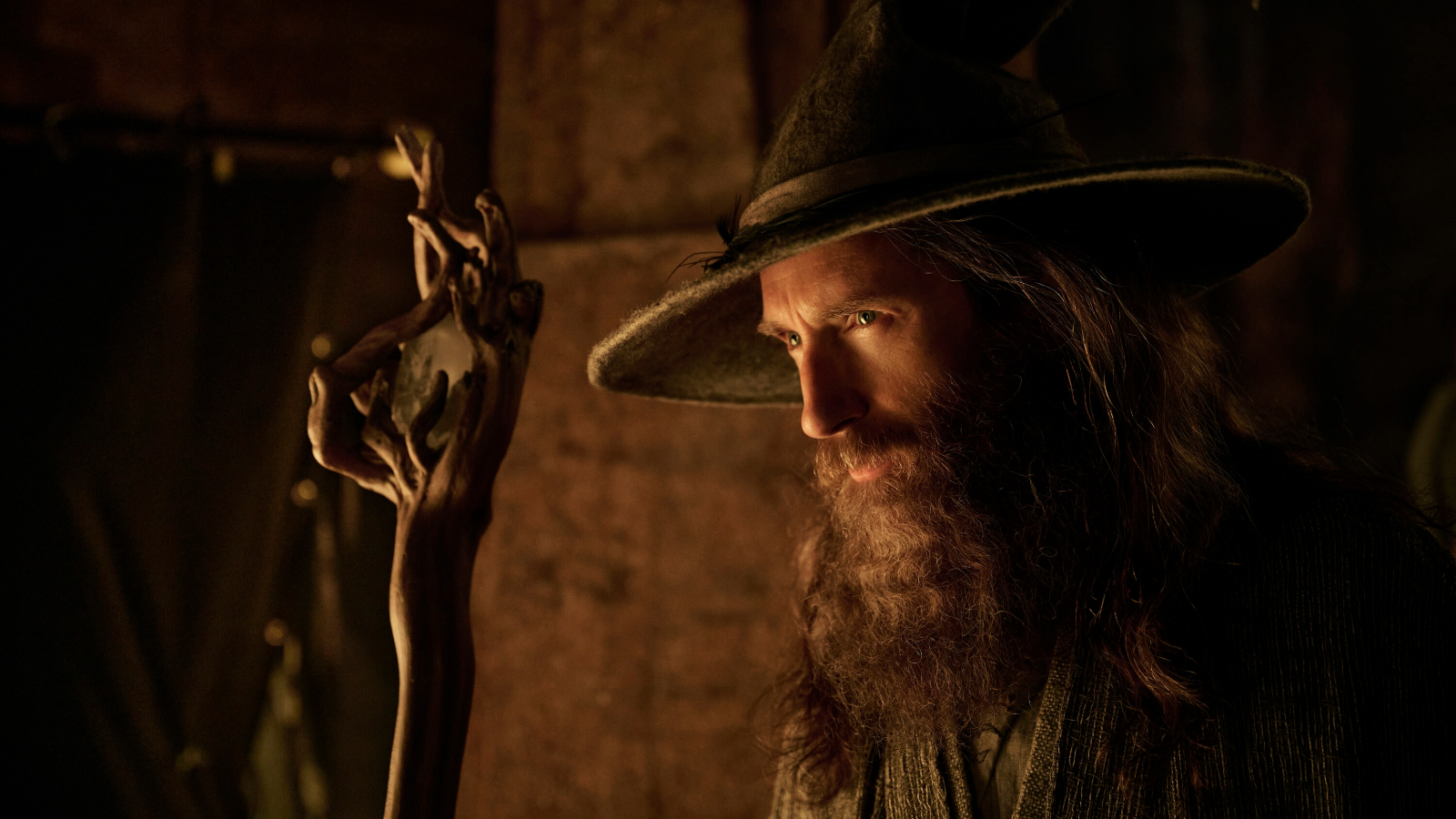
Gandalf’s hat matters in The Rings of Power because it connects a familiar image from The Lord of the Rings to a relationship this version of Gandalf has actually lived. Daniel Weyman, who plays the Wizard, explained in an interview with Fangirlish that the hat means something different to the character than it does to the actor and the audience. That distinction opens up a wonderfully specific question about storytelling: when a television adaptation hands us an object we already recognize, has it also given the character a reason to care about it?
I’ve been hard on this show’s tendency to borrow familiar cinematic language. I’ve also been hard on Tom Bombadil as a dramatic device. Yet Gandalf’s hat has made me reconsider one part of that argument. A prop can carry memory, loss, affection, and a decision. Its emotional meaning can grow from the events of the show itself, even when the audience recognizes the silhouette from somewhere else.
Spoiler note: This piece discusses Gandalf and Tom Bombadil’s storyline through the first four episodes of The Rings of Power Season 3. It contains no Episode 6 analysis.
What Did Daniel Weyman Say About Gandalf’s Hat?
Speaking to Lyra Hale in a Fangirlish interview published November 13, 2026, Weyman described his excitement at finally wearing the iconic hat and the acting problem that came with that excitement. As a longtime viewer, he understood how instantly recognizable the costume would be. As the actor, he had to work out what it meant to Gandalf at that precise point in the story.
Weyman captured the distinction neatly: “Gandalf doesn’t know that this hat has the significance that I know it has.” His answer goes on to connect the hat to Tom Bombadil. Following an argument with Tom, Gandalf returns to find him gone. The hat remains, carrying a memory of their relationship and of the difficult lessons Gandalf has received from him.
That interpretation gives us a reason to examine the moment as drama. The audience already knows the finished icon: the great Wizard with the hat, robes, and staff. This Gandalf is still assembling a sense of himself through his encounters with other people. The costume can become a record of those encounters.
The Challenge of Giving a Famous Character His Famous Look
Prequels and origin stories face a familiar temptation. Audiences arrive with a collection of images they expect to see eventually: the costume, the weapon, the phrase, the familiar pose. Revealing each recognizable object creates an immediate reaction because viewers know where the character is heading.
That recognition is useful. It also gives the writers a responsibility. Once the initial excitement fades, the image needs to mean something to the person wearing it. Gandalf can put on a hat because an audience expects him to look like Gandalf. The more compelling version of that scene shows why this particular man takes this particular object with him at this particular moment.
Weyman’s reading suggests a strong answer. The hat becomes something Gandalf carries from a relationship that has challenged him. He can remember Tom when Tom is absent. That creates a gentle, human-scale emotional idea in the middle of a story crowded with armies, Rings, prophecy, and the fate of Middle-earth.
And I think that is where the series has the chance to be its most effective. The camera can invite us to recognize an icon while the performance asks us to understand a person.
Tom Bombadil Has Always Been a Problematic Storytelling Device for Me
I understand why so many Tolkien readers love Tom Bombadil. He represents a kind of freedom from the appetite for possession that drives so much of Middle-earth’s conflict. His songs, riddles, and strange relationship with the natural world preserve an essential feeling that this imagined history contains mysteries bigger than any single villain.
Television gives that mysterious figure a different job. Once Tom actively guides Gandalf, he becomes part of the mechanism of the plot. He knows things, he answers questions, and he can point the hero toward a revelation. I’ve called that the god of the gaps problem: a figure with almost unlimited narrative authority can begin supplying an answer whenever the story needs one.
We see that tension in Season 3’s Secret Fire material. Gandalf is searching for a way to confront the Dark Wizard. Tom helps move him toward knowledge he cannot gain through ordinary effort. The scenes can be warm and even moving, especially because Weyman makes Gandalf’s uncertainty so sincere. They can also leave the dramatic machinery feeling a little too convenient.
Our Episode 3 Knee-Jerk Reaction goes deeper into why Tom works for me in some moments and troubles me in others.
Why the Hat Feels More Earned Than the Secret Fire Imagery
The moment with the hat offers a quieter way to express Gandalf’s development. His encounter with the Secret Fire leans into an enormous mythic tradition. The staging recalls familiar screen depictions of Moses and divine revelation, and I found that resemblance distracting. We are asked to treat the encounter as a major declaration about what Gandalf must become.
The hat works through a smaller gesture. Gandalf chooses to carry something that reminds him of a person. We can understand that choice without an explanation of the world’s metaphysical rules. There is loss in Tom’s absence, affection in the act of remembering him, and an understated suggestion that Gandalf may take some of Tom’s wisdom with him into the next difficult place.
The series has been strongest this season when the stakes become personal and the characters make decisions that reveal their values. That applies to Galadriel and Celeborn, Elrond and Elros, and even the damage Sauron does to Theo. It applies just as readily to Gandalf. He becomes recognizable through the things he learns and chooses to preserve.
In other words, Weyman’s explanation gives the production design a dramatic purpose. I can look at that hat and see both the iconic Gandalf of the wider story and a man carrying the memory of his strange teacher. The image gains a second life.
What Weyman’s Performance Adds to the Moment
Weyman has done something I appreciate throughout this storyline: he allows Gandalf to be uncertain. The character’s enormous future reputation can overwhelm a prequel if the actor performs every moment as the arrival of a legend. Here, Gandalf often seems unsure which parts of himself deserve to be trusted. That makes his relationships important because they help him discover where his convictions come from.
In the Fangirlish interview, Weyman connects Gandalf’s other familiar belongings to people he has met: the Harfoots and Nori are part of the history carried by his clothing and staff. The hat joins those accumulated reminders. It’s a useful performance concept because it gives the actor something playable. He can carry gratitude, grief, and apprehension into the next scene without needing to announce any of them.
That is the kind of adaptation choice I want more of. A recognizable image becomes richer when the character has to live his way into it. The production design and performance work together, creating meaning that can survive beyond a quick burst of nostalgia.
What the Hat Tells Us About Gandalf and Pallando
Season 3 has also revealed the Dark Wizard’s identity as Pallando, one of Tolkien’s Blue Wizards. Gandalf’s challenge is becoming a test of how he understands power and responsibility. Tom’s teaching presses him to examine the difference between mastering an enemy and preserving the possibility of saving one.
Carrying Tom’s hat into that conflict suggests the lesson is still unfinished. The object is a reminder of the relationship that helped Gandalf understand the stakes of his mission. That can give a future confrontation a stronger emotional foundation because the story has made the source of his values visible.
For the larger lore, read our guides to the Dark Wizard and Pallando, the Secret Fire, and why Gandalf must save Pallando.
Why Gandalf’s Hat Matters: My Verdict
I think Gandalf’s hat is a better piece of storytelling than it first appears. Weyman’s interpretation reveals a modest emotional decision inside a famous visual callback. The hat belongs to the audience’s memory of Gandalf, and the series gives its own Gandalf a memory to place inside it.
Tom Bombadil still presents a real challenge to the show’s sense of cause and effect. I am still wary when his knowledge functions like a shortcut through a difficult story problem. But the hat gives their relationship a consequence that Gandalf can literally carry into the rest of his journey. That is an earned connection, and it makes a familiar image feel a little more personal.
For the full critique of this storyline, continue with our Season 3 Episode 3 reaction. For Gandalf’s larger identity in the adaptation, see the Stranger and Gandalf explained, or return to our Season 3 guide.