
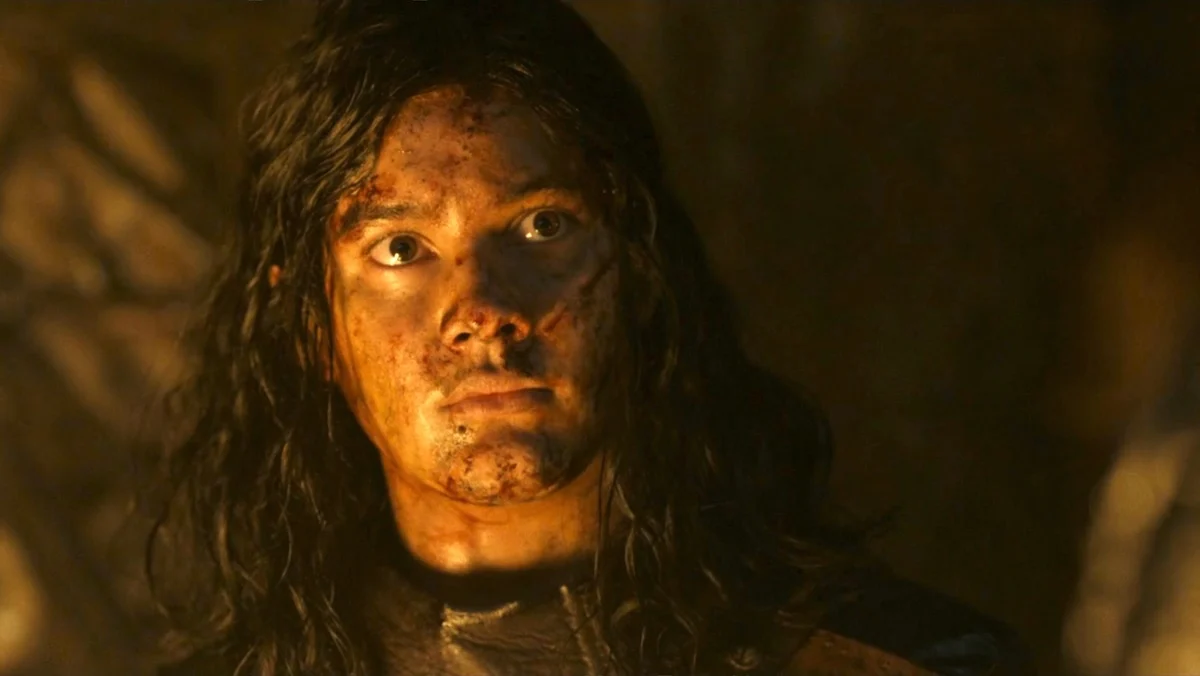
Is Theo the Witch-king in The Rings of Power? Season 3 Episode 1 does not confirm it. What “Marnûkh” does confirm is considerably more disturbing: Theo travels to Sauron’s stronghold and enters a deadly contest for one of the Nine Rings given to Men. The episode cuts away before we learn whether he wins, whom he might hurt, or whether a Ring ever reaches his finger. The Witch-king theory is plausible enough to make that cliffhanger hurt. It remains a theory at the end of the premiere.
And oh, what a place to leave us. We have watched this kid grow up beneath the shadow of a broken sword, lose people who loved him, and inherit a homeland repeatedly claimed by somebody else. Five years after the fall of Eregion, the boy who once needed protection is now being offered a weapon powerful enough to frighten his oppressors. Sauron knows exactly how to present that bargain. Let’s talk about why it works on Theo, what the lore allows, and what the storytelling is actually doing.
What Happens to Theo in The Rings of Power Season 3 Episode 1?
Theo is living in Pelargir, where Númenórean military rule has turned the Southlanders into labor for the king’s expanding fleet. Men are forced to harvest timber; disobedience is met with violence. Kemen makes it very clear that this territory now answers to Númenórean power, and Theo receives twelve lashes while the soldiers enforce that arrangement. The camera gives us a young man surrounded by evidence that obedience has delivered neither safety nor dignity.
Then an invitation from Mordor enters the picture. Kemen wants nothing to do with Sauron’s offer of magical jewelry. Theo, however, notices what his ruler dismisses. By the end of the episode, he is among a group of Southlanders who have traveled to Sauron and promised to lead a rebellion against Númenor if he gives them Rings. Sauron responds with his preferred recruitment method: one sword placed before several men, and a Ring promised to the survivor. Theo reaches for the blade as the scene cuts away.
Notice the careful distinction. We witness the beginning of Theo’s decision, with all its terrible potential. We have yet to witness the end of that contest. The premiere provides enough information to fear what he might become while protecting the answer for the next chapter.
Why Does Theo Want One of Sauron’s Rings?
Because, from Theo’s point of view, the world has made an awfully persuasive case that powerless people get crushed. His community has lost its home, its independence, and any meaningful say over its future. When Númenor reduces the surviving Southlanders to a workforce, a Ring promising strength begins to look like the fastest available way to stop the abuse. Sauron has made his offer at precisely the moment when it is most tempting.
This is where Lajos Egri’s approach to character and conflict becomes useful. A convincing dramatic choice grows out of someone’s circumstances, fears, and deeply rooted contradictions. Theo wants to defend his people. He is understandably furious at the people brutalizing them. Those two things can coexist with the possibility that he is about to make a disastrous moral decision. The writers have taken a recognizable human impulse and put it under unbearable pressure.
And Sauron has already tested the method on the men from Rhûn. He identifies Khamûl’s grievances, places a prize within reach, and forces the candidates to compete for it. By the time Theo faces the same ritual, the audience understands the rules. We know what the sword is for. We know the gift carries a hidden cost. We know more about the trap than Theo appears to know. That is the engine of suspense.
What Evidence Supports the Theory That Theo Becomes the Witch-king?
The most compelling evidence is the structure of Theo’s story. He has been closely associated with Sauron’s power since Season 1, when the strange sword-hilt responded to his blood. His family history remains an unresolved question as of Episode 3.01. Now he is positioned among mortal Men competing for a Ring that could gradually make its wearer a servant of Sauron. The show is deliberately asking us to imagine the consequences.
The Witch-king of Angmar becomes the leader of the Nine Ringwraiths in Tolkien’s wider history. Tolkien leaves the original mortal identity of that figure largely unknown, giving a television adaptation room to build a tragic human origin. Theo would be an emotionally effective candidate because the audience already knows the person who could disappear beneath that terrifying title.
There are also reasons to remain cautious. Episode 1 has yet to establish Theo as the winner of the contest, the recipient of any particular Ring, or the eventual leader of the Nine. A path toward becoming a Nazgûl would still leave the Witch-king question open. Fan theories become much more fun when we keep the difference between evidence and confirmation intact.
Why Theo’s Choice Matters More Than His Final Identity
John Truby’s character framework distinguishes a protagonist’s conscious desire from the deeper moral need revealed by the story. Theo’s desire is easy to understand: free his people from occupation, and gain enough strength that no one can whip them into submission again. His moral test is harder. What is he willing to do to another desperate man to obtain that strength? How much freedom can he surrender before his victory begins to resemble another form of captivity?
Craig Mazin’s idea of a central dramatic argument gives the scene an even wider meaning. Throughout “Marnûkh,” Sauron behaves as though genuine loyalty can be manufactured through domination. Celebrimbor, even in Sauron’s mind, challenges that assumption. Celeborn and Galadriel’s flashback gives us an image of a gift freely offered. Theo’s contest gives us the horrible inverse: men compelled to fight one another for a gift that promises autonomy and demands allegiance to its maker.
There is some delicious dramatic irony in that construction. Theo is trying to escape Númenórean tyranny by going straight to Middle-earth’s most accomplished tyrant. The audience understands the contradiction. Theo is living inside it. That gap between what he believes the Ring will do and what we fear it will do is how the premiere turns an ancient mythological question into an urgent character story.
Related Coverage
What Would Becoming a Nazgûl Mean for Theo?
In Tolkien’s history, the Nine Rings grant mortal Men extraordinary power and extended life while drawing them deeper into Sauron’s will. Their apparent gifts become a mechanism of dependency until their bearers fade into the unseen world. Season 3 has already started making that process frighteningly tangible. When Khamûl receives a Ring, his physical suffering begins to change as the unseen world takes hold. The reward is real, which makes the danger easier to rationalize.
If Theo follows that path, the cruelest consequence would reach beyond a supernatural transformation. Arondir has spent years trying to protect him. Galadriel recognizes how badly the Men of Middle-earth have been failed. Turning Theo into a Ring-servant would make those relationships part of Sauron’s victory. It would also force us to confront a challenging idea: a person can begin with a righteous grievance and still choose an instrument that destroys everything they hoped to protect.
So, Is Theo the Witch-king?
As of the end of Season 3 Episode 1, we do not know. We know that Theo has joined Sauron’s Ring contest. We know his hatred of Númenórean occupation gives that decision an understandable motive. We also know that the Nine Rings lead toward the terrible figures familiar from The Lord of the Rings. The identity of the Witch-king—and Theo’s precise fate—remain unconfirmed in this episode.
For me, the fascinating question is what happens before that identity is ever settled. Does Theo believe he is saving his people? What might Sauron demand in exchange? And who, if anyone, can reach the person Arondir still loves before the Ring begins rewriting his future? Those are the questions that can make this adaptation devastating television.
Keep Exploring The Rings of Power Season 3
For the entire premiere and our craft analysis of Sauron’s recruitment tactics, read our 4.5/5 Knee-Jerk Reaction to Episode 3.01, “Marnûkh”. Our Nazgnagôl explainer breaks down the Ring-servants, and the Khamûl guide explores another man who accepts Sauron’s offer. You can follow the wider story through the Season 3 episode guide.